Sequence-based identification of Anopheles species in eastern Ethiopia
- PMID: 30992003
- PMCID: PMC6469081
- DOI: 10.1186/s12936-019-2768-0
Sequence-based identification of Anopheles species in eastern Ethiopia
Abstract
Background: The recent finding of a typically non-African Anopheles species in eastern Ethiopia emphasizes the need for detailed species identification and characterization for effective malaria vector surveillance. Molecular approaches increase the accuracy and interoperability of vector surveillance data. To develop effective molecular assays for Anopheles identification, it is important to evaluate different genetic loci for the ability to characterize species and population level variation. Here the utility of the internal transcribed spacer 2 (ITS2) and cytochrome oxidase I (COI) loci for detection of Anopheles species from understudied regions of eastern Ethiopia was investigated.
Methods: Adult mosquitoes were collected from the Harewe locality (east) and Meki (east central) Ethiopia. PCR and Sanger sequencing were performed for portions of the ITS2 and COI loci. Both NCBI's Basic Local Alignment Search tool (BLAST) and phylogenetic analysis using a maximum-likelihood approach were performed to identify species of Anopheles specimens.
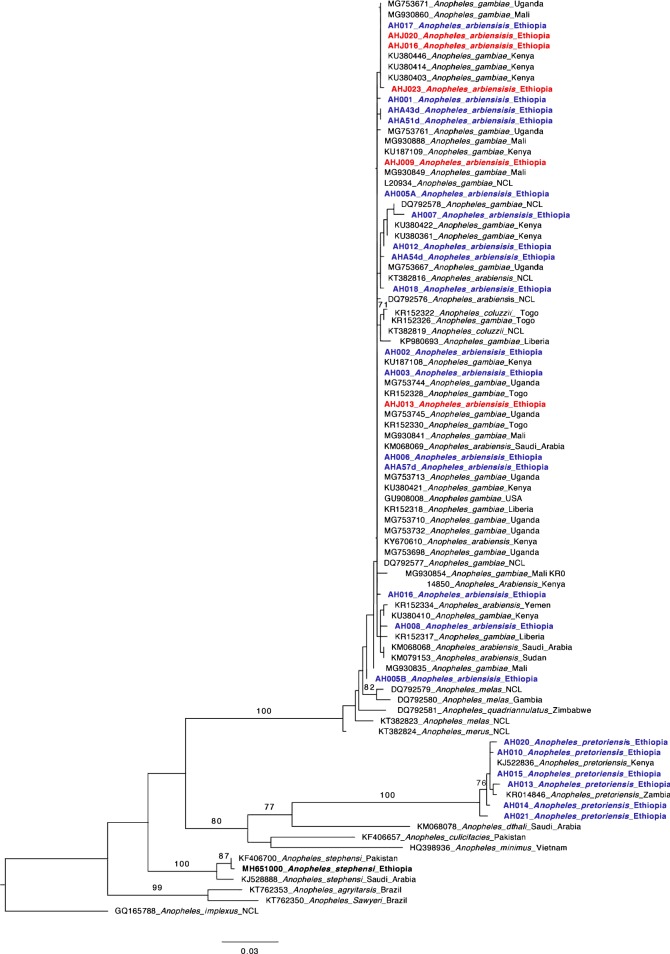
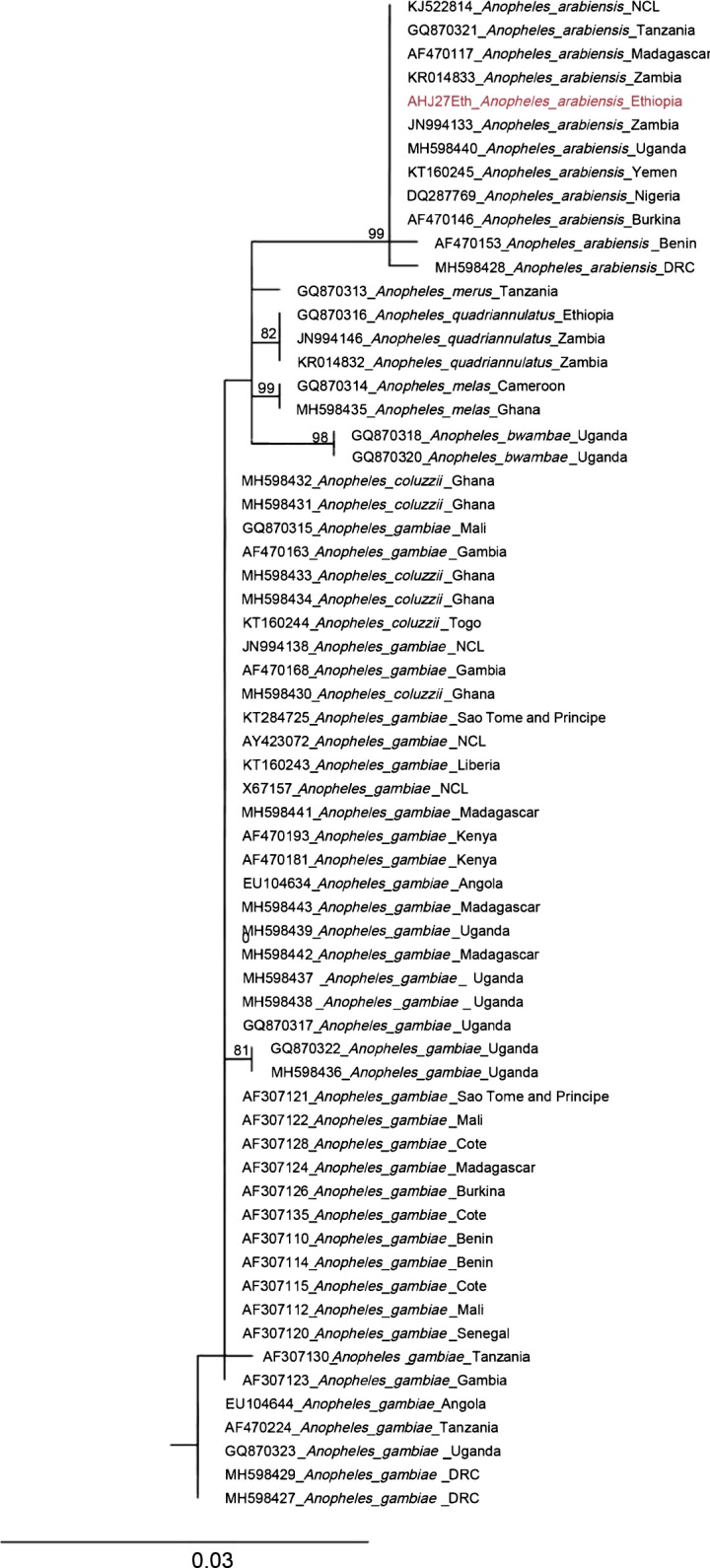
Results: Two species from the east Ethiopian collection, Anopheles arabiensis and Anopheles pretoriensis were identified. Analyses of ITS2 locus resulted in delineation of both species. In contrast, analysis of COI locus could not be used to delineate An. arabiensis from other taxa in Anopheles gambiae complex, but could distinguish An. pretoriensis sequences from sister taxa.
Conclusion: The lack of clarity from COI sequence analysis highlights potential challenges of species identification within species complexes. These results provide supporting data for the development of molecular assays for delineation of Anopheles in east Ethiopia.
Keywords: Anopheles arabiensis; Cytochrome oxidase subunit I; Horn of Africa; Internal transcribed spacer 2; Malaria; Phylogenetics.
Conflict of interest statement
The authors declare that they have no competing interests.
Figures
Similar articles
-
First detection of Anopheles stephensi Liston, 1901 (Diptera: culicidae) in Ethiopia using molecular and morphological approaches.Acta Trop. 2018 Dec;188:180-186. doi: 10.1016/j.actatropica.2018.09.001. Epub 2018 Sep 3. Acta Trop. 2018. PMID: 30189199
-
Molecular phylogeny of Anopheles hyrcanus group members based on ITS2 rDNA.Parasit Vectors. 2017 Sep 7;10(1):417. doi: 10.1186/s13071-017-2351-x. Parasit Vectors. 2017. PMID: 28882174 Free PMC article.
-
Spatial distributions of Anopheles species in relation to malaria incidence at 70 localities in the highly endemic Northwest and South Pacific coast regions of Colombia.Malar J. 2016 Aug 11;15(1):407. doi: 10.1186/s12936-016-1421-4. Malar J. 2016. PMID: 27515166 Free PMC article.
-
The second internal transcribed spacer of nuclear ribosomal DNA as a tool for Latin American anopheline taxonomy - a critical review.Mem Inst Oswaldo Cruz. 2006 Dec;101(8):817-32. doi: 10.1590/s0074-02762006000800002. Mem Inst Oswaldo Cruz. 2006. PMID: 17293975 Review.
-
A decade of invasive Anopheles stephensi sequence-based identification: toward a global standard.Trends Parasitol. 2024 Jun;40(6):477-486. doi: 10.1016/j.pt.2024.04.012. Epub 2024 May 16. Trends Parasitol. 2024. PMID: 38755024 Free PMC article. Review.
Cited by
-
Morphological identification and genetic characterization of Anopheles stephensi in Somaliland.Parasit Vectors. 2022 Jul 8;15(1):247. doi: 10.1186/s13071-022-05339-y. Parasit Vectors. 2022. PMID: 35804441 Free PMC article.
-
Genetic diversity, phylogenetic and phylogeographic analysis of Anopheles culicifacies species complex using ITS2 and COI sequences.PLoS One. 2023 Aug 16;18(8):e0290178. doi: 10.1371/journal.pone.0290178. eCollection 2023. PLoS One. 2023. PMID: 37585421 Free PMC article.
-
Distribution and phylogenetic diversity of Anopheles species in malaria endemic areas of Honduras in an elimination setting.Parasit Vectors. 2020 Jul 1;13(1):333. doi: 10.1186/s13071-020-04203-1. Parasit Vectors. 2020. PMID: 32611432 Free PMC article.
-
Member species of the Anopheles gambiae complex can be misidentified as Anopheles leesoni.Malar J. 2020 Feb 24;19(1):89. doi: 10.1186/s12936-020-03168-x. Malar J. 2020. PMID: 32093677 Free PMC article.
-
Development of a chimeric odour blend for attracting gravid malaria vectors.Malar J. 2021 Jun 9;20(1):262. doi: 10.1186/s12936-021-03797-w. Malar J. 2021. PMID: 34107946 Free PMC article.
References
-
- WHO . World malaria report 2017. Geneva: World Health Organization; 2018.
MeSH terms
Substances
LinkOut - more resources
Full Text Sources
Research Materials