. 2019 Apr 16;10(2):e00568-19.
doi: 10.1128/mBio.00568-19.

Experimental Evidence that Stochasticity Contributes to Bacterial Composition and Functioning in a Decomposer Community

Affiliations

Experimental Evidence that Stochasticity Contributes to Bacterial Composition and Functioning in a Decomposer Community

Michaeline B N Albright et al. mBio. .

Abstract

Stochasticity emerging from random differences in replication, death, mutation, and dispersal is thought to alter the composition of ecological communities. However, the importance of stochastic effects remains somewhat speculative because stochasticity is not directly measured but is instead inferred from unexplained variations in beta-diversity. Here, we performed a field experiment to more directly disentangle the role of stochastic processes, environmental selection, and dispersal in the composition and functioning of a natural bacterial decomposer community in the field. To increase our ability to detect these effects, we reduced initial biological and environmental heterogeneity using replicate nylon litterbags in the field. We then applied two treatments: ambient/added precipitation and bacterial and fungal dispersal using "open" litterbags (made from 18.0-μm-pore-size mesh) ("open bacterial dispersal") versus bacterial and fungal dispersal using "closed" litterbags (made from 22.0-μm-pore-size mesh) ("closed bacterial dispersal"). After 5 months, we assayed composition and functioning by the use of three subsamples from each litterbag to disentangle stochastic effects from residual variation. Our results indicate that stochasticity via ecological drift can contribute to beta-diversity in bacterial communities. However, residual variation, which had previously been included in stochasticity estimates, accounted for more than four times as much variability. At the same time, stochastic effects on beta-diversity were not attenuated at the functional level, as measured by genetic functional potential and extracellular enzyme activity. Finally, dispersal was found to interact with precipitation availability to influence the degree to which stochasticity contributed to functional variation. Together, our results demonstrate that the ability to quantify stochastic processes is key to understanding microbial diversity and its role in ecosystem functioning.IMPORTANCE Randomness can alter the diversity and composition of ecological communities. Such stochasticity may therefore obscure the relationship between the environment and community composition and hinder our ability to predict the relationship between biodiversity and ecosystem functioning. This study investigated the role of stochastic processes, environmental selection, and dispersal in microbial composition and its functioning on an intact field community. To do this, we used a controlled and replicated experiment that was similar to that used to study population genetics in the laboratory. Our study showed that, while the stochastic effects on taxonomic composition are smaller than expected, the degree to which stochasticity contributes to variability in ecosystem processes may be much higher than previously assumed.

Keywords: beta-diversity; dispersal; ecological drift; ecosystem functioning; stochastic.


Figures

FIG 1
FIG 1
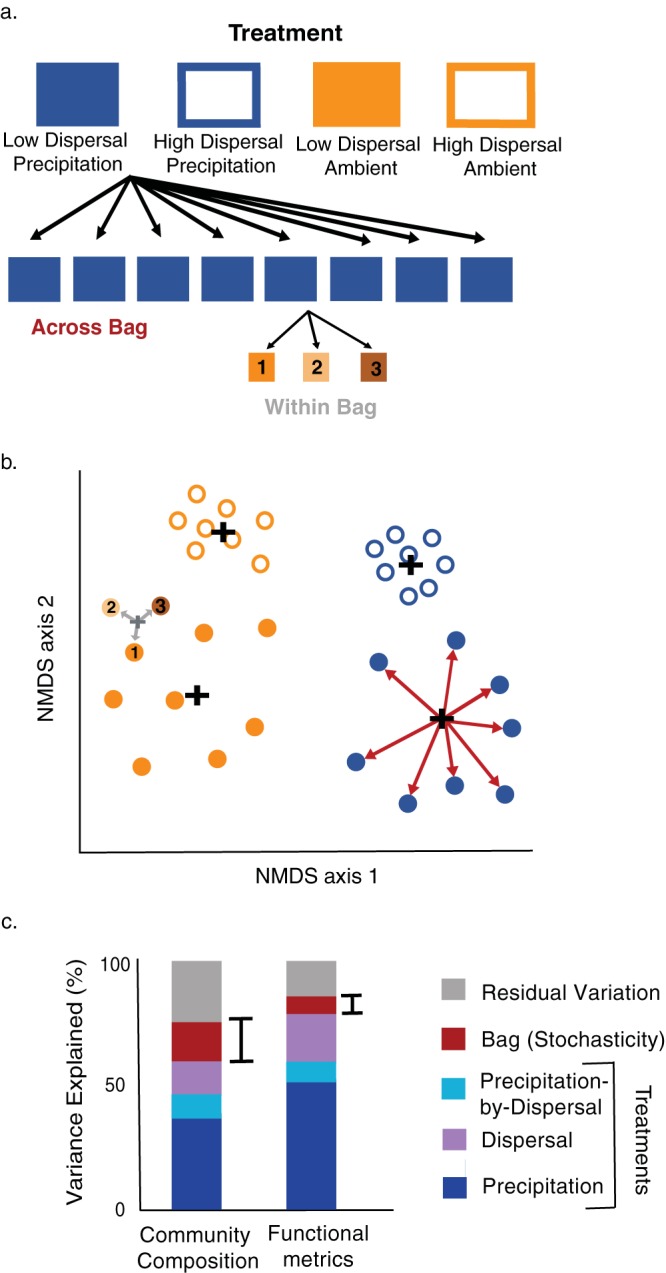
(a) Schematic diagram of experimental design. Four treatments were replicated eight times for a total of 32 litterbags containing homogenized leaf litter communities on a common litter substrate. To account for spatial heterogeneity within a litterbag, we assayed compositional and functional metrics on three subsamples from each of the litterbags. (b) Ordination showing hypothesized variation in community composition. Black crosses indicate group centroids of the different treatments and distances between the black crosses reflect variation among treatments. Within-treatment variation is denoted by red arrows. This variation was calculated after accounting for within bag variation (shown here for just one bag denoted by gray arrows and gray centroid). (c) Hypotheses for the relative variations in community composition and ecosystem function metrics. Variations due to the treatments (precipitation [blue], dispersal [purple], and a precipitation-by-dispersal interaction [light blue]) correspond to the distances between the centroids indicated in panel b. Variations due to stochasticity (red) correspond to the red arrows in panel b. Similarly, residual variations (gray) correspond to the gray arrows in panel b.
FIG 2
FIG 2
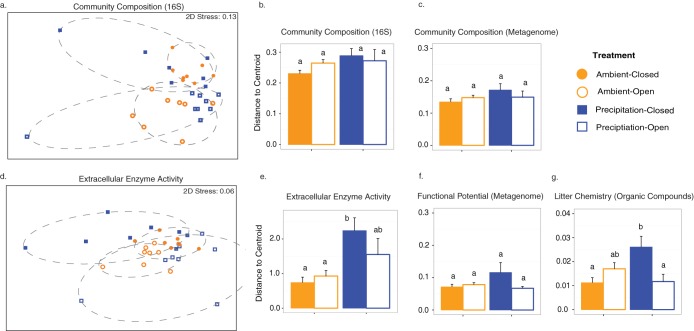
(a and d) Nonmetric multidimensional scaling (NMDS) ordinations showing variability in (a) 16S bacterial community composition (Bray-Curtis dissimilarity) and (d) extracellular enzyme activity (Euclidean distance). Each point represents the median of data determined from the 3 replicates from the bag (n = 32). 2D, two dimensional. (b, c, e, f, and g) Within-group distances ± standard errors (SE) for (b) 16S bacterial community composition (Bray-Curtis dissimilarity), (c) metagenome bacterial community composition, (e) extracellular enzyme activity (Euclidean distance), (f) functional genetic potential, and (g) organic litter chemistry of replicate litterbags within treatments (Ambient-Closed, Ambient-Open, Precipitation-Closed, Precipitation-Open). The individual sample points used to calculate within group distances are shown in the NMDS plots in panels a and b (see also Fig. S7a and Fig. S9).
FIG 3
FIG 3
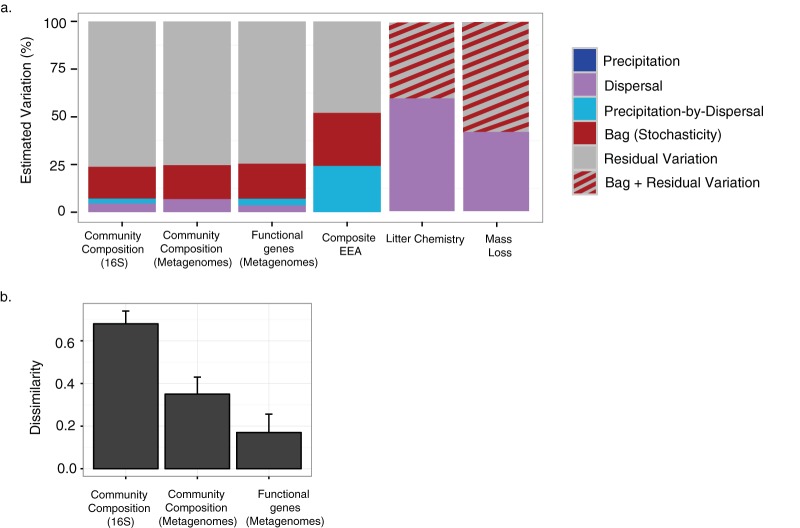
(a) Percentages of estimated variation across a variety of community composition and ecosystem function metrics explained by the environment, dispersal, environment-by-dispersal, across-replicate bag data (stochasticity), and residual variation. For community composition and extracellular enzyme activity, estimates were derived from a PERMANOVA model; for mass loss and litter chemistry, estimates were derived from a two-way ANOVA model. (b) Average Bray-Curtis dissimilarity values ± standard deviations (SD) from comparisons between samples for 16S and metagenomic sequence data.

References

    1. Kimura M. 1968. Genetic variability maintained in a finite population due to mutational production of neutral and nearly neutral isoalleles. Genet Res 11:247–269. doi: 10.1017/S0016672300011459. - DOI - PubMed
    1. Chase JM, Myers JA. 2011. Disentangling the importance of ecological niches from stochastic processes across scales. Philos Trans R Soc Lond B Biol Sci 366:2351–2363. doi: 10.1098/rstb.2011.0063. - DOI - PMC - PubMed
    1. Vellend M. 2010. Conceptual synthesis in community ecology. Q Rev Biol 85:183–206. doi: 10.1086/652373. - DOI - PubMed
    1. Hubbell SP. 2001. The unified neutral theory of biodiversity and biogeography. Princeton Univeristy Press, Princeton, NJ. - PubMed

    1. Cottenie K. 2005. Integrating environmental and spatial processes in ecological community dynamics. Ecol Lett 8:1175–1182. doi: 10.1111/j.1461-0248.2005.00820.x. - DOI - PubMed

Publication types