


Dietary Patterns and Determinants of Changing Diets in Bangladesh from 1985 to 2010
- PMID: 30993255
- PMCID: PMC6459985
- DOI: 10.1093/cdn/nzy091
Dietary Patterns and Determinants of Changing Diets in Bangladesh from 1985 to 2010
Abstract
Background: The government of Bangladesh has implemented multiple policies since 1971 to provide the population with more diverse and nutritious diets.
Objective: The aim of this study was to examine the drivers of dietary change over time and the roles agriculture and economic development have played.
Methods: We used principal component analysis to derive dietary patterns from 7 cross-sectional rounds of the Bangladesh Household [Income and] Expenditure Survey. We then used linear probability models to estimate associations of adherence to dietary patterns with socio-economic characteristics of households, and with agricultural production on the household and regional level. For dietary patterns that increased or decreased over time, Blinder-Oaxaca decomposition was used to assess factors associated with these changes.
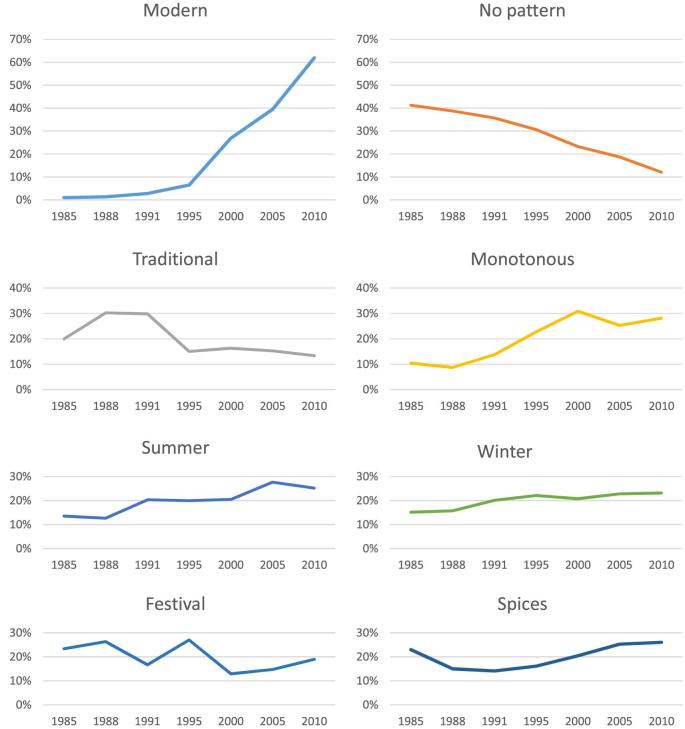
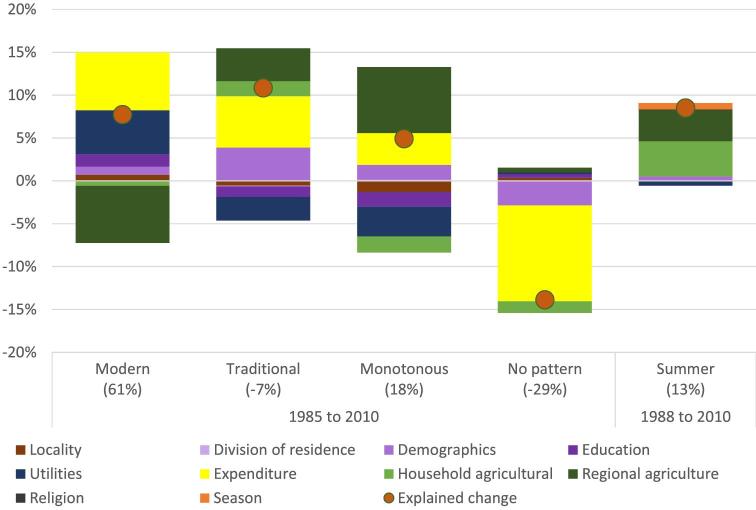
Results: Seven dietary patterns were identified: modern, traditional, festival, winter, summer, monotonous, and spices. All diets were present in all survey rounds. In 1985, over 40% of households had diets not associated with any identified pattern, which declined to 12% by 2010. The proportion of the population in households adhering to the modern, winter, summer, and monotonous diets increased over time, whereas the proportion adhering to the traditional diet decreased. Although many factors were associated with adherence to dietary patterns in the pooled sample, changes in observed factors only explained a limited proportion of change over time due to variation in coefficients between periods. Increased real per capita expenditure was the largest driver of elevated adherence to dietary patterns over time, whereas changes in the agricultural system increased adherence to less diverse dietary patterns.
Conclusions: These findings highlight the need for both diversified agricultural production and a continued reduction in poverty in order to drive dietary improvement. This study lays the groundwork for further analysis of the impact of changing diets on health and nutrition.
Keywords: Bangladesh; Household Consumption and Expenditure Survey; Socio-economic status; agriculture; dietary change; dietary pattern.
Figures
References
-
- The Constitution of the People's Republic of Bangladesh. [Internet]. 1972. Available from: http://bdlaws.minlaw.gov.bd/sections_detail.php?id=367§ions_id=24566.
-
- The Planning Commissions, Government of the People's Republic of Bangladesh. Nutrition Background Paper to inform the preparation of the 7th Five Year Plan, Dhaka, BD: (2015).
-
- Naher F, Barkat-e-Khuda, Ahmed SS, Hossain M. How nutrition-friendly are agriculture and health policies in Bangladesh? Food Nutr Bull 2014;35:133–46. - PubMed
-
- FAO, FAOSTAT: Food Balance Sheets. Food Agric. [Internet]. Organ. United Nations; 2014. Available from: http://www.fao.org/faostat/en/#data/FBS.
-
- Waid JL, Ali M, Thilsted SH, Gabrysch S. Dietary change in Bangladesh from 1985 to 2010. Global Food Security 2017;17:221–32.
LinkOut - more resources
Full Text Sources
