


A randomized controlled trial of metformin on left ventricular hypertrophy in patients with coronary artery disease without diabetes: the MET-REMODEL trial
- PMID: 30993313
- PMCID: PMC6823615
- DOI: 10.1093/eurheartj/ehz203
A randomized controlled trial of metformin on left ventricular hypertrophy in patients with coronary artery disease without diabetes: the MET-REMODEL trial
Abstract
Aim: We tested the hypothesis that metformin may regress left ventricular hypertrophy (LVH) in patients who have coronary artery disease (CAD), with insulin resistance (IR) and/or pre-diabetes.
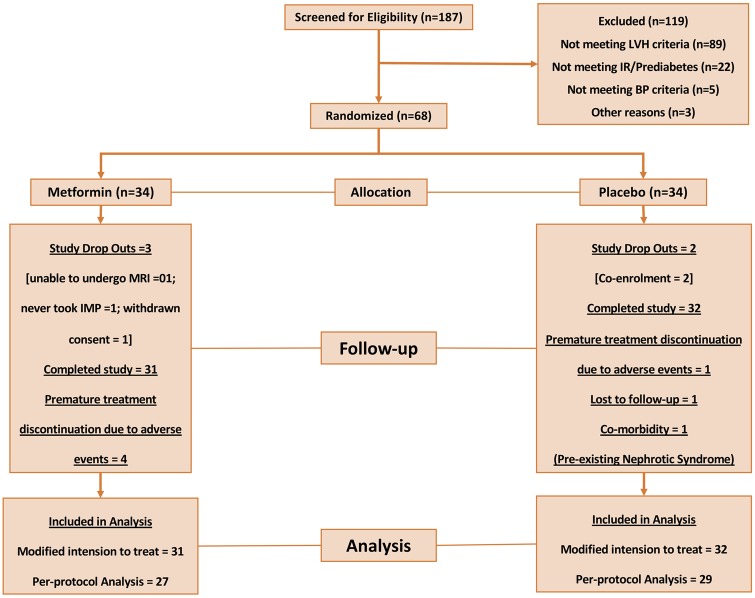
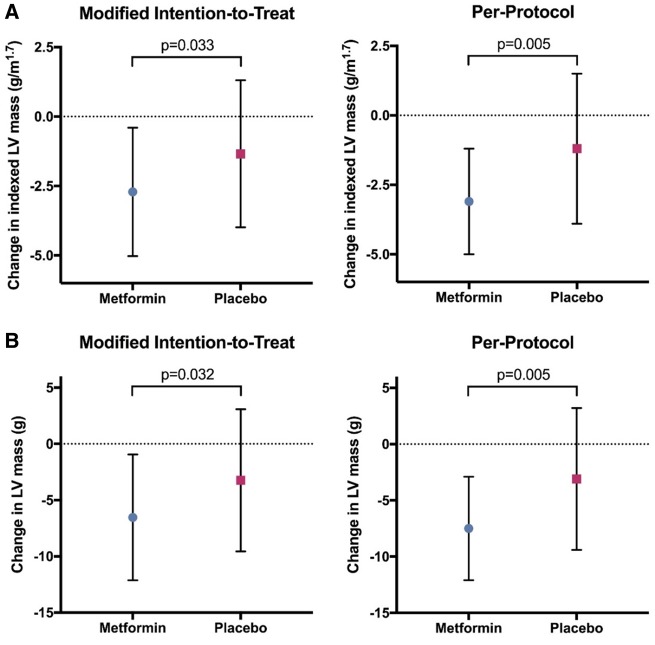
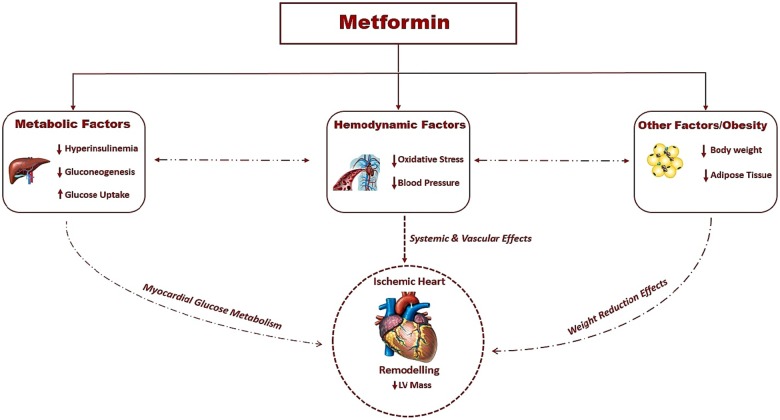
Methods and results: We randomly assigned 68 patients (mean age 65 ± 8 years) without diabetes who have CAD with IR and/or pre-diabetes to receive either metformin XL (2000 mg daily dose) or placebo for 12 months. Primary endpoint was change in left ventricular mass indexed to height1.7 (LVMI), assessed by magnetic resonance imaging. In the modified intention-to-treat analysis (n = 63), metformin treatment significantly reduced LVMI compared with placebo group (absolute mean difference -1.37 (95% confidence interval: -2.63 to -0.12, P = 0.033). Metformin also significantly reduced other secondary study endpoints such as: LVM (P = 0.032), body weight (P = 0.001), subcutaneous adipose tissue (P = 0.024), office systolic blood pressure (BP, P = 0.022) and concentration of thiobarbituric acid reactive substances, a biomarker for oxidative stress (P = 0.04). The glycated haemoglobin A1C concentration and fasting IR index did not differ between study groups at the end of the study.
Conclusion: Metformin treatment significantly reduced LVMI, LVM, office systolic BP, body weight, and oxidative stress. Although LVH is a good surrogate marker of cardiovascular (CV) outcome, conclusive evidence for the cardio-protective role of metformin is required from large CV outcomes trials.
Keywords: Oxidative stress; Coronary artery disease; Insulin resistance; Left ventricular mass; Metformin; Pre-diabetes.
© The Author(s) 2019. Published by Oxford University Press on behalf of the European Society of Cardiology.
Figures
Comment in
-
Regression therapy for cardiovascular disease.Eur Heart J. 2019 Nov 1;40(41):3418-3420. doi: 10.1093/eurheartj/ehz481. Eur Heart J. 2019. PMID: 31289825 No abstract available.
References
-
- Ang DS, Pringle SD, Struthers AD.. The cardiovascular risk factor, left ventricular hypertrophy, is highly prevalent in stable, treated angina pectoris. Am J Hypertens 2007;20:1029–1035. - PubMed
-
- East MA, Jollis JG, Nelson CL, Marks D, Peterson ED.. The influence of left ventricular hypertrophy on survival in patients with coronary artery disease: do race and gender matter? J Am Coll Cardiol 2003;41:949–954. - PubMed
-
- Artham SM, Lavie CJ, Milani RV, Patel DA, Verma A, Ventura HO.. Clinical impact of left ventricular hypertrophy and implications for regression. Prog Cardiovasc Dis 2009;52:153–167. - PubMed
-
- Verdecchia P, Angeli F, Borgioni C, Gattobigio R, de Simone G, Devereux RB, Porcellati C.. Changes in cardiovascular risk by reduction of left ventricular mass in hypertension: a meta-analysis. Am J Hypertens 2003;16:895–899. - PubMed
Publication types
MeSH terms
Substances
Grants and funding
LinkOut - more resources
Full Text Sources
Medical
Miscellaneous
