


Differences in Narrative Language in Evaluations of Medical Students by Gender and Under-represented Minority Status
- PMID: 30993609
- PMCID: PMC6502922
- DOI: 10.1007/s11606-019-04889-9
Differences in Narrative Language in Evaluations of Medical Students by Gender and Under-represented Minority Status
Abstract
Background: In varied educational settings, narrative evaluations have revealed systematic and deleterious differences in language describing women and those underrepresented in their fields. In medicine, limited qualitative studies show differences in narrative language by gender and under-represented minority (URM) status.
Objective: To identify and enumerate text descriptors in a database of medical student evaluations using natural language processing, and identify differences by gender and URM status in descriptions.
Design: An observational study of core clerkship evaluations of third-year medical students, including data on student gender, URM status, clerkship grade, and specialty.
Participants: A total of 87,922 clerkship evaluations from core clinical rotations at two medical schools in different geographic areas.
Main measures: We employed natural language processing to identify differences in the text of evaluations for women compared to men and for URM compared to non-URM students.
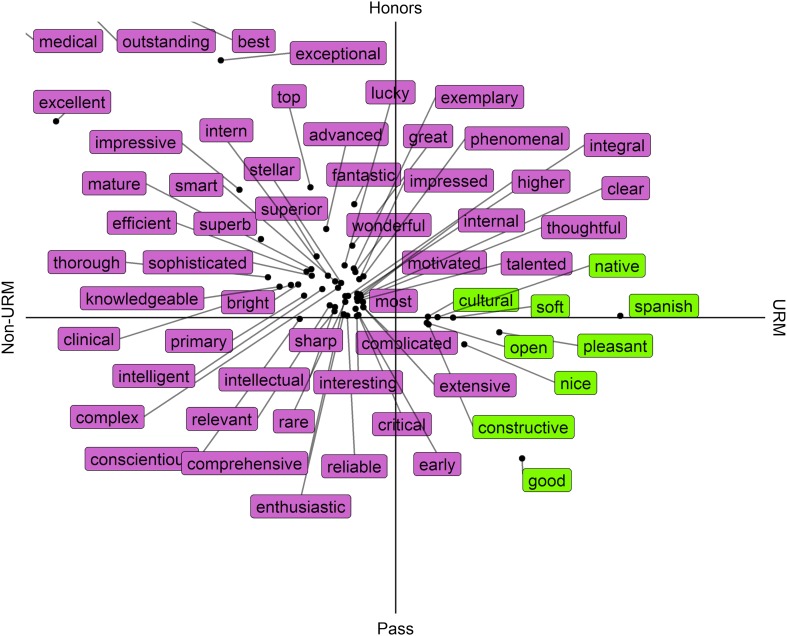
Key results: We found that of the ten most common words, such as "energetic" and "dependable," none differed by gender or URM status. Of the 37 words that differed by gender, 62% represented personal attributes, such as "lovely" appearing more frequently in evaluations of women (p < 0.001), while 19% represented competency-related behaviors, such as "scientific" appearing more frequently in evaluations of men (p < 0.001). Of the 53 words that differed by URM status, 30% represented personal attributes, such as "pleasant" appearing more frequently in evaluations of URM students (p < 0.001), and 28% represented competency-related behaviors, such as "knowledgeable" appearing more frequently in evaluations of non-URM students (p < 0.001).
Conclusions: Many words and phrases reflected students' personal attributes rather than competency-related behaviors, suggesting a gap in implementing competency-based evaluation of students. We observed a significant difference in narrative evaluations associated with gender and URM status, even among students receiving the same grade. This finding raises concern for implicit bias in narrative evaluation, consistent with prior studies, and suggests opportunities for improvement.
Keywords: medical education; medical education—assessment/evaluation; medical student and residency education.
Conflict of interest statement
The authors declare that they do not have a conflict of interest.
Figures

Comment in
-
Let's Face It: We Are Biased, and It Should Not Be That Way.J Gen Intern Med. 2019 May;34(5):649-651. doi: 10.1007/s11606-019-04923-w. J Gen Intern Med. 2019. PMID: 30993617 Free PMC article. No abstract available.
References
-
- Association of American Medical Colleges. Recommendations for Revising the Medical Student Performance Evaluation (MSPE). May 2017. https://www.aamc.org/download/470400/data/mspe-recommendations.pdf. Accessed December 11, 2018.
-
- Biernat M, Tocci MJ, Williams JC. The Language of Performance Evaluations: Gender-Based Shifts in Content and Consistency of Judgment. Social Psychological and Personality Science. 2012;3(2):186–192. doi: 10.1177/1948550611415693. - DOI
-
- Manning CD, Raghavan P. Schütze H. Introduction to Information Retrieval: Cambridge Unviersity Press; 2009.
-
- Corrice A. Unconscious Bias in Faculty and Leadership Recruitment: A Literature Review. Association of American Medical Colleges. 2009;9(2).
-
- Trix F, Psenka C. Exploring the Color of Glass: Letters of Recommendation for Female and Male Medical Faculty. Discourse & Society. 2003;14(2):191–220. doi: 10.1177/0957926503014002277. - DOI
Publication types
MeSH terms
Grants and funding
LinkOut - more resources
Full Text Sources
Miscellaneous
