


HPV-vaccination and cancer cervical screening in 53 WHO European Countries: An update on prevention programs according to income level
- PMID: 30993902
- PMCID: PMC6536990
- DOI: 10.1002/cam4.2048
HPV-vaccination and cancer cervical screening in 53 WHO European Countries: An update on prevention programs according to income level
Abstract
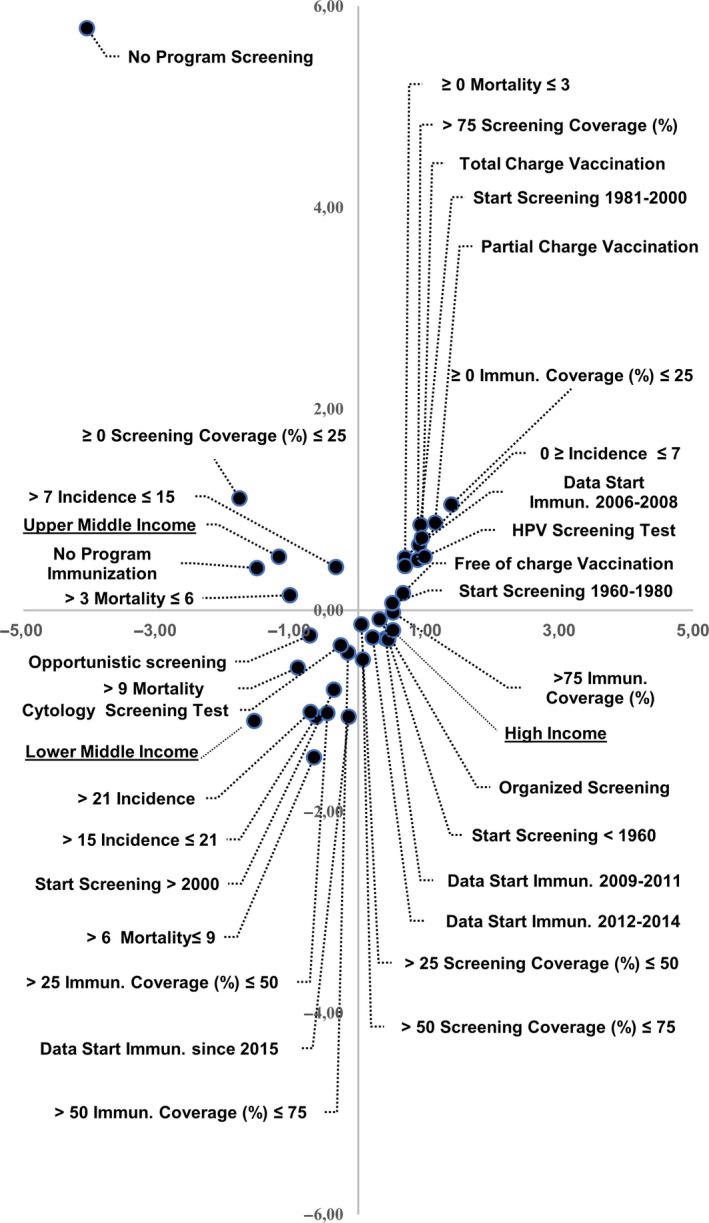
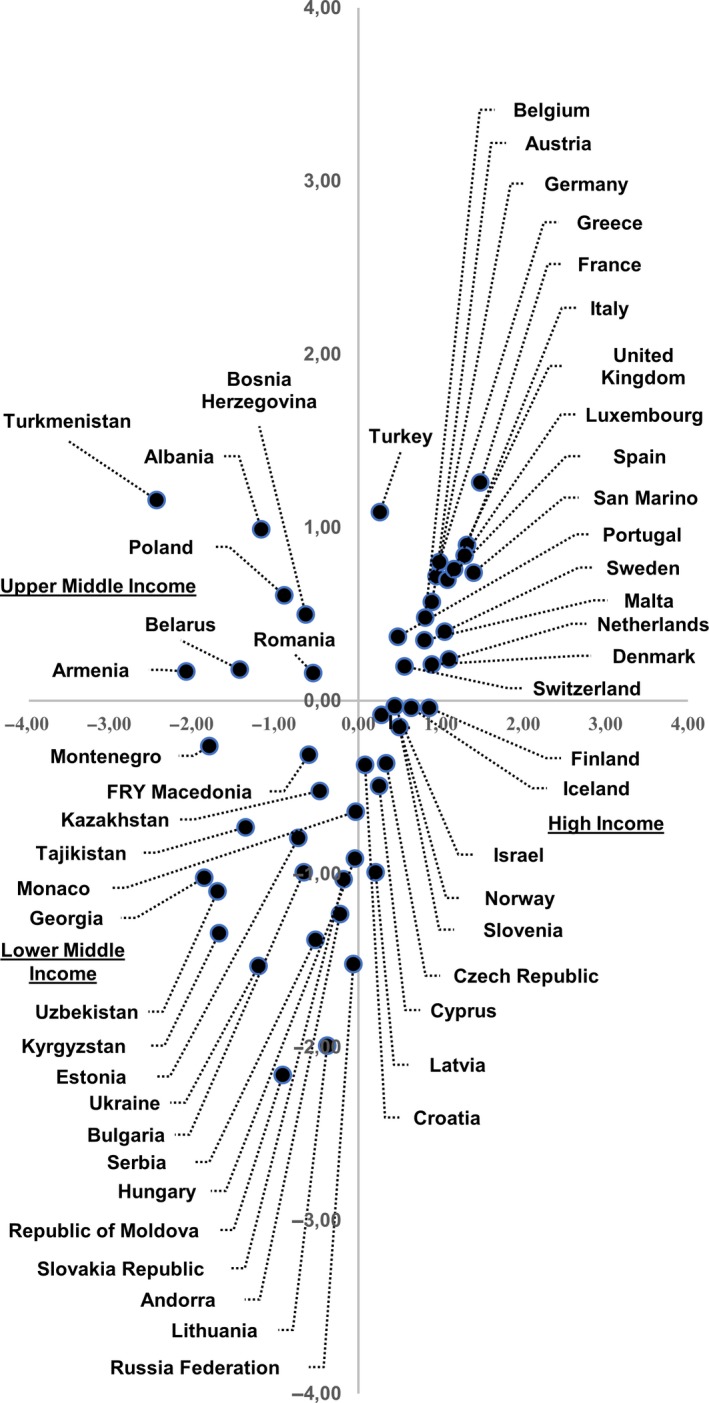
Human papillomavirus (HPV) is the most common sexually transmitted disease in the world. The aim of our study is to describe the differences in HPV-vaccination coverage and screening programs in WHO European Countries notably according to income levels. Multiple correspondence analysis was applied to examine the association among the following variables: Gross National Income (GNI) levels (Lower-Middle Income, LMI; Upper-Middle Income, UMI; and High Income, HI); type of CC screening program (coverage; opportunistic/organized); vaccination payment policies (free or partial or total charge); mortality rates/100 000 (≤3; >3-6; >6-9; >9); incidence rates/100 000 (≤7; >7-15; >15-21; >21). Data HPV-vaccination start (years) (2006-2008; 2009-2011; 2012-2014; >2014; no program); coverage HPV-vaccination percentage (≤25; 26-50; 51-75; >75); data screening start (years) (<1960; 1960-1980; 1981-2000; >2000); primary screening test (HPV, cytology), and screening coverage percentage (≤25; >25-50; >50-75; >75). A high income is associated with: start of screening before 1960, medium-high screening coverage, organized screening, start of vaccination in the periods 2009-2011 and 2012-2014 and high immunization coverage. On the other hand, lower-middle income is associated with: late start of vaccination and screening programs with cytology as primary test, high mortality and incidence rates and lower-medium vaccination coverage. Our results show a useful scenario for crucial support to public health decision-makers. Public health authorities should monitor the HPV-vaccinated population in order to determine more precisely the effects on short- and long-term incidence and mortality rates. In fact, the greater the vaccination coverage, the greater will be the efficacy of the program for the prevention of CC and other HPV-related diseases.
Keywords: HPV vaccination; cervical cancer; coverage; income level; screening programs; surveillance.
© 2019 The Authors. Cancer Medicine published by John Wiley & Sons Ltd.
Conflict of interest statement
The authors declare no conflict of interest.
Figures
References
-
- Harper DM, DeMars LR. HPV vaccines – a review of the first decade. Gynecol Oncol. 2017;146:196‐204. - PubMed
-
- Walboomers JM, Jacobs MV, Manos MM, et al. Human papillomavirus is a necessary cause of invasive cervical cancer worldwide. J Pathol. 1999;189(1):12‐19. - PubMed
-
- Ferlay J, Soerjomataram I, Dikshit R, et al. Cancer incidence and mortality worldwide: sources, methods and major patterns in GLOBOCAN 2012. Int J Cancer.2015;136(5):E359-386. - PubMed
-
- Zur Hausen H. Papillomaviruses and cancer: from basic studies to clinical application. Nat Rev Cancer. 2002;2:342‐350. - PubMed
-
- Castle PE, Maza M. Prophylactic HPV vaccination: past, present, and future. Epidemiol Infect. 2016;44(3):449‐468. - PubMed
