


Obstructive sleep apnea, nighttime arousals, and leukocyte telomere length: the Multi-Ethnic Study of Atherosclerosis
- PMID: 30994174
- PMCID: PMC6612669
- DOI: 10.1093/sleep/zsz089
Obstructive sleep apnea, nighttime arousals, and leukocyte telomere length: the Multi-Ethnic Study of Atherosclerosis
Abstract
Study objectives: Sleep disturbances and sleep apnea are associated with increased vulnerability to age-related disease, altering molecular pathways affecting biological aging. Telomere length captures one component of biological aging. We evaluated whether objectively assessed sleep and sleep apnea relate to leukocyte telomere length (LTL) in the Multi-Ethnic Study of Atherosclerosis (MESA).
Methods: Men and women aged 44-84 years (n = 672) from the MESA Stress and MESA Sleep studies underwent polysomnography and 7 day actigraphy (at Exam 5) and assessment of LTL (at baseline [Exam 1] and about 10 years later [Exam 5]).
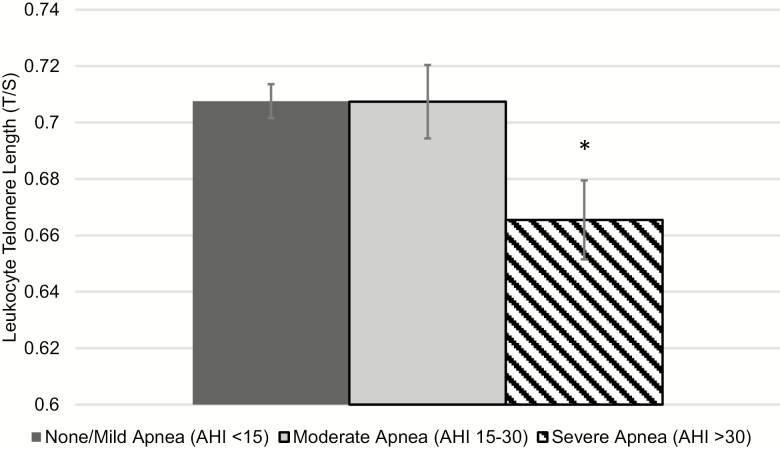
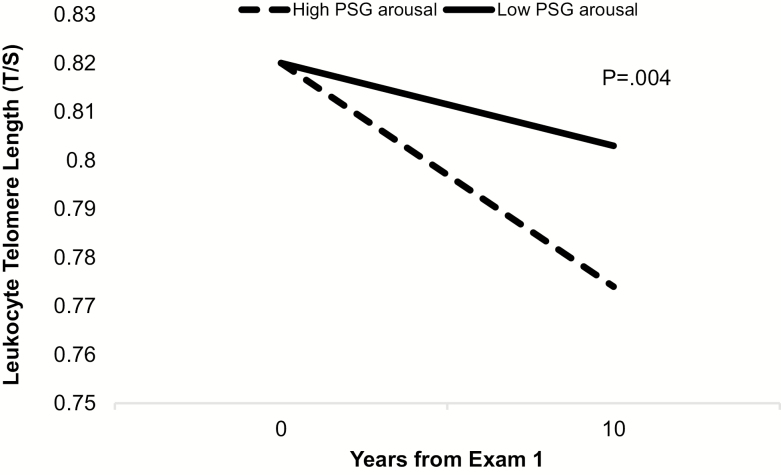
Results: General linear models adjusting for age, sex, race/ethnicity, BMI, physical activity, and smoking found that severe obstructive sleep apnea (OSA; apnea-hypopnea index > 30) was cross-sectionally associated with shorter LTL (p = 0.007). Modest associations of shorter LTL with less rapid eye movement sleep, more stage 1 sleep, wake after sleep onset >30 min, and long sleep duration were found, but these effects were diminished after adjusting for lifestyle and OSA. Exploratory analyses found that higher arousal index at Exam 5 was associated with greater LTL decline over the prior 10 years (p = 0.004).
Conclusions: OSA was associated with shorter LTL. Individuals with high-arousal frequency had greater leukocyte telomere attrition over the prior decade. These findings suggest that sleep apnea and sleep fragmentation are associated with accelerated biological aging.
Keywords: actigraphy; aging; biomarkers; epidemiology; obstructive sleep apnea; psychoneuroimmunology; sleep; telomere length.
© Sleep Research Society 2019. Published by Oxford University Press on behalf of the Sleep Research Society. All rights reserved. For permissions, please e-mail journals.permissions@oup.com.
Figures
References
-
- Ohayon MM. Epidemiology of insomnia: what we know and what we still need to learn. Sleep Med Rev. 2002;6(2):97–111. - PubMed
-
- Center for Disease Control. CDC Data & Statistics | Feature: Insufficient Sleep Is a Public Health Epidemic 2011. http://www.cdc.gov/Features/dsSleep/. Accessed August 4, 2011.
-
- Colten HR, et al. ; Research I of MUS. C on SM and. Sleep Disorders and Sleep Deprivation: An Unmet Public Health Problem. Washington, DC: National Academies Press; 2006. http://books.google.com/books?hl=en&lr=&id=KexmhhRu84MC&pgis=1. Accessed August 4, 2011. - PubMed
-
- Motivala SJ. Sleep and inflammation: psychoneuroimmunology in the context of cardiovascular disease. Ann Behav Med. 2011;42(2):141–152. - PubMed
Publication types
MeSH terms
Grants and funding
- N01HC95169/HL/NHLBI NIH HHS/United States
- R01 HL076831/HL/NHLBI NIH HHS/United States
- N01HC95161/HL/NHLBI NIH HHS/United States
- N01HC95162/HL/NHLBI NIH HHS/United States
- UL1 TR000124/TR/NCATS NIH HHS/United States
- K01 AG044462/AG/NIA NIH HHS/United States
- N01HC95163/HL/NHLBI NIH HHS/United States
- R01 HL101161/HL/NHLBI NIH HHS/United States
- UL1 TR001420/TR/NCATS NIH HHS/United States
- N01HC95164/HL/NHLBI NIH HHS/United States
- UL1 TR000040/TR/NCATS NIH HHS/United States
- N01HC95168/HL/NHLBI NIH HHS/United States
- R01 CA160245/CA/NCI NIH HHS/United States
- N01HC95165/HL/NHLBI NIH HHS/United States
- R35 HL135818/HL/NHLBI NIH HHS/United States
- R01 HL098433/HL/NHLBI NIH HHS/United States
- R01 CA119159/CA/NCI NIH HHS/United States
- N01HC95167/HL/NHLBI NIH HHS/United States
- R01 AG034588/AG/NIA NIH HHS/United States
- R01 AG026364/AG/NIA NIH HHS/United States
- N01HC95159/HL/NHLBI NIH HHS/United States
- UL1 TR001079/TR/NCATS NIH HHS/United States
- N01HC95166/HL/NHLBI NIH HHS/United States
- UL1 TR001881/TR/NCATS NIH HHS/United States
- R01 HL142051/HL/NHLBI NIH HHS/United States
- N01HC95160/HL/NHLBI NIH HHS/United States
