. 2019 Apr 16;11(4):857.
doi: 10.3390/nu11040857.

The Edible Insect Gryllus bimaculatus Protects against Gut-Derived Inflammatory Responses and Liver Damage in Mice after Acute Alcohol Exposure

Affiliations

The Edible Insect Gryllus bimaculatus Protects against Gut-Derived Inflammatory Responses and Liver Damage in Mice after Acute Alcohol Exposure

Bo Byeol Hwang et al. Nutrients. .

Abstract

Accumulation of reactive oxygen species (ROS) in response to excess alcohol exposure is a major cause of gut barrier disruption and lipopolysaccharide (LPS)-induced hepatic inflammation, as well as liver steatosis and apoptosis. This study was designed to investigate protective effects of the cricket Gryllus bimaculatus, an edible insect recognized by the Korea Food and Drug Administration, against acute alcoholic liver damage in mice. Administration of G. bimaculatus extracts (GBE) attenuated alcohol-induced steatosis and apoptotic responses in the liver and intestinal permeability to bacterial endotoxin. These protective effects were associated with suppression of ROS-mediated oxidative stress in both the liver and small intestine. Furthermore, in vivo and in vitro studies revealed that GBE inhibits LPS-induced Kupffer cell activation and subsequent inflammatory signaling. Importantly, the protective effects of GBE were more potent than those of silymarin, a known therapeutic agent for alcoholic liver diseases.

Keywords: Gryllus bimaculatus; alcoholic liver diseases; intestinal permeability; reactive oxygen species.


Conflict of interest statement

The authors declare no conflict of interest.

Figures
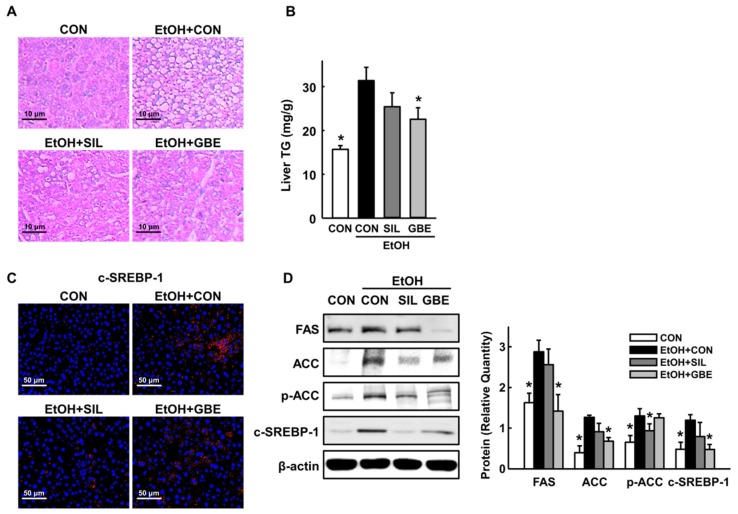
Figure 1
Figure 1
Protective effects of GBE against alcohol-induced hepatic steatosis. (A) Representative hematoxylin and eosin (H&E) staining of the liver, (B) Liver triglyceride (TG) contents, (C) Representative immunohistochemical staining for hepatic cleaved sterol regulatory element-binding protein 1 (SREBP-1) (red), (D) Western blot of hepatic fatty acid synthase (FAS), acetyl-CoA carboxylase (ACC), phospho-ACC (p-ACC), and cleaved SREBP-1 expression with quantitative data. CON, control; SIL, silymarin; GBE, water extract of G. bimaculatus. Data are shown as means ± SEM (n = 4 for A and C and n = 8 for B and D). * p < 0.05 vs. EtOH control group.
Figure 2
Figure 2
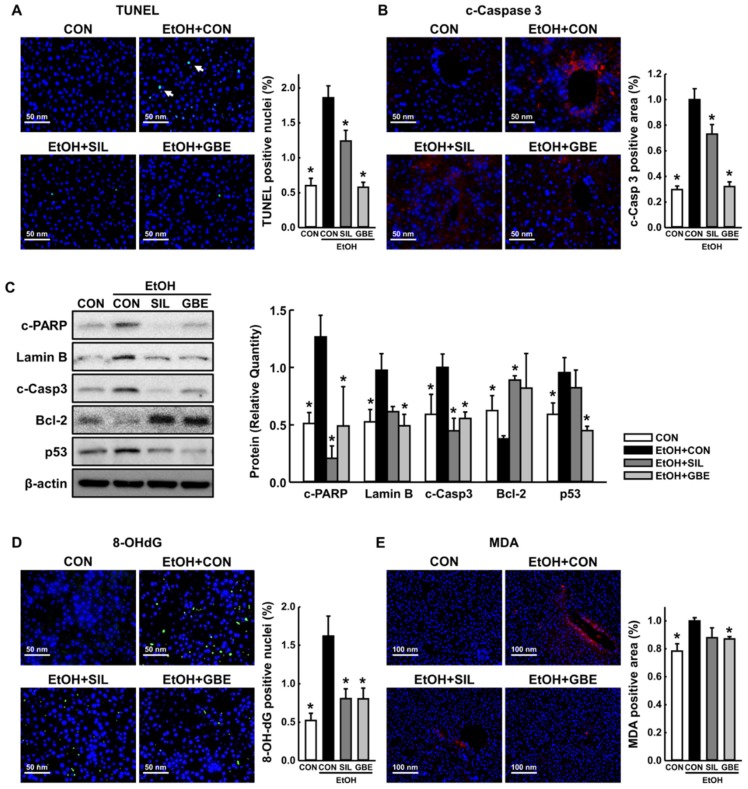
Protective effects of GBE against alcohol-induced hepatic apoptosis and oxidative stress. Representative immunohistochemical staining of liver for (A) terminal deoxynucleotidyl transferase dUTP nick end labeling (TUNEL) (green) and (B) cleaved caspase-3 (red) with corresponding quantitative data. (C) Western blot of hepatic cleaved poly (ADP-ribose) polymerase (PARP), lamin B, cleaved caspase-3, B-cell lymphoma 2 (Bcl-2), and p53 expression with quantitative data. Representative immunohistochemical staining of liver for (D) 8-hydroxy-2’-deoxyguanosine (8-OHdG) (green) and (E) malondialdehyde (red) with corresponding quantitative data. CON, control; SIL, silymarin; GBE, water extract of G. bimaculatus. Data are shown as means ± SEM (n = 4 for A, B, D and E and n = 8 for C). * p < 0.05 vs. EtOH control group.
Figure 3
Figure 3
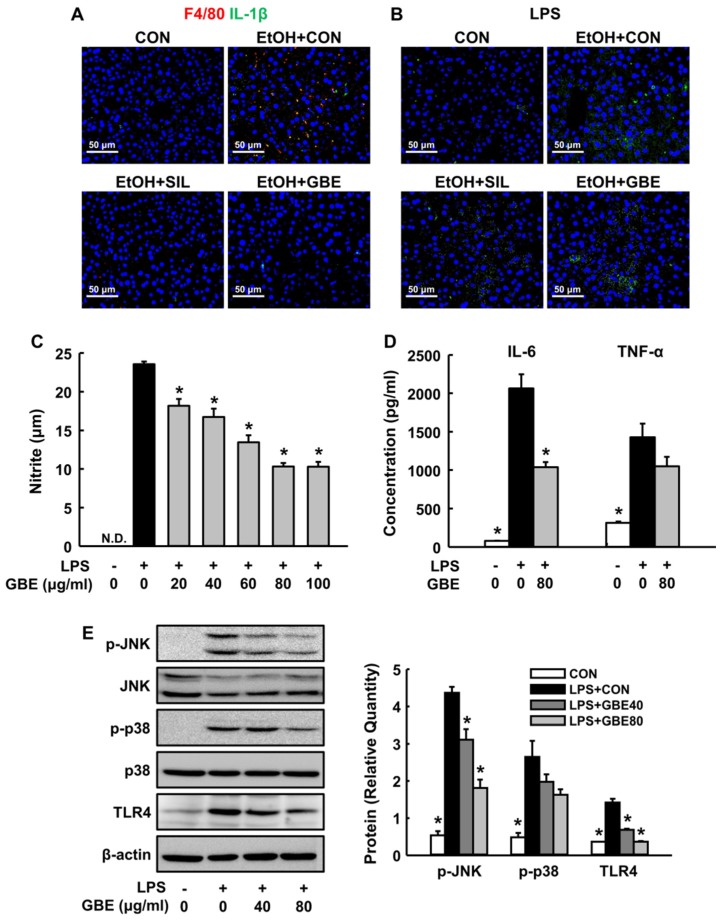
Effects of GBE on alcohol-induced Kupffer cells activation and lipopolysaccharide (LPS)-stimulated inflammatory response in macrophages. Representative immunohistochemical staining of liver for (A) F4/80 (red, Kupffer cells marker) and interleukin-1β (green) and (B) lipopolysaccharide (green). The released levels of (C) nitrite, (D) interleukin-6, and tumor necrosis factor-α from lipopolysaccharide-stimulated RAW 264.7 macrophage cells. (E) Western blot of phospho-c-Jun N-terminal kinase (p-JNK), total JNK, p-p38, total p38 and toll-like receptor 4 (TLR4) from macrophage cell extracts with quantitative data. CON, control; SIL, silymarin; GBE, water extract of G. bimaculatus. Data are shown as means ± SEM (n = 4 for A–C and n = 6 for D–F). * p < 0.05 vs. EtOH control group or LPS control group.
Figure 4
Figure 4
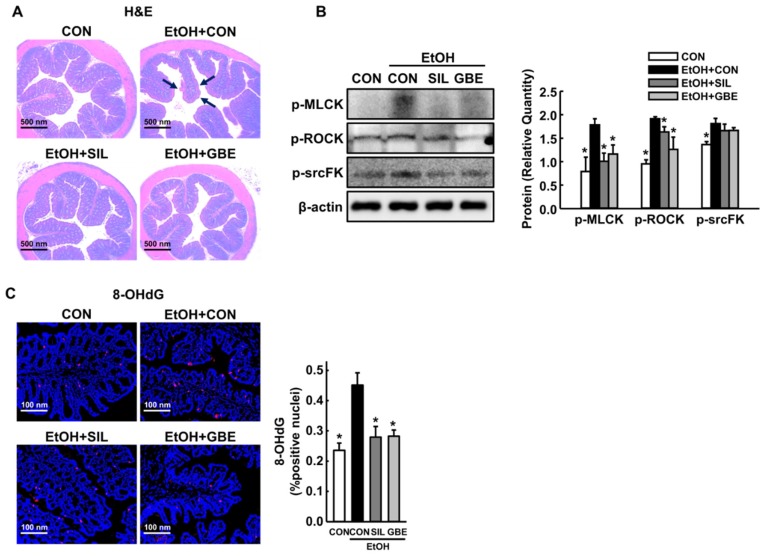
Protective effects of GBE against alcohol-induced intestinal hyperpermeability and oxidative stress. (A) Representative H&E staining of the small intestine, (B) Western blot of intestinal phospho-myosin light chain kinase (p-MLCK), phospho-Rho-associated protein kinase (p-ROCK), and phospho-Src-family kinase (p-srcFK) with quantitative data, (C) Representative immunohistochemical staining for intestinal 8-OHdG with quantitative data. CON, control; SIL, silymarin; GBE, water extract of G. bimaculatus. Data are shown as means ± SEM (n = 4 for A and C and n = 8 for B). * p < 0.05 vs. EtOH control group.
Figure 5
Figure 5
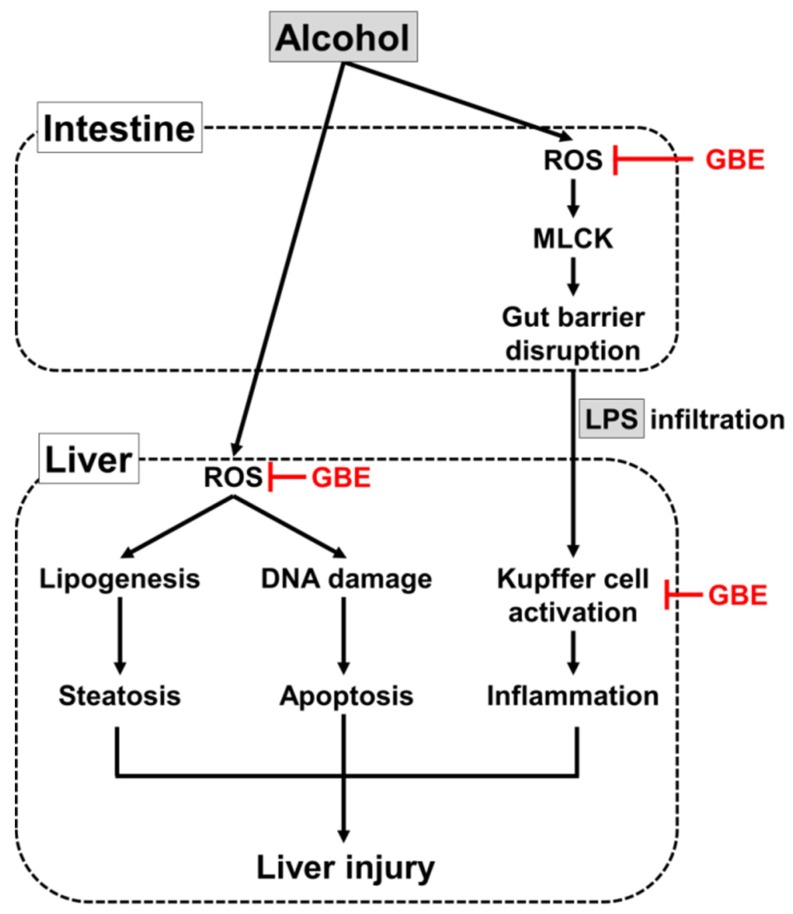
Proposed mechanism of protection of GBE against alcohol-induced liver injury.

References

    1. Van Huis A., Van Itterbeeck J., Klunder H., Mertens E., Halloran A., Muir G., Vantomme P. Edible insects: Future Prospects for Food and Feed Security. Food and Agriculture Organization of the United Nations; Rome, Italy: 2013.
    1. Belluco S., Losasso C., Maggioletti M., Alonzi C.C., Paoletti M.G., Ricci A. Edible insects in a food safety and nutritional perspective: A critical review. Compr. Rev. Food Sci. Food Saf. 2013;12:296–313. doi: 10.1111/1541-4337.12014. - DOI
    1. Dobermann D., Swift J.A., Field L.M. Opportunities and hurdles of edible insects for food and feed. Nutr. Bull. 2017;42:293–308. doi: 10.1111/nbu.12291. - DOI
    1. Ahn M.Y., Hwang J.S., Yun E.Y., Kim M.-J., Park K.-K. Anti-aging effect and gene expression profiling of aged rats treated with G. bimaculatus extract. Toxicol. Res. 2015;31:173. doi: 10.5487/TR.2015.31.2.173. - DOI - PMC - PubMed
    1. Ahn M.Y., Kim M.-J., Kwon R.H., Hwang J.S., Park K.-K. Gene expression profiling and inhibition of adipose tissue accumulation of G. bimaculatus extract in rats on high fat diet. Lipids Health Dis. 2015;14:116. doi: 10.1186/s12944-015-0113-3. - DOI - PMC - PubMed

MeSH terms

LinkOut - more resources