


Mycotoxins during the Processes of Nixtamalization and Tortilla Production
- PMID: 30995755
- PMCID: PMC6520960
- DOI: 10.3390/toxins11040227
Mycotoxins during the Processes of Nixtamalization and Tortilla Production
Abstract
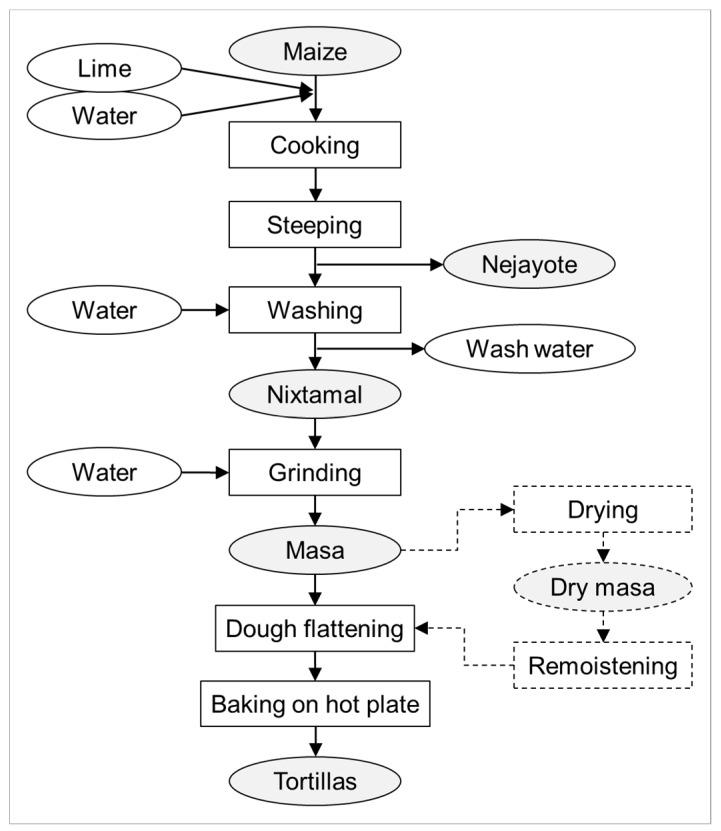
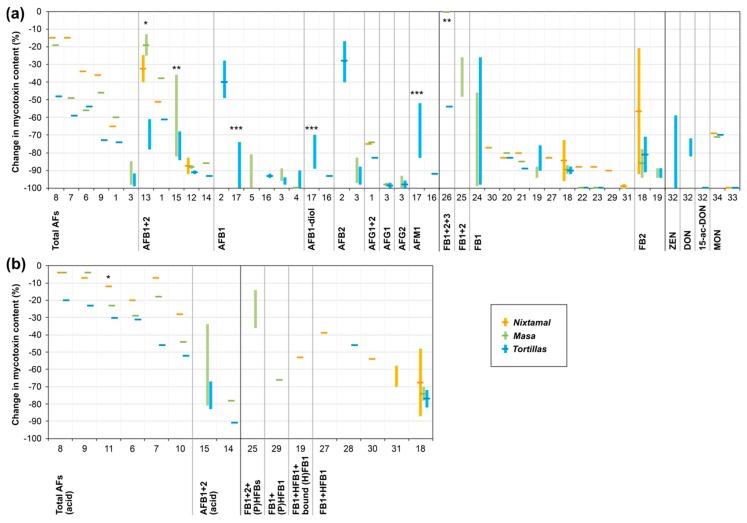
Tortillas are a traditional staple food in Mesoamerican cuisine, which have also become popular on a global level, e.g., for wraps or as snacks (tortilla chips). Traditional tortilla production includes alkaline cooking (nixtamalization) of maize kernels. This article summarizes the current knowledge on mycotoxin changes during the nixtamalization of maize and tortilla production. Upon nixtamalization, mycotoxins can be affected in different ways. On the one hand, the toxins can be physically removed during steeping and washing. On the other hand, mycotoxins might be degraded, modified, or released/bound in the matrix by high pH and/or high temperature. This also applies to the subsequent baking of tortillas. Many studies have shown reduced mycotoxin levels in alkali-cooked maize and in tortillas. Most of the available data relate to aflatoxins and fumonisins. The reduction (and detoxification) of aflatoxins during nixtamalization might, however, be partially reversed in acidic conditions. The loss of fumonisin concentrations is to some extent accompanied by hydrolyzation and by lower toxicity. However, some studies have indicated the potential formation of toxicologically relevant modified forms and matrix-associated fumonisins. More data are required to assess the influence of alkaline cooking regarding such modified forms, as well as mycotoxins other than aflatoxins/fumonisins.
Keywords: aflatoxins; alkaline; food processing; fumonisins; hydrolyzed fumonisins; maize; masa; matrix-associated mycotoxins; modified mycotoxins; tortillas.
Conflict of interest statement
The authors declare no conflicts of interest.
Figures
References
-
- Pitt J., Wild C., Baan R., Gelderblom W., Miller J., Riley R., Wu F. Improving Public Health through Mycotoxin Control. Chapter 1: Fungi Producing Significant Mycotoxins. International Agency for Research on Cancer, WHO Press; Geneva, Switzerland: 2012. pp. 1–30.
-
- Taniwaki M.H., Pitt J.I., Magan N. Aspergillus species and mycotoxins: Occurrence and importance in major food commodities. Curr. Opin. Food Sci. 2018;23:38–43. doi: 10.1016/j.cofs.2018.05.008. - DOI
-
- EFSA CONTAM Opinion of the scientific panel on contaminants in the food chain [CONTAM] related to the potential increase of consumer health risk by a possible increase of the existing maximum levels for aflatoxins in almonds, hazelnuts and pistachios and derived products. EFSA J. 2007;446:1–127.
-
- EFSA Panel on Contaminants in the Food Chain. Knutsen H.-K., Barregård L., Bignami M., Brüschweiler B., Ceccatelli S., Cottrill B., Dinovi M., Edler L., Grasl-Kraupp B., et al. Appropriateness to set a group health-based guidance value for fumonisins and their modified forms. EFSA J. 2018;16:e05172. - PMC - PubMed
Publication types
MeSH terms
Substances
LinkOut - more resources
Full Text Sources
Other Literature Sources
Medical
