Review
. 2019 Apr 17;16(1):90.
doi: 10.1186/s12974-019-1475-7.

Role of inflammation in depression relapse

Affiliations
Review

Role of inflammation in depression relapse

Chun-Hong Liu et al. J Neuroinflammation. .

Abstract

Major depressive disorder (MDD) is a leading cause of disability worldwide. After the first episode, patients with remitted MDD have a 60% chance of experiencing a second episode. Consideration of therapy continuation should be viewed in terms of the balance between the adverse effects of medication and the need to prevent a possible relapse. Relapse during the early stages of MDD could be prevented more efficiently by conducting individual risk assessments and providing justification for continuing therapy. Our previous work established the neuroimaging markers of relapse by comparing patients with recurrent major depressive disorder (rMDD) in depressive and remitted states. However, it is not known which of these markers are trait markers that present before initial relapse and, consequently, predict disease course. Here, we first describe how inflammation can be translated to subtype-specific clinical features and suggest how this could be used to facilitate clinical diagnosis and treatment. Next, we address the central and peripheral functional state of the immune system in patients with MDD. In addition, we emphasize the important link between the number of depressive episodes and rMDD and use neuroimaging to propose a model for the latter. Last, we address how inflammation can affect brain circuits, providing a possible mechanism for rMDD. Our review suggests a link between inflammatory processes and brain region/circuits in rMDD.

Keywords: (Neuro) inflammation; Functional magnetic resonance imaging; Recurrent major depressive disorder; Vagus nerve stimulation.


Conflict of interest statement

Ethics approval and consent to participate

Not applicable.

Consent for publication

Not applicable.

Competing interests

The authors declare that they have no competing interests.

Publisher’s Note

Springer Nature remains neutral with regard to jurisdictional claims in published maps and institutional affiliations.

Figures
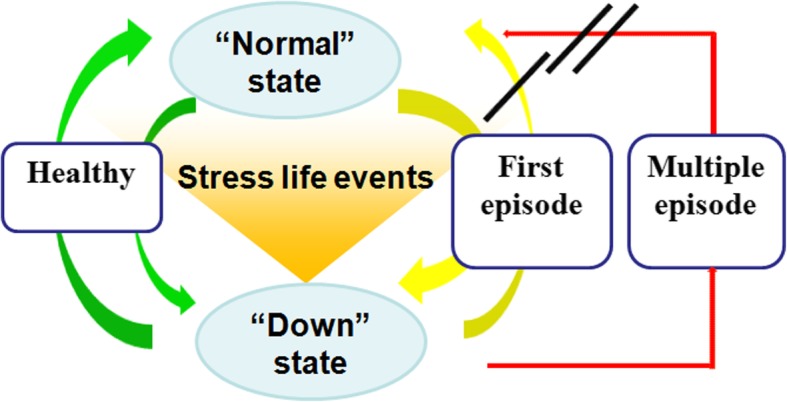
Fig. 1
Fig. 1
Neural dysfunction becomes increasingly serious in rMDD with increased numbers of depressive episodes. In health, the tendency to enter a “down state” is relatively low, and the ability to return to a “normal state” is relatively rapid and complete (green arrows). In individuals with first-episode MDD, the tendency to enter a down state is relatively high, and the ability to return to a normal state is impaired slightly (yellow arrows). This ability becomes impaired more seriously in individuals with rMDD (red arrow). The down state itself is not abnormal in this model
Fig. 2
Fig. 2
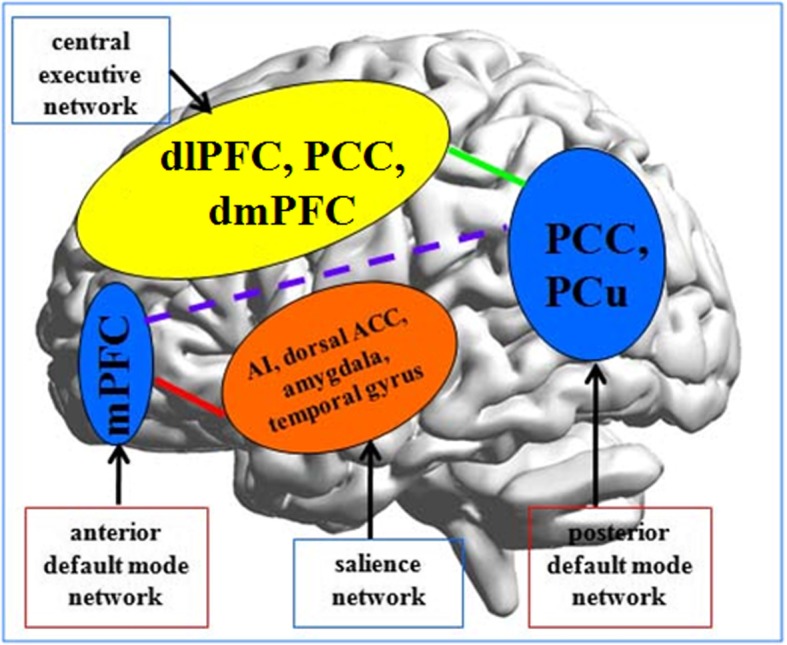
Proposed model of rMDD (schematic). Segregation of the anterior and posterior DMN could be an indicator of recurrent depression. Increased functional connectivity between the anterior DMN and the salience network may be an early sign of depression recurrence. Decreased functional connectivity between the posterior DMN and central executive networks is unique to rMDD. ACC, anterior cingulate cortex; AI, anterior insula; dlPFC, dorsolateral prefrontal cortex; dmPFC, dorsomedial prefrontal cortex; DMN, default mode network; mPFC, medial prefrontal cortex; PCC, posterior cingulate cortex; PCu, precuneus;; rMDD, recurrent major depressive disorder
Fig. 3
Fig. 3
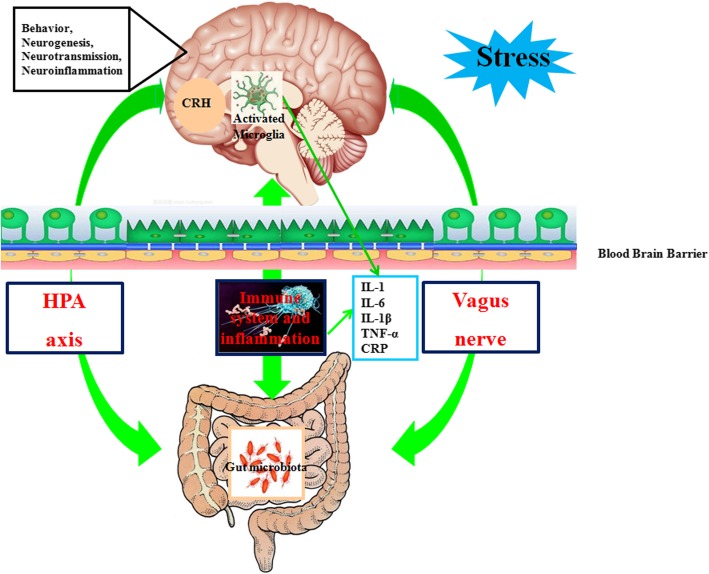
Relationship between inflammation and rMDD. Stress is an important factor in the occurrence of depression relapse. Neuroendocrine- and inflammation-related signals generated by gut microbiota and specialized cells within the gut can, in principle, affect the brain and may lead to release of neurotransmitters, excessive activation of microglial cells, increased levels of inflammatory factors from the peripheral nervous system and the central nervous system, release of inflammatory cytokines by immune macrophages, and depressive-like behaviors. CRH corticotropin-releasing hormone, CRP C-reactive protein, HPA hypothalamic–pituitary–adrenal, IL interleukin, TNF-α tumor necrosis factor-α

References

    1. Marchetti I, Koster EH, Sonuga-Barke EJ, De Raedt R. The default mode network and recurrent depression: a neurobiological model of cognitive risk factors. Neuropsychol Rev. 2012;22(3):229–251. doi: 10.1007/s11065-012-9199-9. - DOI - PubMed
    1. Hamilton JP, Farmer M, Fogelman P, Gotlib IH. Depressive rumination, the default-mode network, and the dark matter of clinical neuroscience. Biol Psychiatry. 2015;78(4):224–230. doi: 10.1016/j.biopsych.2015.02.020. - DOI - PMC - PubMed
    1. Smith K. Mental health: a world of depression. Nature. 2014;515(7526):181. doi: 10.1038/515180a. - DOI - PubMed
    1. Rush AJ, Trivedi MH, Wisniewski SR, Nierenberg AA, Stewart JW, Warden D, et al. Acute and longer-term outcomes in depressed outpatients requiring one or several treatment steps: a STAR*D report. Am J Psychiatr. 2006;163(11):1905–1917. doi: 10.1176/ajp.2006.163.11.1905. - DOI - PubMed
    1. Andrade L, Caraveo-Anduaga JJ, Berglund P, Bijl RV, De Graaf R, Vollebergh W, et al. The epidemiology of major depressive episodes: results from the International Consortium of Psychiatric Epidemiology (ICPE) Surveys. Int J Methods Psychiatr Res. 2003;12(1):3–21. doi: 10.1002/mpr.138. - DOI - PMC - PubMed

LinkOut - more resources