


Relaxation training for management of paediatric headache: A rapid review
- PMID: 30996601
- PMCID: PMC6462122
- DOI: 10.1093/pch/pxy157
Relaxation training for management of paediatric headache: A rapid review
Abstract
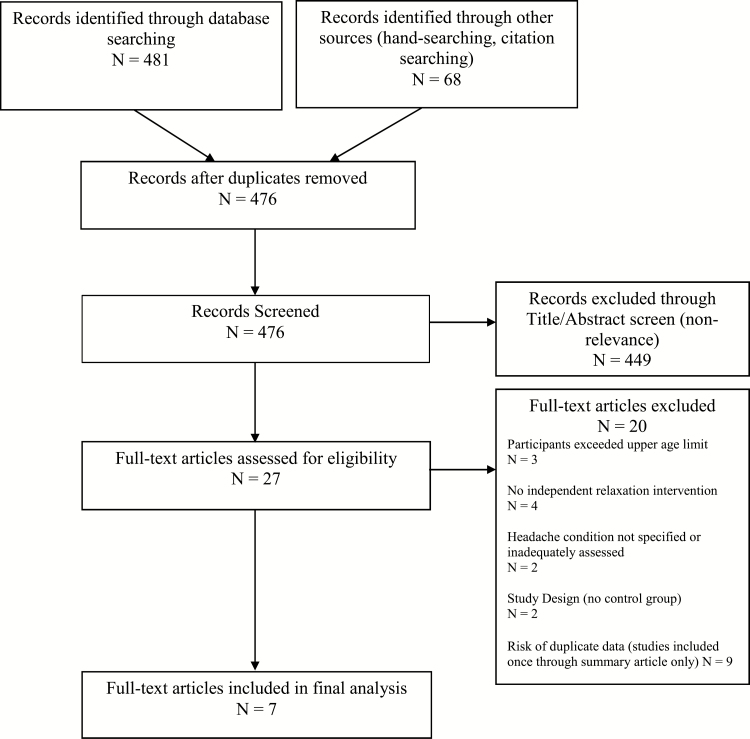
The objective of this review was to assess the evidence on relaxation training for management of paediatric headaches. Our methodology was a rapid review of English-language peer reviewed published literature focused on studies evaluating relaxation training as a primary or adjunct management option for headache in a paediatric population (0 to 18 years of age). Seven studies involving 571 children were included in the review. The quality of evidence was very low using GRADE criteria. Headache frequency, duration, and intensity were the primary outcomes in the included studies. Results for the effects of relaxation training for paediatric headache are inconsistent. Four of the seven studies reported decreased headache frequency, two of the five studies reported decreased headache duration, and two of the six studies reported decreased headache intensity following relaxation training. No adverse events were reported. The current state of the evidence for relaxation training for management of paediatric headache is both inconsistent and of very low quality. High-quality research evaluating the effects of relaxation training for paediatric headaches is required to advance the field.
Keywords: Headache; Migraine; Paediatric; Relaxation; Review.
Figures
References
-
- Gofshteyn JS, Stephenson DJ. Diagnosis and management of childhood headache. Curr Probl Pediatr Adolesc Health Care 2016;46(2):36–51. - PubMed
-
- Hershey AD. Pediatric headache. Continuum (Minneap Minn) 2015;21(4 Headache):1132–45. - PubMed
-
- Abu-Arafeh I, Razak S, Sivaraman B, Graham C. Prevalence of headache and migraine in children and adolescents: A systematic review of population-based studies. Dev Med Child Neurol 2010;52(12):1088–97. - PubMed
-
- U.S. Department of Health and Human Services, National Institutes of Health, National Center for Complementary and Alternative Medicine. Exploring the science of complementary and alternative medicine: third strategic plan 2011–2015 [Internet]. Washington, DC: National Center for Complementary and Alternative Medicine; 2011; 2015 (cited March 30, 2017). Report No.: NIH Publication Number 11–7643, D45. Available from: https://nccih.nih.gov/sites/nccam.nih.gov/files/about/plans/2011/NCCAM_S... (Accessed March 30, 2017).
-
- Trautmann E, Lackschewitz H, Kröner-Herwig B. Psychological treatment of recurrent headache in children and adolescents–a meta-analysis. Cephalalgia 2006;26(12):1411–26. - PubMed
Publication types
LinkOut - more resources
Full Text Sources