


Vaccine hesitancy: An overview on parents' opinions about vaccination and possible reasons of vaccine refusal
- PMID: 30997357
- PMCID: PMC6444379
- DOI: 10.4081/jphr.2019.1436
Vaccine hesitancy: An overview on parents' opinions about vaccination and possible reasons of vaccine refusal
Abstract
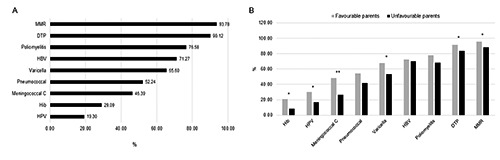
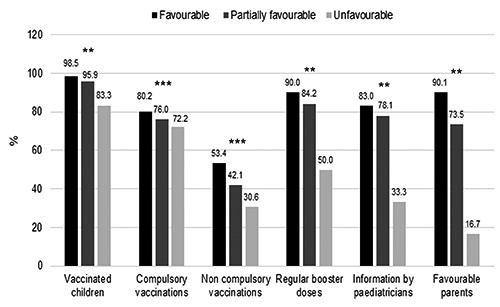
Background. Vaccine hesitancy has increased worldwide with a subsequent decreasing of vaccination rates and outbreaks of vaccine-preventable diseases (i.e. measles, poliomyelitis and pertussis) in several developed countries, including Italy. Design and Methods. We conducted a survey to investigate the attitudes of a parents' sample about vaccinations by the distribution of questionnaires in six lower secondary schools of the Italian city of Messina. Results. Regarding vaccinations carried out on children, the declared vaccination coverage rates ranged widely between good coverage percentages for some vaccinations (Measles-Mumps-Rubella, Diphtheria-Tetanus-Pertussis), and very low coverage rates for others, especially for "new" vaccinations (HPV, meningococcal, pneumococcal). The vaccinations carried out correlated negatively with both parents' age and their level of education. Moreover, a favourable parents' opinion was strongly influenced by a favourable opinion of the physician, while an unfavourable parents' opinion seemed conditioned by a direct or indirect knowledge of people harmed by vaccines. In addition, our data show that parents do not often know or partially know the real composition of the vaccines and the diseases prevented by vaccinations. Conclusions. Data analysis shows that parents are, theoretically, favourable towards vaccinations but have little knowledge of such practices, sometimes not being unaware of the types of vaccines administrated to their children. Health education and communication of correct information are certainly the cornerstones to improve the situation and to fight the widespread and non-grounded fears about vaccines.
Keywords: Health Education; Hesitancy; Prevention; Vaccines.
Conflict of interest statement
Conflict of interest: the authors declare no potential conflict of interests.
Figures
References
-
- Centers for Disease Control and Prevention. Ten great public health achievements-United States, 1900-1999. MMWR Morb Mortal Wkly Rep 1999;48:241-3. Available from: https://www.cdc.gov/mmwr/preview/mmwrhtml/00056796.htm. - PubMed
-
- World Health Organization. Immunization summary - A statistical reference containing data through. 2013. Available from: http://www.who.int/immunization/monitoring_surveillance/Immunization_Sum...
-
- Omer SB, Salmon DA, Orenstein WA, et al. Vaccine refusal, mandatory immunization, and the risks of vaccine-preventable diseases. N Engl J Med 2009;360:1981-8. - PubMed
-
- Glanz JM, Newcomer SR, Narwaney KJ, et al. A population-based cohort study of undervaccination in 8 managed care organizations across the United States. JAMA Pediatr 2013;167:274-81. - PubMed
LinkOut - more resources
Full Text Sources
Medical
