. 2019 Jun 4;47(10):5260-5275.
doi: 10.1093/nar/gkz254.

Single-stranded regions modulate conformational dynamics and ATPase activity of eIF4A to optimize 5'-UTR unwinding

Affiliations

Single-stranded regions modulate conformational dynamics and ATPase activity of eIF4A to optimize 5'-UTR unwinding

Alexandra Zoi Andreou et al. Nucleic Acids Res. .

Abstract

Eukaryotic translation initiation requires unwinding of secondary structures in the 5'-untranslated region of mRNA. The DEAD-box helicase eIF4A is thought to unwind structural elements in the 5'-UTR in conjunction with eIF4G and eIF4B. Both factors jointly stimulate eIF4A activities by modulation of eIF4A conformational cycling between open and closed states. Here we examine how RNA substrates modulate eIF4A activities. The RNAs fall into two classes: Short RNAs only partially stimulate the eIF4A ATPase activity, and closing is rate-limiting for the conformational cycle. By contrast, longer RNAs maximally stimulate ATP hydrolysis and promote closing of eIF4A. Strikingly, the rate constants of unwinding do not correlate with the length of a single-stranded region preceding a duplex, but reach a maximum for RNA with a single-stranded region of six nucleotides. We propose a model in which RNA substrates affect eIF4A activities by modulating the kinetic partitioning of eIF4A between futile, unproductive, and productive cycles.


Figures

Figure 1.
Figure 1.
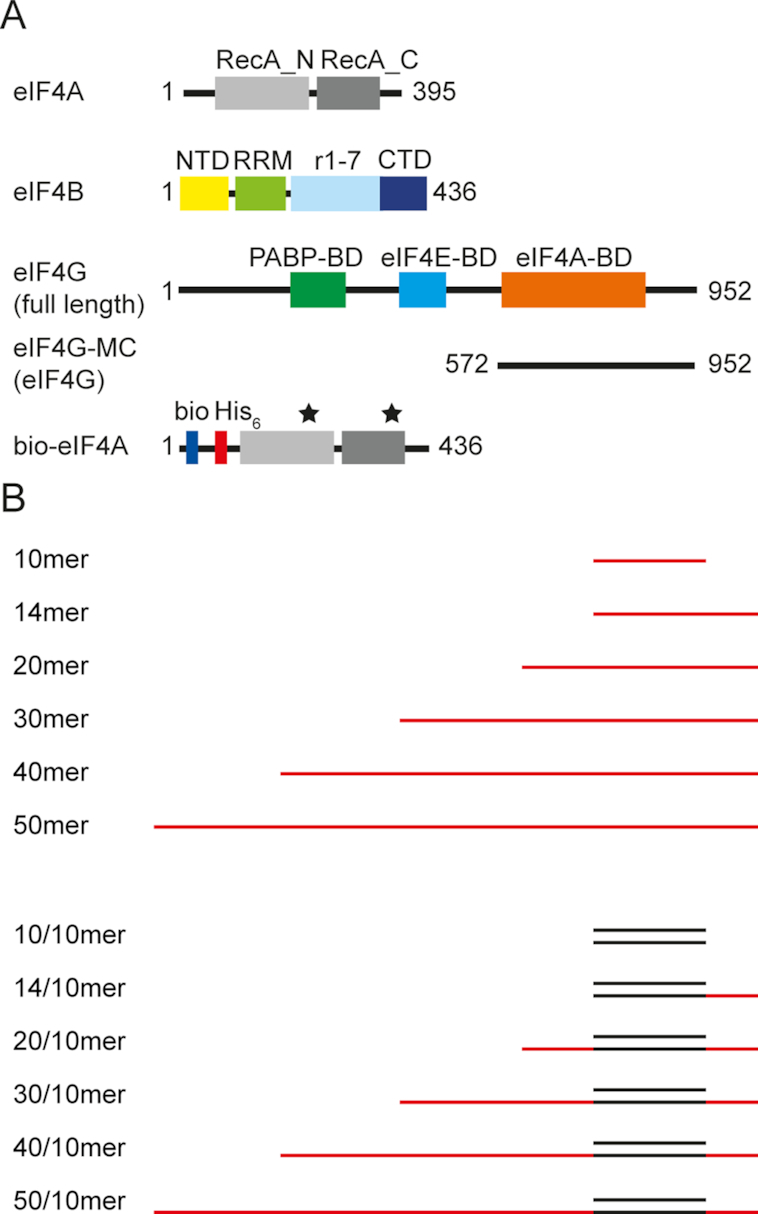
Constructs and RNA substrates used in this study. (A) Experiments were performed with full-length S. cerevisiae eIF4A and eIF4B, and a deletion variant of full-length eIF4G comprising the middle and C-terminal domains (eIF4G-MC, amino acids 572–952, referred to as eIF4G throughout). For smFRET experiments, the biotinylated eIF4A_Q186/G370C variant was used (18,19,25). bio: Biotin, His6: hexa-Histidine-tag. The black stars mark the positions of cysteines for fluorescent labeling. (B) Single-stranded RNA substrates of different lengths (10mer, 14mer, 20mer, 30mer, 40mer, 50mer) and double-stranded RNA substrates with a 10 bp duplex flanked by 5′-single-stranded regions of different lengths (10/10mer, 14/10mer, 20/10mer, 30/10mer, 40/10mer, 50/10mer). See Materials and Methods for sequences.
Figure 2.
Figure 2.
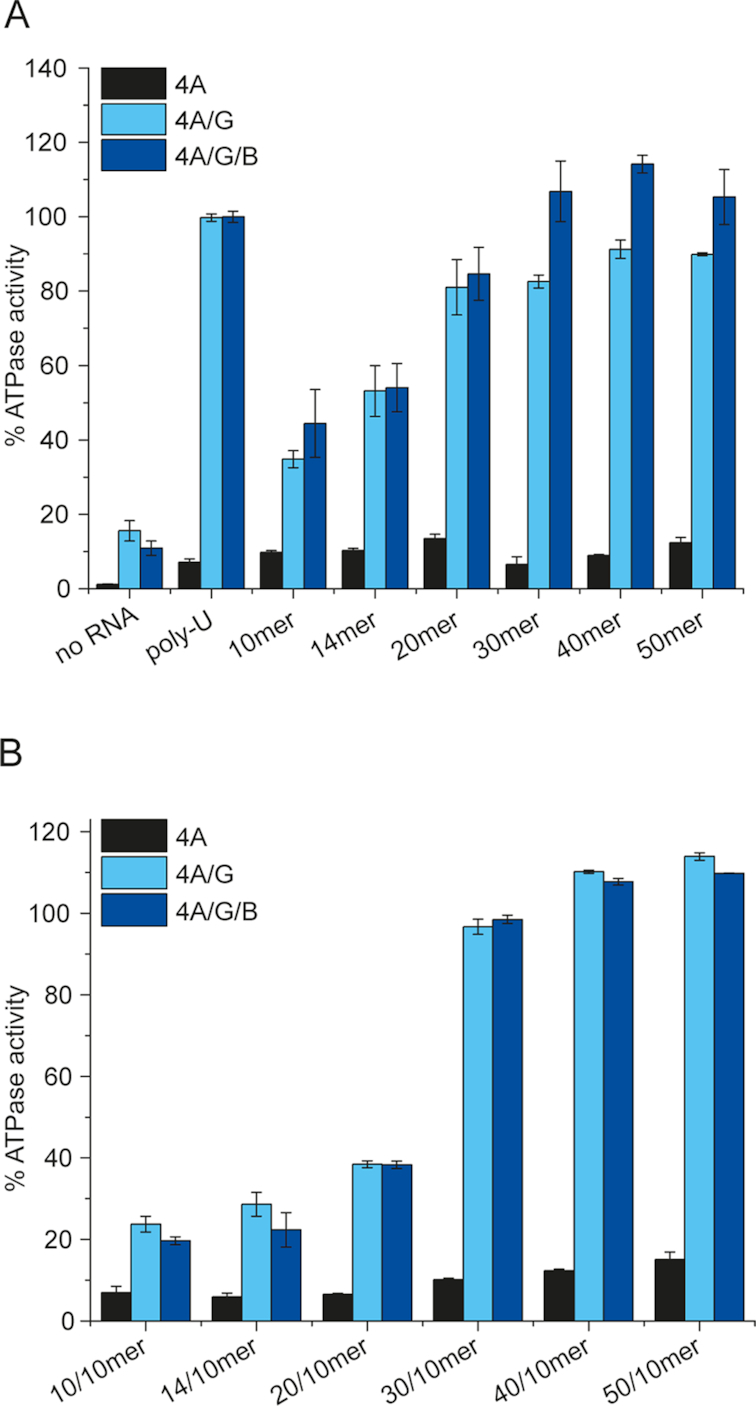
Dependence of the eIF4A steady-state ATPase activity on the length of the RNA substrate and of single-stranded 5′-tails. (A) Rate constant of ATP hydrolysis as a function of length of single-stranded RNA, relative to the ATP hydrolysis in the presence of poly-U RNA (set to 100%, typical values for the rate of ATP hydrolysis in the presence of poly-U RNA range between 70 and 100 × 10−3 s−1). Experiments were performed with 1 μM eIF4A, 2 μM eIF4B and eIF4G, 15 μM RNA (molecular concentration), 2 mM ATP in 30 mM HEPES/KOH, pH 7.4, 100 mM KOAc, 3 mM Mg(OAc)2, 2 mM DTT at 25°C. (B) Rate constant of ATP hydrolysis as a function of length of the 5′-single-stranded region flanking a 10 bp duplex. Black: eIF4A, light blue: eIF4A/eIF4G, dark blue: eIF4A, eIF4B, and eIF4G. Rate constants are given relative to the turnover number in the presence of poly-U RNA (see panel A), which was set to 100%. Experiments were performed at least twice; error bars reflect the standard error of the mean (n = 2) or the standard deviation (n > 2).
Figure 3.
Figure 3.
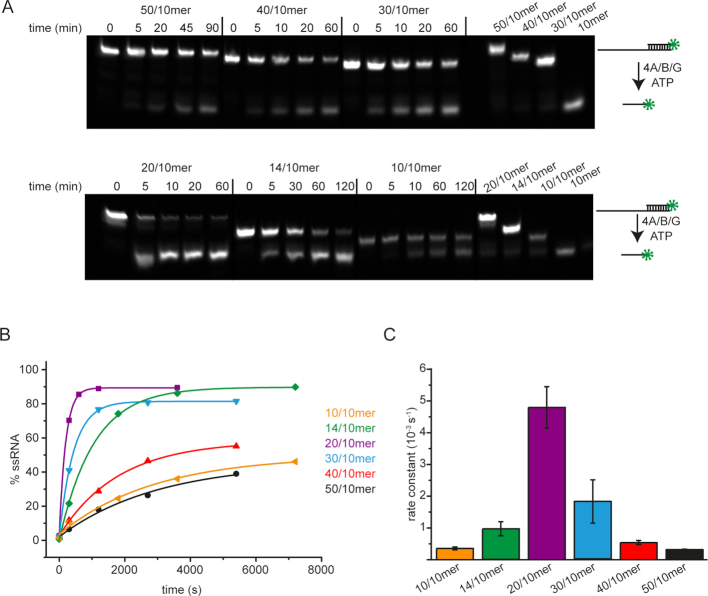
Unwinding of the 10/10mer, 14/10mer, 20/10mer, 30/10mer, 40/10mer, and 50/10mer RNAs. (A) Unwinding of the 10/10mer, 14/10mer, 20/10mer, 30/10mer, 40/10mer, and 50/10mer RNAs (0.5 μM) by 5 μM eIF4A in the presence of 5 μM eIF4B and eIF4G in 30 mM HEPES/KOH, pH 7.4, 100 mM KOAc, 3 mM Mg(OAc)2, 2 mM DTT at 25°C. 5 μM of 10mer RNA was added as a trap to ensure single-turnover conditions. Reactions were started by addition of of 3 mM ATP, and stopped at indicated time points, followed by separation of substrate and product by native gel electrophoresis (see Methods). The 10/10mer, 14/10mer, 20/10mer, 30/10mer, 40/10mer, and 50/10mer RNAs in the absence of proteins were included as a control. The green star marks the position of the FAM label used for fluorescence detection of the RNA. (B) Time traces of unwinding, obtained by densitometric quantification of double-stranded substrate and single-stranded product. (C) Rate constants of RNA unwinding for the different RNAs. Rate constants were obtained by analyzing time traces (see B) with single-exponential functions. Error bars depict the standard deviation from at least three independent experiments.
Figure 4.
Figure 4.
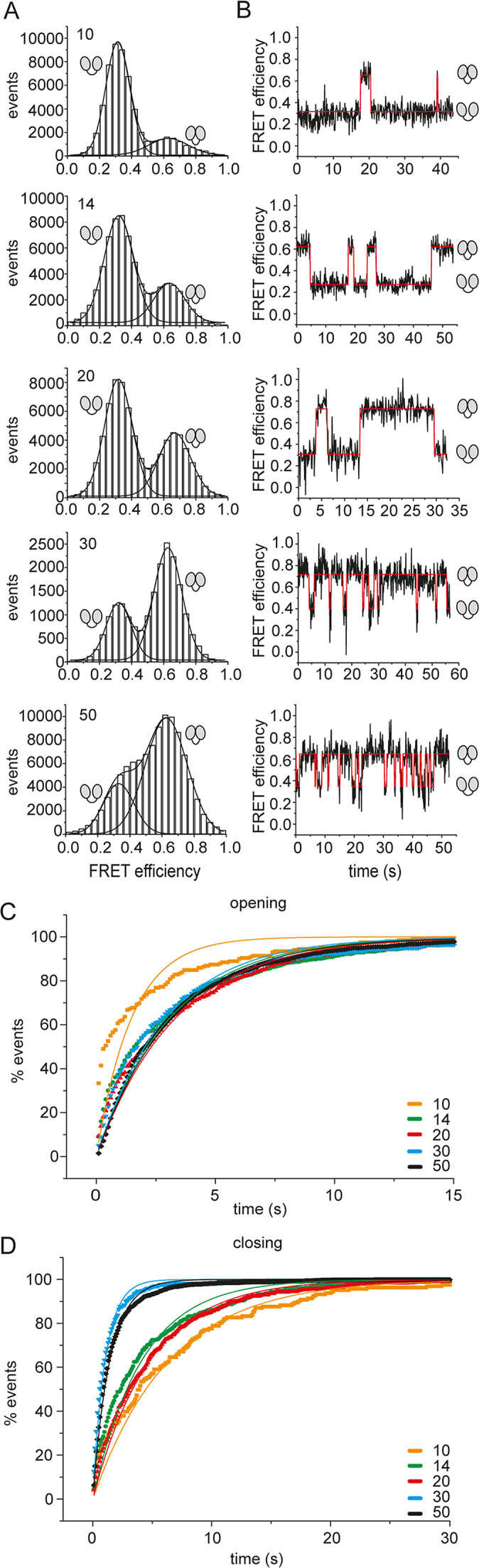
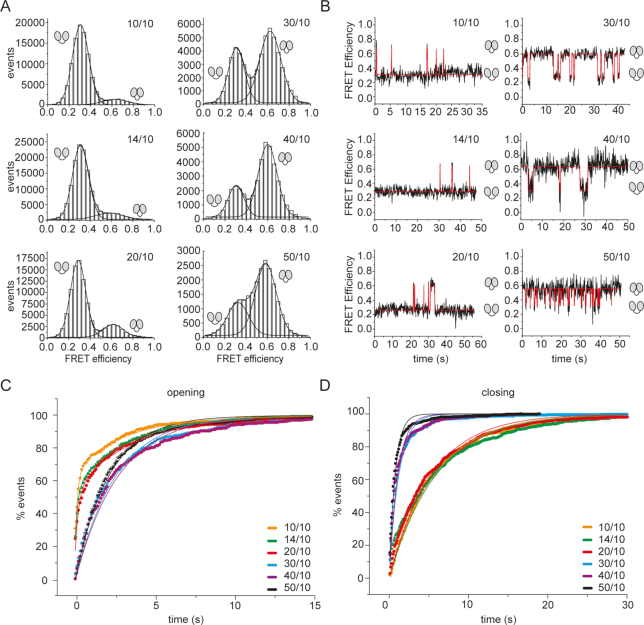
Effect of single-stranded RNAs of different lengths on the eIF4A conformational cycle. (A) FRET histograms for eIF4A in the presence of eIF4B, eIF4G, and the 10mer, 14mer, 20mer, 30mer, 40mer, or 50mer single-stranded RNAs. Experiments were performed with biotinylated, donor/acceptor-labeled, surface-immobilized eIF4A in the presence of 10 μM eIF4B and eIF4G, and 15 μM of the 10mer, 14mer, 20mer, 30mer, 40mer, or 50mer RNA, and 3 mM ATP in 50 mM Tris/HCl, pH 7.5, 80 mM KCl, 2.5 mM MgCl2, 1 mM DTT and 1% glycerol at 25°C. (B) Representative FRET time traces. (C) Normalized cumulative dwell time histograms for opening and single-exponential fits. See Supplementary Figure S2A for analyses with single-exponential functions and the respective residuals, Supplementary Figure S3A for analyses with double-exponential functions and residuals, and Supplementary Table S1 for corrected R2-values. (D) Normalized cumulative dwell time histograms for closing and single-exponential fits. See Supplementary Figure S2B for single-exponential fits and respective residuals, Supplementary Figure S3B for double-exponential fits and residuals, and Supplementary Table S1 for corrected R2-values. The cartoons indicate the low-FRET (half-)open conformation and the high-FRET closed state of eIF4A.
Figure 5.
Figure 5.
Effect of 5′-single-stranded regions of different lengths on the eIF4A conformational cycle. (A) FRET histograms for eIF4A in the presence of 10 μM eIF4B and eIF4G and 15 μM of the 10/10mer, 14/10mer, 20/10mer, 30/10mer, 40/10mer, or 50/10mer RNA. Experiments were performed in 50 mM Tris/HCl, pH 7.5, 80 mM KCl, 2.5 mM MgCl2, 1 mM DTT, and 1% glycerol in the presence of 3 mM ATP at 25°C. (B) Representative FRET time traces. (C) Cumulative dwell time histograms for opening, double-exponential (10/10mer, 14/10mer, 20/10mer) and single-exponential fits (30/10mer, 40/10mer, 50/10mer). (D) Cumulative dwell time histograms for closing and single-exponential fits. See Supplementary Figure S4 for analyses with single-exponential functions and residuals obtained, Supplementary Figure S5 for analyses with double-exponential functions and residuals. The corrected R2-values are summarized in Supplementary Table S1.
Figure 6.
Figure 6.
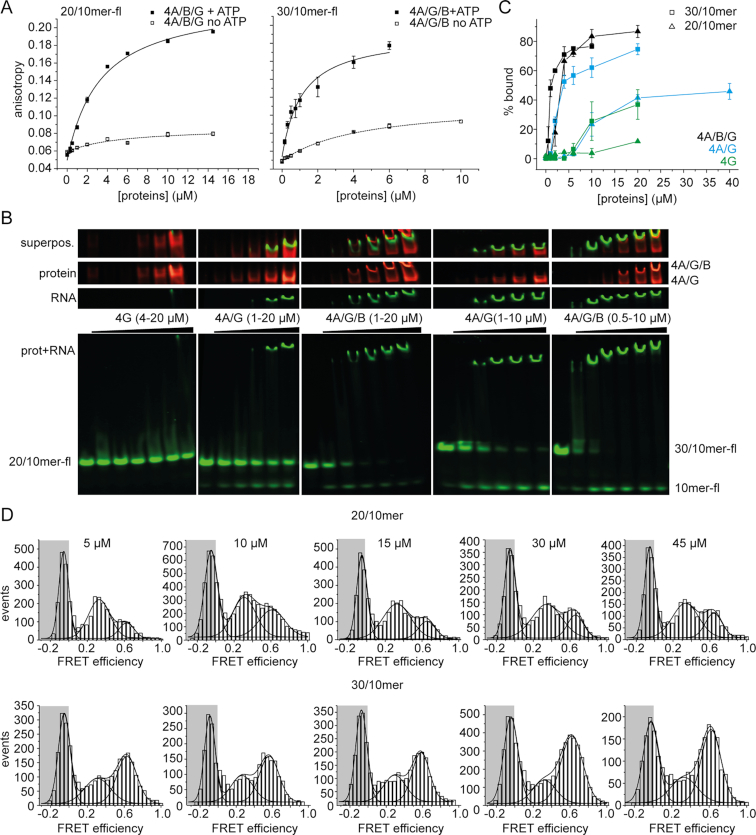
Interaction of eIF4A with 20/10mer and 30/10mer RNA. (A) Anisotropy titrations of fluorescein-labeled 20/10mer and 30/10mer RNAs with eIF4A/B/G in the absence (open squares) and presence of 5 mM ATP (filled squares). Titrations were performed in 30 mM HEPES/KOH, pH 7.4, 100 mM KOAc, 3 mM Mg(OAc)2, and 2 mM DTT at 25°C. Error bars depict the standard error of the mean from two independent experiments. (B) Electrophoretic mobility shift assay of 100 nM fluorescein-labeled 20/10- and 30/10mer with increasing concentrations of eIF4G, eIF4A/G and eIF4A/B/G in 30 mM HEPES/KOH, pH 7.4, 100 mM KOAc, 3 mM Mg(OAc)2, 2 mM DTT in the presence of 5 mM ATP and 0.4 U/μl of RNase inhibitor, incubated for 10 min at 25°C. To regenerate ATP, 23 μg/ml pyruvate kinase and 1 mM phoshoenolpyruvate were added. 1% of eIF4G is labeled with Alexa647 (red), the 10mer of the RNA substrate is labeled with fluorescein (fl; green). A representative gel from two independent EMSAs is shown. Note that these epxeriments were performed with an excess of translation initiation factors, such that under saturation all of the RNA is protein-bound, but only a small fraction of the translation factors is bound to RNA. See Supplementary Figure S8 for control experiments with labeled eIF4A and labeled eIF4B. (C) Quantification of RNA-bound complexes of eIF4G, eIF4A/G, and eIF4A/B/G from B. Error bars depict either the error of the mean from two independent experiments (20/10mer, eIF4G; 20/10mer, eIF4A, eIF4G, eIF4B) or the standard deviation from at least three independent experiments (all other experiments). (D) smFRET experiments in presence of different concentrations of 20/10mer and 30/10mer RNAs. 100 pM biotinylated eIF4A_Q186C/G370C, labeled with Alexa488-maleimide (A488, donor) and Alexa546-maleimide (A546, acceptor), in 50 mM Tris/HCl, pH 7.5, 80 mM KCl, 2.5 mM MgCl2, 1 mM DTT, and 1% glycerol in the presence of 3 mM ATP, 10 μM eIF4B and eIF4G, and 5, 10, 15, 30, and 45 μM RNA at 25°C.
Figure 7.
Figure 7.
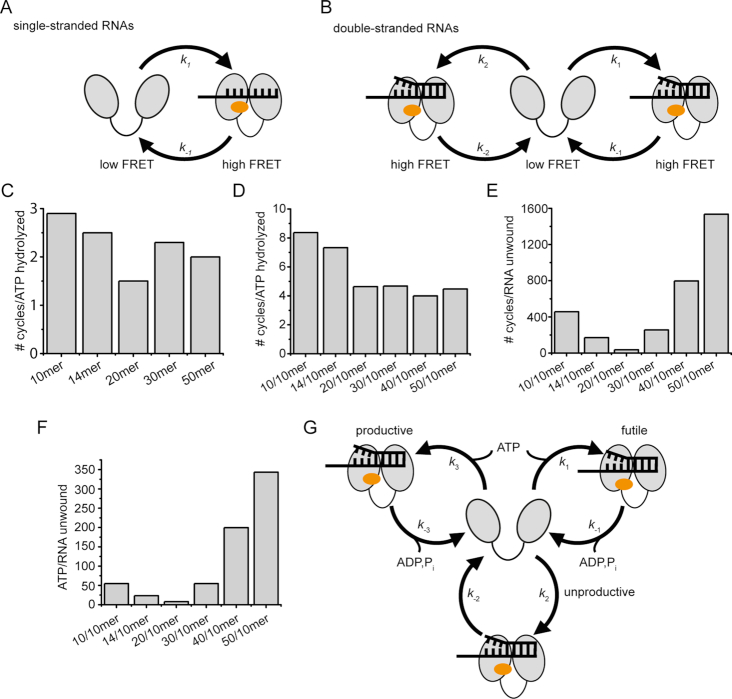
Kinetic models for conformational cycling of eIF4A, and comparison of conformational dynamics, ATP hydrolysis, and RNA unwinding. (A) Kinetic model for eIF4A conformational changes in the presence of single-stranded RNAs and RNAs with long 5′-single-stranded regions. (B) Kinetic model for conformational cycling in the presence of RNAs with no or short 5′-single-stranded regions. (C) Coupling of conformational cycling to ATP hydrolysis in the presence of single-stranded RNAs. The number of conformational cycles per ATP hydrolyzed is independent of the length of the RNA. (D) Number of conformational cycles per ATP hydrolyzed in the presence of double-stranded RNAs. (E) Number of conformational cycles per RNA unwound. In the presence of the 20/10mer RNA, eIF4A undergoes the minimal number of approx. 37 conformational cycles per RNA unwound. (F) Coupling of ATP hydrolysis to RNA unwinding. In the presence of the 20/10mer RNA, eIF4A hydrolyzes the minimal number of 8 ATP per RNA unwound. (G) Model linking eIF4A conformational cycling with ATP hydrolysis and RNA unwinding. eIF4A can undergo futile cycles (ATP hydrolysis, but no RNA unwinding), unproductive cycles (no ATP hydrolysis, no RNA unwinding), and productive cycles (ATP-dependent RNA unwinding). In productive cycles the first strand of an RNA duplex dissociates from eIF4A closed state, prior to ATP hydrolysis. In futile cycles the duplex dissociates from eIF4A without unwinding, and ATP is then hydrolyzed. In unproductive cycles, eIF4A undergoes conformational changes without ATP hydrolysis and unwinding. The kinetic competition of the individual cycles determines the coupling of conformational cycling, ATP hydrolysis, and RNA unwinding. The cartoons reflect the conformation of eIF4A in the presence of the translation initiation factors eIF4B and eIF4G. Note that for simplicity the closed states in the different conformational cycles in panels B and G are depicted identically, but reflect different physical states with different functional properties.

References

    1. Grifo J.A., Tahara S.M., Morgan M.A., Shatkin A.J., Merrick W.C.. New initiation factor activity required for globin mRNA translation. J. Biol. Chem. 1983; 258:5804–5810. - PubMed
    1. Neff C.L., Sachs A.B.. Eukaryotic translation initiation factors 4G and 4A from Saccharomyces cerevisiae interact physically and functionally. Mol. Cell Biol. 1999; 19:5557–5564. - PMC - PubMed
    1. Sonenberg N., Morgan M.A., Merrick W.C., Shatkin A.J.. A polypeptide in eukaryotic initiation factors that crosslinks specifically to the 5′-terminal cap in mRNA. Proc. Natl. Acad. Sci. U.S.A. 1978; 75:4843–4847. - PMC - PubMed
    1. Altmann M., Handschin C., Trachsel H.. mRNA cap-binding protein: cloning of the gene encoding protein synthesis initiation factor eIF-4E from Saccharomyces cerevisiae. Mol. Cell Biol. 1987; 7:998–1003. - PMC - PubMed
    1. Goyer C., Altmann M., Lee H.S., Blanc A., Deshmukh M., Woolford J.L. Jr, Trachsel H., Sonenberg N.. TIF4631 and TIF4632: two yeast genes encoding the high-molecular-weight subunits of the cap-binding protein complex (eukaryotic initiation factor 4F) contain an RNA recognition motif-like sequence and carry out an essential function. Mol. Cell Biol. 1993; 13:4860–4874. - PMC - PubMed

Publication types

MeSH terms