Review
. 2019 Oct;35(7):e3171.
doi: 10.1002/dmrr.3171. Epub 2019 May 9.

SGLT2 inhibition to address the unmet needs in diabetic nephropathy

Affiliations
Review

SGLT2 inhibition to address the unmet needs in diabetic nephropathy

Federica Barutta et al. Diabetes Metab Res Rev. 2019 Oct.

Abstract

Current treatment of diabetic nephropathy is effective; however, substantial gaps in care still remain and new therapies are urgently needed to reduce the global burden of the complication. Desirable properties of an "ideal" new drug should include primary prevention of microalbuminuria, additive/synergistic anti-proteinuric effect in combination therapy with renin angiotensin system blockers, reduction of chronic kidney disease progression to lower the risk of end-stage renal disease, and cardiovascular protection. Growing evidence suggests that sodium-glucose cotransporter 2 inhibitors (SGLT2i) may fulfil many of these criteria and represent novel tools to cover the unmet needs in diabetic nephropathy care. However, the underlying mechanisms of SGLT2i renal benefits are still poorly understood and promising results from cardiovascular outcome trials with SGLT2i need confirmation in dedicated renal outcome trials.

Keywords: GFR; SGLT2; albuminuria; diabetic nephropathy; experimental diabetes.


Conflict of interest statement

Gruden G. has received a speaker fee from MundiPharma.

Figures
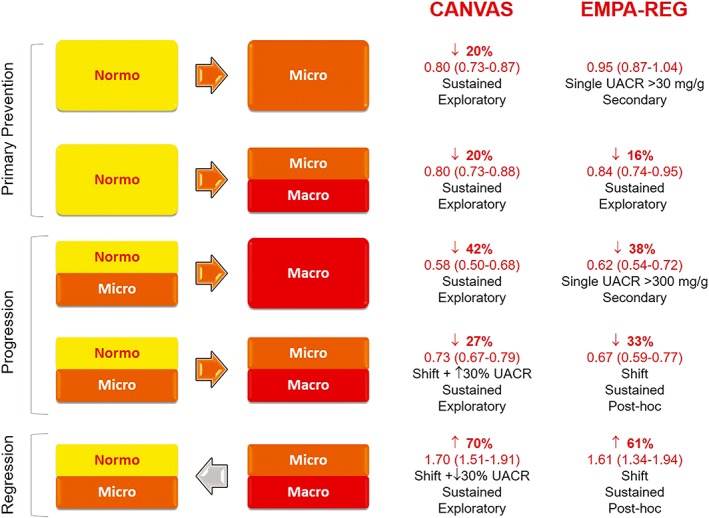
Figure 1
Figure 1
Effects of sodium‐glucose cotransporter 2 (SGLT2) inhibition on primary prevention, progression, and regression of albuminuria in the EMPA‐REG OUTCOME trial and the CANVAS Program. Hazard ratio (95% CI) are shown in red
Figure 2
Figure 2
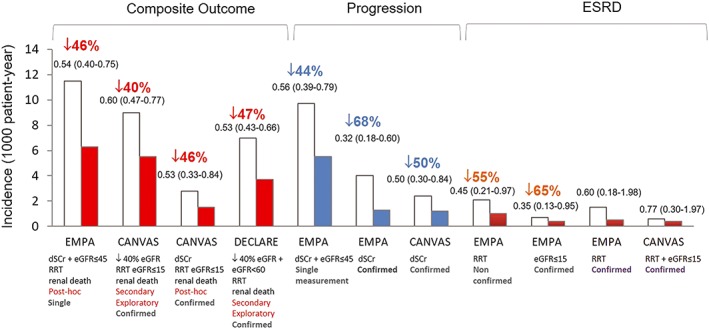
Renal outcomes in the EMPA‐REG OUTCOME (EMPA), CANVAS Program (CANVAS), and DERIVE‐TIMI 58 (DERIVE) trials. Data are expressed as incidence per 1000 patient‐year in SGLT2i‐treated (red bars: composite end‐point; blue bars: progression; brown bars: ESRD) and placebo‐treated patients (white bars). Hazard ratio (95% CI) values are also reported. On the x‐axis, it is specified: end‐point definition, type of variable (post‐hoc, secondary, exploratory) and whether analyses were based on either single or confirmed measurements. Comparison should be taken with caution because of differences in both study design and recruited subjects. ESRD, end‐stage renal disease; dSCr, doubling of serum creatinine; eGFR, estimated glomerular filtration rate (value expressed as mL/min/1.73 m2), RRT, renal replacement therapy
Figure 3
Figure 3
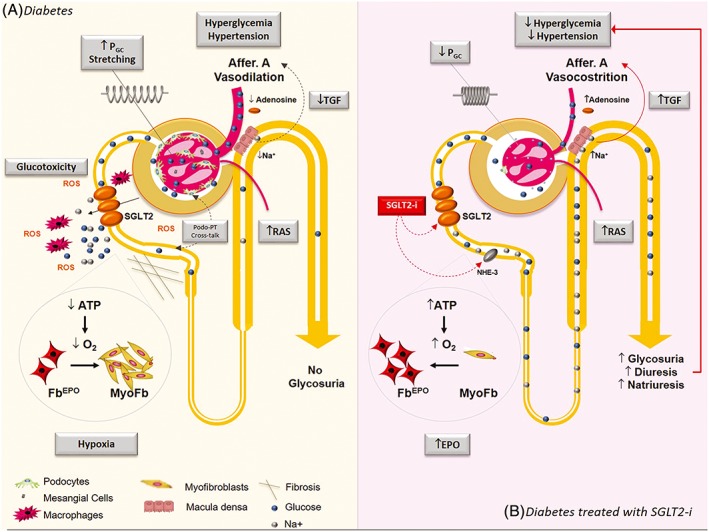
Mechanisms implicated in renal protective effect of sodium‐glucose cotransporter 2 (SGLT2) inhibition. A, In diabetes, both hyperglycaemia and systemic hypertension play a key role in the pathogenesis of the glomerular injury and enhanced SGLT2‐mediated glucose/Na+ reabsorption in the proximal tubule (PT) contribute to both. The reduced delivery of Na+ to the macula densa diminishes adenosine production and leads to afferent arteriole vasodilation. Deactivation of the tubular‐glomerular feedback (TGF) together with renin‐angiotensin‐system (RAS)‐mediated efferent arteriole vasoconstriction results in glomerular capillary hypertension (PGC) that induces hyperfiltration and glomerular volume expansion with cyclic stretching and damage of glomerular cells. Enhanced PT glucose reabsorption may cause inflammation, oxidative stress with reactive oxygen species (ROS) production, and fibrosis leading to tubule‐interstitial injury and possibly contributing to podocyte damage via PT‐podocyte cross talk. Finally, increased oxygen consumption in the renal cortex may contribute to renal fibrosis by inducing hypoxia and trans‐differentiation of erythropoietin‐producing fibroblasts (FBEPO) in profibrotic myofibroblasts (MyoFb). B, In patients treated with SGLT2 inhibitors (SGLT2i), enhanced glycosuria, natriuresis, and osmotic diuresis lower both blood glucose and blood pressure levels. By inhibiting Na+ reabsorption at both SGLT2 and Na+/H+ exchanger‐3 (NHE3) level, SGLT2i reactivate the TGF with lowering of PGC and reduced glomerular cell stretching. Reduced glucose reabsorption diminishes local glucotoxicity. Amelioration of renal cortex hypoxia allows myofibroblasts re‐differentiation in EPO‐producing cells reducing renal fibrosis and enhancing EPO production.

References

    1. Afkarian M, Zelnick LR, Hall YN, et al. Clinical manifestations of kidney disease among US adults with diabetes. 1988‐2014. JAMA. 2016;316(6):602‐610. - PMC - PubMed
    1. Saran R, Robinson B, Abbott KC, et al. US renal data system 2017 annual data report: epidemiology of kidney disease in the United States. Am J Kidney Dis. 2018;71(3S1):A7. - PMC - PubMed
    1. Levin A, Tonelli M, Bonventre J, et al. Global kidney health 2017 and beyond: a roadmap for closing gaps in care, research, and policy. Lancet. 2017;390(10105):1888‐1917. - PubMed
    1. Brenner BM, Cooper ME, de Zeeuw D, et al. Effects of losartan on renal and cardiovascular outcomes in patients with type 2 diabetes and nephropathy. N Engl J Med. 2001;345(12):861‐869. - PubMed
    1. Lewis EJ, Hunsicker LG, Bain RP, Rohde RD. The effect of angiotensin‐converting‐enzyme inhibition on diabetic nephropathy. The collaborative study group. N Engl J Med. 1993;329(20):1456‐1462. - PubMed

MeSH terms

Substances