


Review
doi: 10.1249/JES.0000000000000193.
The Panacea of Human Aging: Calorie Restriction Versus Exercise
Affiliations
- PMID: 30998529
- PMCID: PMC6579613
- DOI: 10.1249/JES.0000000000000193
Item in Clipboard
Review
The Panacea of Human Aging: Calorie Restriction Versus Exercise
Exerc Sport Sci Rev.
2019 Jul.
Abstract
Primary aging is the progressive decline in health and fitness and depends on metabolic rate and oxidative stress. Untoward changes in body composition and metabolic function characterize secondary aging. We hypothesize that both exercise and calorie restriction (CR) improve secondary aging, but only CR improves primary. However, CR followed with exercise is a superior strategy to maintain overall health and quality of life with age.
Trial registration: ClinicalTrials.gov NCT00427193 NCT02695511.
Conflict of interest statement
Figures
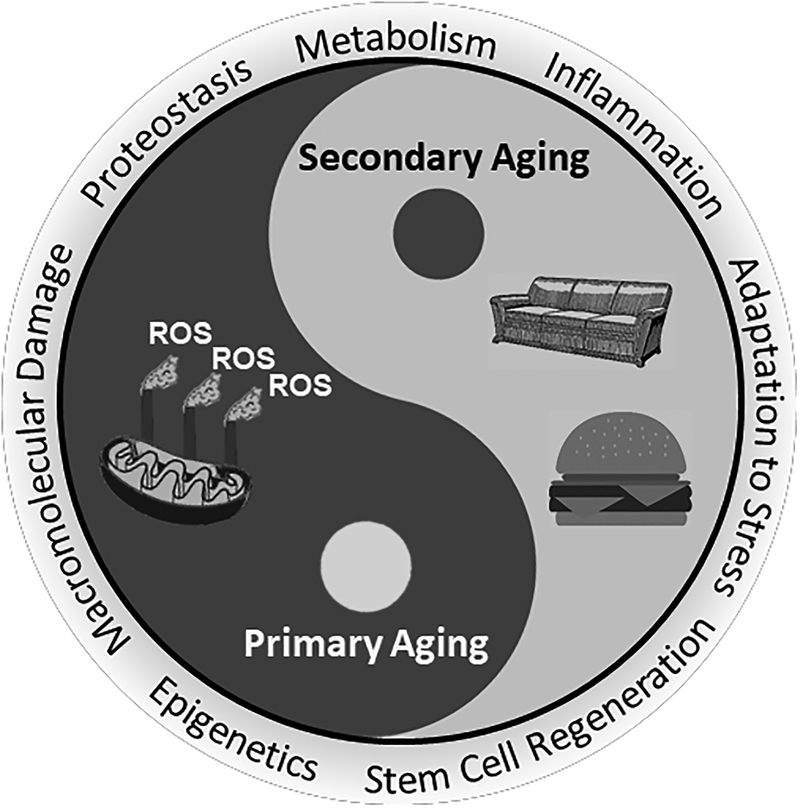
Schematic of the interplay between primary and secondary aging. Primary aging is an unavoidable consequence of living stemming from the accumulation of macromolecular damage during lifespan progression. These processes are cyclic, and thus continual oxidative damage favors further generation of ROS ultimately impairing homeostasis and function of cells and tissues, and hence defines primary aging. On the other hand, secondary aging results from external influences originating throughout the lifespan as the result of non-communicable diseases, environmental exposures, and social behaviors such as overeating or low physical activity. These two intertwined factors encompass the seven unique pillars of aging
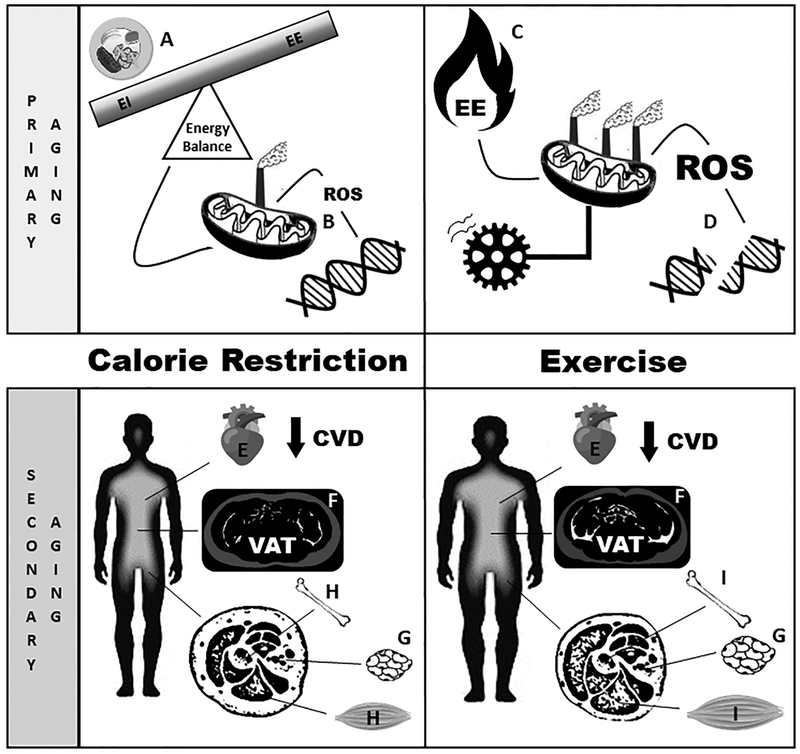
Schematic diagram representing the effect of calorie restriction (CR) and exercise on components of primary and secondary aging. Primary aging is the progressive physiological decline, which depends on in body functioning and depends on ones metabolic rate and oxidative stress. A.) CR exerts its effect on primary aging via reductions in energy intake and subsequently less flux of macronutrients through the mitochondria. B.) In turn, mitochondria release less reactive oxygen species (ROS) inducing a state of less oxidative damage to DNA. C.) On the other hand, exercise increases energy expenditure, which increases energy flux through the mitochondria and leads to higher generation of ROS and oxidative damage (D.). Secondary aging is defined as untoward change in body composition and metabolic function. E.) In regard to secondary aging, CR has been shown to improve biomarkers associated with cardiovascular disease (CVD) and reductions in adiposity. These reductions are primarily through decreases in both F.) visceral adipose tissue (VAT) and G.) subcutaneous adipose tissue. H.) However, CR also leads to loss of fat-free mass (muscle and bone). Likewise, exercise has shown to improve biomarkers associated with CVD (E.) and reduces adiposity (F., G.), albeit not to the extent of CR, but maintain fat-free mass (I.). CVD=cardiovascular disease, EE=energy expenditure, EI=energy intake, ROS=reactive oxygen species, VAT=visceral adipose tissue.
References
Publication types
MeSH terms
Associated data
Grants and funding
LinkOut - more resources
Full Text Sources
Other Literature Sources
Medical
