


Probing the Substrate Promiscuity of Isopentenyl Phosphate Kinase as a Platform for Hemiterpene Analogue Production
- PMID: 30998839
- PMCID: PMC6818514
- DOI: 10.1002/cbic.201900135
Probing the Substrate Promiscuity of Isopentenyl Phosphate Kinase as a Platform for Hemiterpene Analogue Production
Abstract
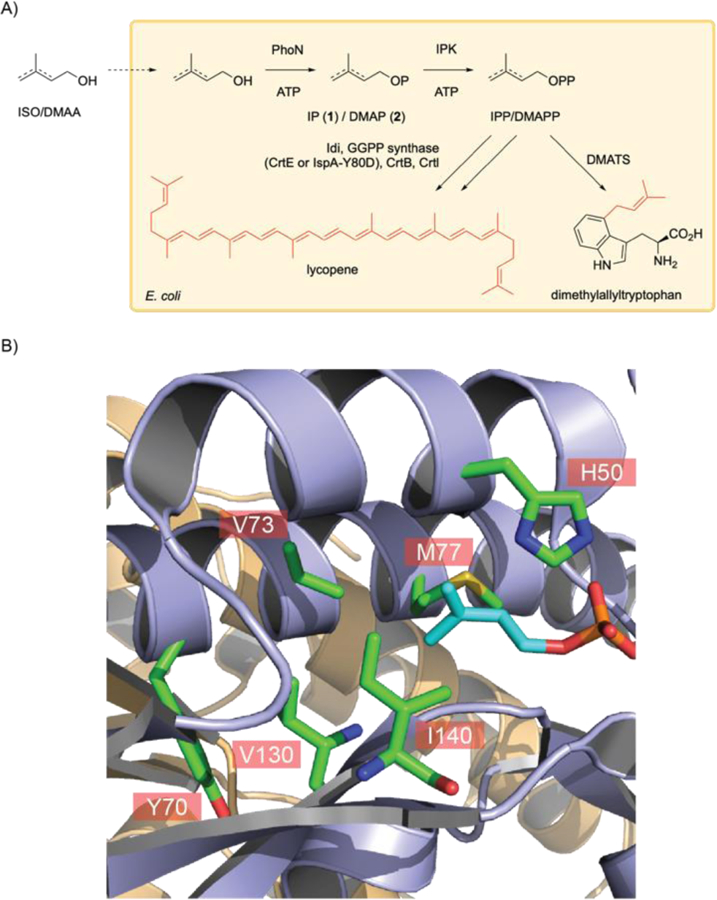
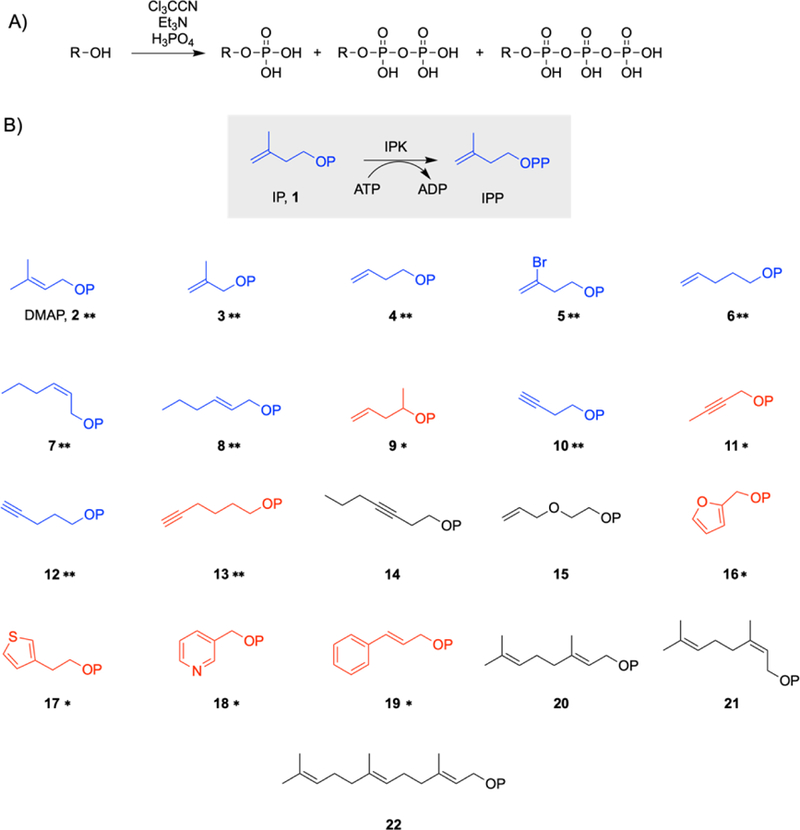
Isoprenoids are a large class of natural products with wide-ranging applications. Synthetic biology approaches to the manufacture of isoprenoids and their new-to-nature derivatives are limited due to the provision in nature of just two hemiterpene building blocks for isoprenoid biosynthesis. To address this limitation, artificial chemo-enzymatic pathways such as the alcohol-dependent hemiterpene (ADH) pathway serve to leverage consecutive kinases to convert exogenous alcohols into pyrophosphates that could be coupled to downstream isoprenoid biosynthesis. To be successful, each kinase in this pathway should be permissive of a broad range of substrates. For the first time, we have probed the promiscuity of the second enzyme in the ADH pathway-isopentenyl phosphate kinase from Thermoplasma acidophilum-towards a broad range of acceptor monophosphates. Subsequently, we evaluate the suitability of this enzyme to provide unnatural pyrophosphates and provide a critical first step in characterizing the rate-limiting steps in the artificial ADH pathway.
Keywords: hemiterpenes; kinases; phosphorylation; synthetic biology; terpenoids.
© 2019 Wiley-VCH Verlag GmbH & Co. KGaA, Weinheim.
Figures
References
-
- Beller HR, Lee TS, Katz L, Nat. Prod. Rep 2015, 32, 1508–1526; - PubMed
- Wang C, Zada B, Wei G, Kim SW, Bioresour. Technol 2017, 241, 430–438; - PubMed
- Vickers CE, Williams TC, Peng B, Cherry J, Curr. Opin. Chem. Biol 2017, 40, 47–56; - PubMed
- Buckingham J, Cooper CM, Purchase R, Natural Products Reference Desk, CRC Press, Taylor & Francis Group, Boca Raton, FL, 2016.
Publication types
MeSH terms
Substances
Grants and funding
LinkOut - more resources
Full Text Sources
Molecular Biology Databases
