Review
. 2019 Aug:200:42-54.
doi: 10.1016/j.pharmthera.2019.04.005. Epub 2019 Apr 16.

Mesenchymal stem cells: From regeneration to cancer

Affiliations
Review

Mesenchymal stem cells: From regeneration to cancer

Peishan Li et al. Pharmacol Ther. 2019 Aug.

Abstract

Mesenchymal stem cells (MSCs) are multipotent tissue stem cells that differentiate into a number of mesodermal tissue types, including osteoblasts, adipocytes, chondrocytes and myofibroblasts. MSCs were originally identified in the bone marrow (BM) of humans and other mammals, but recent studies have shown that they are multilineage progenitors in various adult organs and tissues. MSCs that localize at perivascular sites function to rapidly respond to external stimuli and coordinate with the vascular and immune systems to accomplish the wound healing process. Cancer, considered as wounds that never heal, is also accompanied by changes in MSCs that parallels the wound healing response. MSCs are now recognized as key players at distinct steps of tumorigenesis. In this review, we provide an overview of the function of MSCs in wound healing and cancer progression with the goal of providing insight into the development of novel MSC-manipulating strategies for clinical cancer treatment.

Keywords: Cancer; Mesenchymal stem cells; Regeneration; Tumor microenvironment; Wound healing.


Conflict of interest statement

Conflict of Interest Statement

The authors declare that there are no conflicts of interest.

Figures
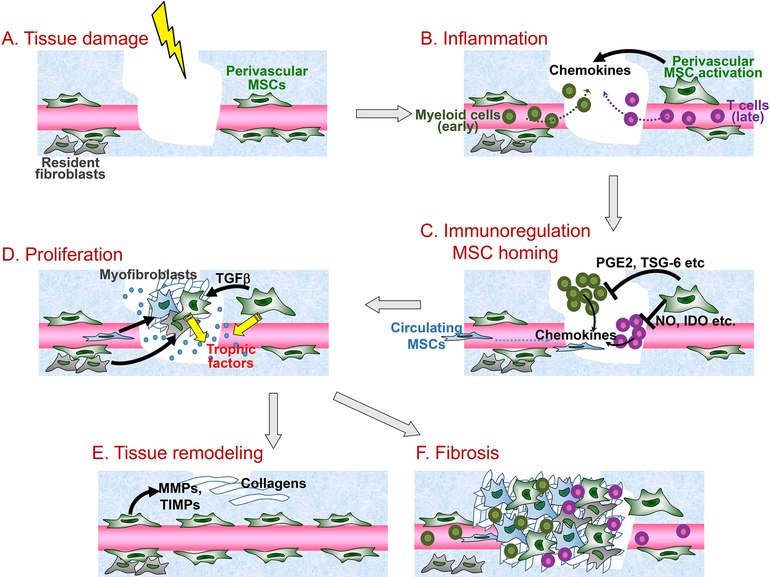
Figure 1.
Figure 1.. Participation of MSCs in distinct steps of wound healing
MSCs are involved in all stages of wound healing. (A) After tissue damage, perivascular MSCs are activated. (B) At the inflammation stage, MSCs recruit both innate and adaptive immune cells via secretion of chemokines. (C) Through negative feedback loops, MSCs regulate the immune response (immunoregulation) by suppressing excessive innate and adaptive immune cell activities through release of prostaglandin E2 (PGE2), TSG-6, nitric oxide (NO), indoleamine 2, 3-dioxygenase (IDO) and others. In the meantime, chemokines produced by immune cells and stromal cells further recruit BM- and other tissue-derived MSCs (MSC homing). (D) MSCs then differentiate into myofibroblasts via transforming growth factor beta (TGFβ) signaling and also produce a series of trophic factors to support tissue cell proliferation to accomplish re-epithelialization, fibroplasia and revascularization. (E) At the tissue remodeling stage, MSCs express matrix metalloproteinases (MMPs) as well as tissue inhibitor of metallopeptidases (TIMPs) to re-organize the extracellular matrix (ECM) structures leading to scar formation and wound repair. (F) In the cases of chronic inflammation and infection, the dysregulated MSC differentiation program can result in uncontrolled myofibroblast generation, causing tissue fibrosis.
Figure 2.
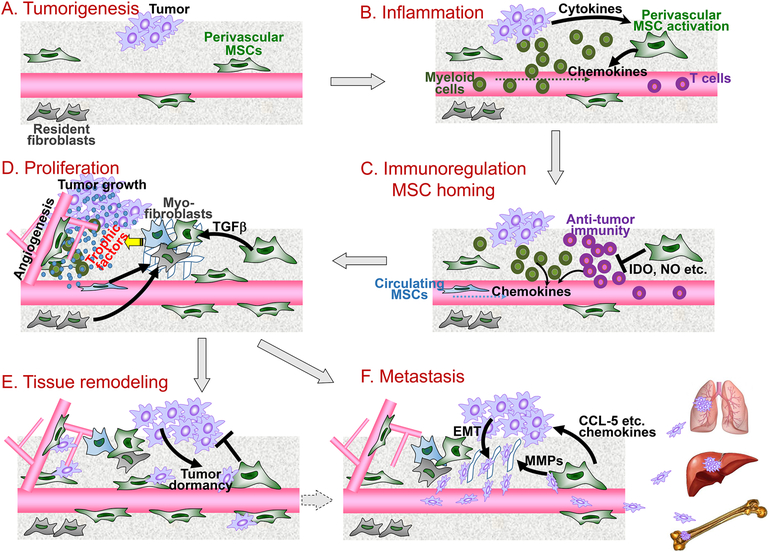
Figure 2.. Roles of tumor-associated MSCs (TA-MSCs) in the tumor “wounds”
TA-MSCs are essential for distinct steps of cancer progression from the view of cancer as “wounds”. (A) During tumorigenesis, perivascular MSCs are activated. (B) Inflammatory cytokines stimulate TA-MSCs to produce myeloid cell chemokines which recruit inflammatory cells to the tumor microenvironment causing an aggravated inflammation. (C) TA-MSCs suppress anti-tumor adaptive immunity through immunosuppressive effector molecules IDO, NO, and others. Guided by the chemotactic cues, circulating MSCs home to the tumor sites. (D) TA-MSCs are further differentiated into myofibroblasts (or CAFs), and both TA-MSCs and myofibroblasts produce trophic factors to support tumor cell proliferation and angiogenesis. (E) At the tissue remodeling stage, TA-MSCs may suppress the outgrowth of tumor cells while impelling them to enter dormancy. Such a dormant cancer stem cell status plays a key role in tumor recurrence and therapeutic resistance. (F) TA-MSCs secrete multiple chemokines and also stimulate the tumor cells to undergo epithelial–mesenchymal transition (EMT) which instigates tumor cell invasion and metastasis to distant organs such as lung, liver and bone.

References

    1. Aggarwal S, & Pittenger MF (2005). Human mesenchymal stem cells modulate allogeneic immune cell responses. Blood, 105(4), 1815–1822. - PubMed
    1. Ahn S, & Joyner AL (2004). Dynamic changes in the response of cells to positive hedgehog signaling during mouse limb patterning. Cell, 118(4), 505–516. - PubMed
    1. Alcayaga-Miranda F, Cuenca J, Martin A, Contreras L, Figueroa FE, & Khoury M (2015). Combination therapy of menstrual derived mesenchymal stem cells and antibiotics ameliorates survival in sepsis. Stem Cell Res Ther, 6, 199. - PMC - PubMed
    1. Alexeev V, Donahue A, Uitto J, & Igoucheva O (2013). Analysis of chemotactic molecules in bone marrow-derived mesenchymal stem cells and the skin: Ccl27-Ccr10 axis as a basis for targeting to cutaneous tissues. Cytotherapy, 15(2), 171–184e171. - PMC - PubMed
    1. Anjos-Afonso F, Siapati EK, & Bonnet D (2004). In vivo contribution of murine mesenchymal stem cells into multiple cell-types under minimal damage conditions. J Cell Sci, 117(Pt 23), 5655–5664. - PubMed

Publication types