Prognostic Value of Post-diagnosis Health-Related Quality of Life for Overall Survival in Breast Cancer: Findings from a 10-Year Prospective Cohort in Korea
- PMID: 30999723
- PMCID: PMC6790846
- DOI: 10.4143/crt.2018.426
Prognostic Value of Post-diagnosis Health-Related Quality of Life for Overall Survival in Breast Cancer: Findings from a 10-Year Prospective Cohort in Korea
Abstract
Purpose: We aimed to evaluate health-related quality of life (HRQOL) at 1-year post-diagnosis in breast cancer (BC) patients and its association with overall survival using data from the National Cancer Center Hospital.
Materials and methods: Data of a BC cohort were first obtained between 2004 and 2006 and followed up. HRQOL was assessed using EORTC QLQ-C30 and BC specific module QLQ-BR23 few days after diagnosis and 1 year after that. We examined and compared the difference in the two HRQOL scores measured for each patient by the patient's current survival status. The Cox proportional hazards model was fitted to evaluate the impact of HRQOL on survival, with adjustment for baseline HRQOL and other factors.
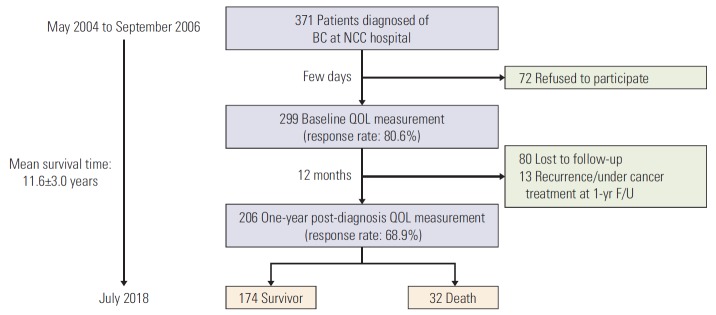
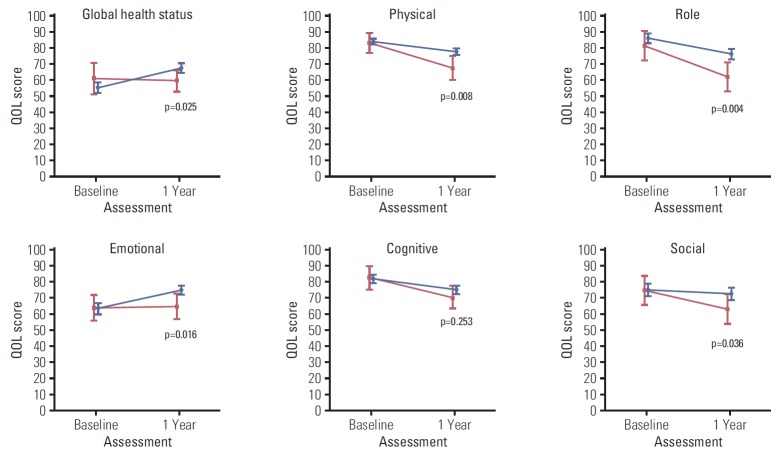
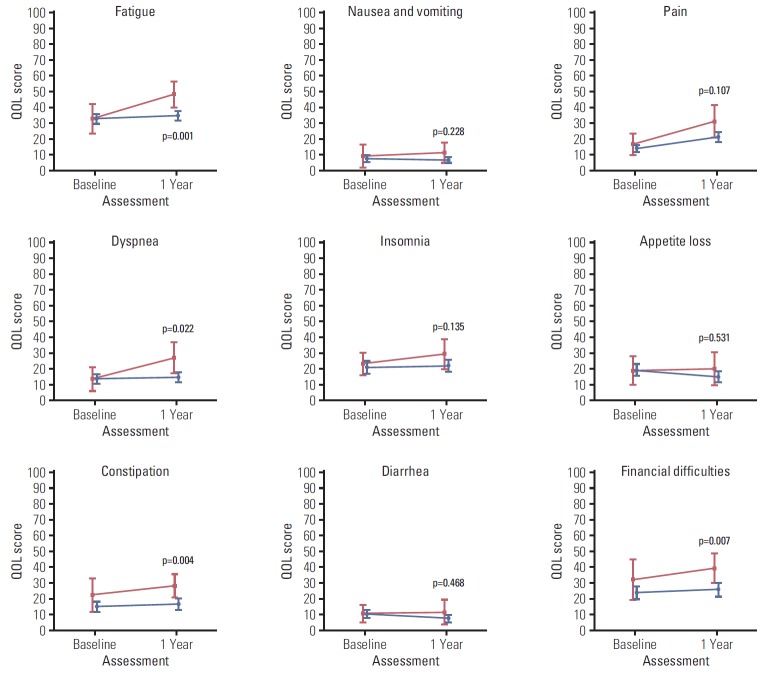
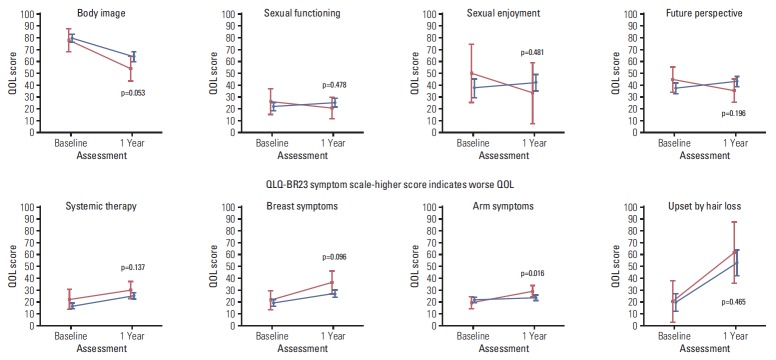
Results: Of 299 enrolled patients, 206 responded at 1-year post-diagnosis (80.6%) and were followed up for 11.6 years on average. At 1-year post-diagnosis, survivors had better HRQOL scores than those who died, although their health status was similar at baseline. Survivors reported significant increase 1 year after diagnosis in global health status and emotional scales. Between the groups, functional scales such as physical, role, and emotional were significantly different. Functional scales, including physical (adjusted hazard ratio [aHR], 0.70), role (aHR, 0.68), emotional (aHR, 0.72), and symptom scales, including fatigue (aHR, 1.34), dyspnea (aHR, 1.29), appetite loss (aHR, 1.24) were significantly associated with overall survival. Patients who were less worried about future health had favorable survival (aHR, 0.83).
Conclusion: Besides treatment-related symptoms, non-medical aspects at 1-year post-diagnosis, including functional well-being and future perspective, are predictive of long-term survival. Intervention to enhance physical, role, and emotional support for women soon after their BC diagnosis might help to improve disease survival outcomes afterwards.
Keywords: Breast neoplasms; Overall survival; Quality of life.
Conflict of interest statement
Conflict of interest relevant to this article was not reported.
Figures
References
-
- Gotay CC, Kawamoto CT, Bottomley A, Efficace F. The prognostic significance of patient-reported outcomes in cancer clinical trials. J Clin Oncol. 2008;26:1355–63. - PubMed
-
- Hahn EA, Cella D, Chassany O, Fairclough DL, Wong GY, Hays RD, et al. Precision of health-related quality-of-life data compared with other clinical measures. Mayo Clin Proc. 2007;82:1244–54. - PubMed
-
- Sprangers MA. Disregarding clinical trial-based patient-reported outcomes is unwarranted: five advances to substantiate the scientific stringency of quality-of-life measurement. Acta Oncol. 2010;49:155–63. - PubMed
-
- Staren ED, Gupta D, Braun DP. The prognostic role of quality of life assessment in breast cancer. Breast J. 2011;17:571–8. - PubMed
MeSH terms
Grants and funding
LinkOut - more resources
Full Text Sources
Medical