. 2019;8(1):613-623.
doi: 10.1080/22221751.2019.1603791.

Detection of dicistroviruses RNA in blood of febrile Tanzanian children

Affiliations

Detection of dicistroviruses RNA in blood of febrile Tanzanian children

Samuel Cordey et al. Emerg Microbes Infect. 2019.

Abstract

Fever is the leading cause of paediatric outpatient consultations in Sub-Saharan Africa. Although most are suspected to be of viral origin, a putative causative pathogen is not identified in over a quarter of these febrile episodes. Using a de novo assembly sequencing approach, we report the detection (15.4%) of dicistroviruses (DicV) RNA in sera collected from 692 febrile Tanzanian children. In contrast, DicV RNA was only detected in 1/77 (1.3%) plasma samples from febrile Tanzanian adults, suggesting that children could represent the primary susceptible population. Estimated viral load by specific quantitative real-time RT-PCR assay ranged from < 1.32E3 to 1.44E7 viral RNA copies/mL serum. Three DicV full-length genomes were obtained, and a phylogenetic analyse on the capsid region showed the presence of two clusters representing tentative novel genus. Although DicV-positive cases were detected throughout the year, a significantly higher positivity rate was observed during the rainy season. This study reveals that novel DicV RNA is frequently detected in the blood of Tanzanian children, paving the way for further investigations to determine if DicV possibly represent a new agent in humans.

Keywords: Dicistrovirus; Tanzanian children; de novo analysis; sera; viremia.


Figures
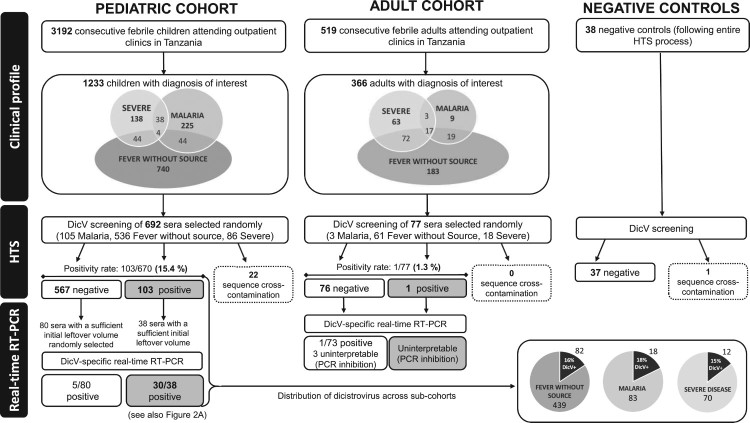
Figure 1.
Figure 1.
Study flow chart. Severe febrile illness is defined as having severe tachypnea (respiratory rate ≥97th percentile for age and temperature), severe tachycardia (heart rate ≥90th percentile for age and temperature), Hypoxemia (SaO2 < 90%), inability to tolerate oral fluids and/or neurological danger signs (such as coma or >2 convulsions in 24 h). The diagnosis of “fever without source” is attributed when the probable cause of a febrile illness cannot be determined by history or physical examination. The diagnosis of “malaria” is attributed in case of positive malaria-specific quantitative PCR, targeting multiple genomic copies of the conserved C-terminus of the var gene family (detection level: 0.1 parasite/µl). HTS: high-throughput sequencing, DicV: dicistrovirus, RT-PCR: reverse transcription PCR.
Figure 2.
Figure 2.
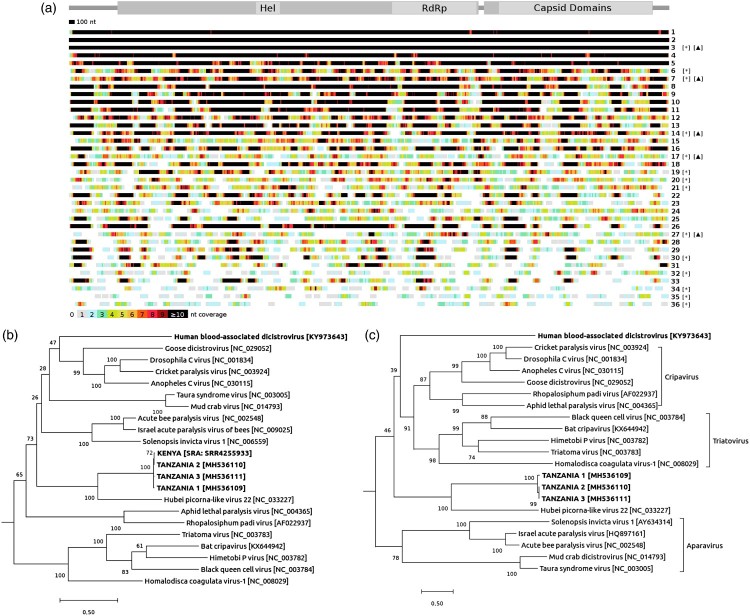
Analysis of Dicistrovirus sequences. (a) Location of DicV sequences with more than fifty percent DicV genome coverage obtained by de novo analysis for positive subjects. A schematic representation of the major ORFs of the DicV genome is featured at the top of the figure (Hel: helicase domain [pfam00910]; RdRp: RNA-dependent RNA polymerase domain [pfam00680]; Capsid domains include two Picornavirus capsid-like domains [cd00205], a DicV VP4 domain and CRPV capsid protein like domain [pfam08762]). On the right side is indicated when the presence of DicV could be verified by real-time RT-PCR (*) in sera with sufficient leftover volume and/or by RT-PCR followed by classical sequencing (▴). (b) Phylogenetic tree of the RdRp region of DicV. The 370-residue amino acid sequence considered for RdRp alignment is between position 1435 and 1804 of ORF1. Dicistrovirus sequences found in human blood are in bold font; the three complete coding sequences obtained in this study (TANZANIA 1–3), the Human blood-associated dicistrovirus sequence reported from a Peruvian patients with fever of unknown aetiology [21], and the KENYA sequence detected by our retrospective analysis in one pool (SRR4255933) from a study that investigated the plasma virome of febrile adult Kenyans [22]. (c) Phylogenetic tree of the capsid region of DicV. The 791-residue amino acid sequence considered for capsid alignment is between position 73 and the terminus of ORF2. Dicistrovirus sequences found in human blood are in bold font; the three complete coding sequences obtained in this study (TANZANIA 1–3), and the Human blood-associated dicistrovirus sequence reported from a Peruvian patients with fever of unknown aetiology [21].
Figure 3.
Figure 3.
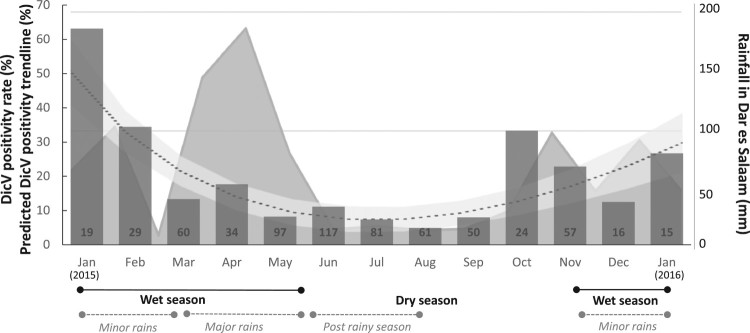
Monthly Dicistrovirus-positivity rate in febrile children. Bar graphs represent the positivity rates (%) (Left Y axis) of DicV RNA across each month of the study. Too few specimens (n = 10) were collected in December 2014 and February 2016 to provide reliable positivity rates, and, thus, are not represented on the graph. The total number of sera collected appear in the base of each bar. A dotted line with shaded CI95% shows a fractional polynomial trendline for predicted DicV positivity (also featured on the left Y axis). The rainfall recorded in Dar es Salaam (mm; adapted from https://www.worldweatheronline.com/dar-es-salaam-weatheraverages/dar-es-salaam/tz.aspx) over the patient recruitment period appears as a shaded graphic in the background (Right Y axis). Corresponding seasons are indicated below.
Figure 4:
Figure 4:
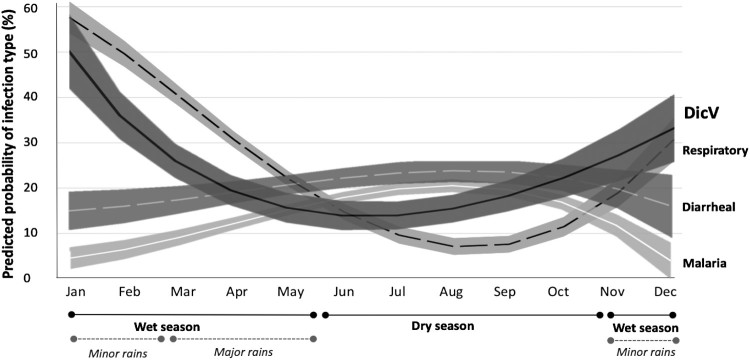
Temporal distribution of diseases representing the major modes of infectious transmission (airborne, fecal-oral and mosquito-borne) compared to DicV prevalence. The mean predicted prevalences (fractional polynomial trendlines) and their 95% confidence intervals (shaded areas around trendlines) are depicted for the probability of having the diagnoses of 1: “Respiratory infection” (dashed black line), 2: “Diarrheal disease” (white dashed line) and 3: Malaria (white solid line). The predicted prevalence of DicV is shown as a solid black line. The months of the entire 2015 recruitment period are depicted. Seasons are indicated below. DicV: Dicistrovirus.

References

    1. Anthony SJ, et al. . A strategy to estimate unknown viral diversity in mammals. mBio. 2013;4:e00598–e00513. doi: 10.1128/mBio.00598-13 - DOI - PMC - PubMed
    1. Shi M, et al. . Redefining the invertebrate RNA virosphere. Nature. 2016;540:539–543. doi: 10.1038/nature20167 - DOI - PubMed
    1. van Aerle R, Santos EM.. Advances in the application of high-throughput sequencing in invertebrate virology. J Invertebr Pathol. 2017;147:145–156. doi: 10.1016/j.jip.2017.02.006 - DOI - PubMed
    1. Brown JR, et al. . Astrovirus VA1/HMO-C: an increasingly recognized neurotropic pathogen in immunocompromised patients. Clin Infect Dis. 2015;60:881–888. doi: 10.1093/cid/ciu940 - DOI - PMC - PubMed
    1. Cordey S, et al. . Astrovirus MLB2, a New Gastroenteric virus associated with Meningitis and Disseminated infection. Emerg Infect Dis. 2016;22:846–853. doi: 10.3201/eid2205.151807 - DOI - PMC - PubMed