. 2019 Apr 18;16(1):34.
doi: 10.1186/s12966-019-0797-2.

The epidemiology of aerobic physical activity and muscle-strengthening activity guideline adherence among 383,928 U.S. adults

Affiliations

The epidemiology of aerobic physical activity and muscle-strengthening activity guideline adherence among 383,928 U.S. adults

Jason A Bennie et al. Int J Behav Nutr Phys Act. .

Abstract

Background: The World Health Organization's 'Global Recommendations on Physical Activity for Health' state that adults should engage in regular moderate-to-vigorous intensity aerobic physical activity (MVPA; e.g. walking, running, cycling) and muscle-strengthening activity (MSA; e.g. strength/resistance training). However, assessment of both MVPA and MSA is rare in physical activity surveillance. The aim of this study is to describe the prevalence, correlates and chronic health conditions associated with meeting the combined MVPA-MSA guidelines among a population representative sample of U.S. adults.

Methods: In this cross-sectional study, data were drawn from the U.S. 2015 Behavioral Risk Factor Surveillance System. During telephone interviews, MVPA and MSA were assessed using validated questionnaires. We calculated the proportions meeting both the global MVPA and MSA physical activity guidelines (MVPA ≥150 min/week and MSA ≥2 sessions/week). Poisson regressions with a robust error variance were used to assess: (i) prevalence ratios (PR) for meeting both guidelines across sociodemographic factors (e.g. age, sex, education, income, race/ethnicity); and (ii) PRs of 12 common chronic health conditions (e.g. diabetes, coronary heart disease, hypertension, depression) across different categories of physical activity guideline adherence (met neither [reference]; MSA only; MVPA only; met both).

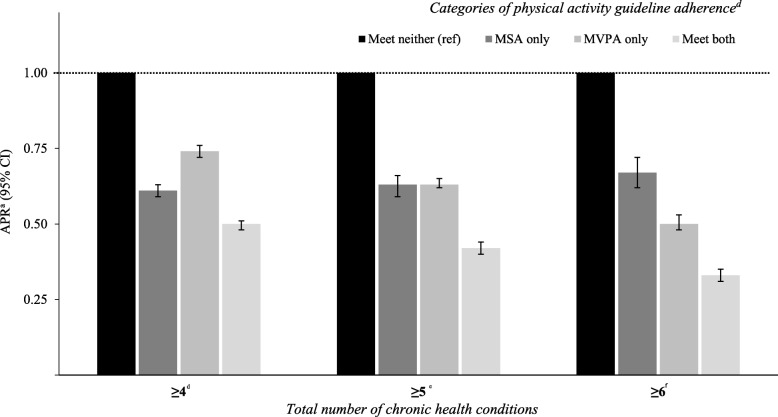
Results: Among 383,928 adults (aged 18-80 years), 23.5% (95% CI: 20.1, 20.6%) met the combined MVPA-MSA guidelines. Those with poorer self-rated health, older adults, women, lower education/income and current smokers were less likely to meet the combined guidelines. After adjustment for covariates (e.g. age, self-rated health, income, smoking) compared with meeting neither guidelines, MSA only and MVPA only, meeting the combined MVPA-MSA guidelines was associated with the lowest PRs for all health conditions (APR range: 0.44-0.76), and the clustering of ≥6 chronic health conditions (APR = 0.33; 95% CI: 0.31-0.35).

Conclusions: Eight out of ten U.S. adults do not meet the global physical activity guidelines. This study supports the need for comprehensive health promotion strategies to increase the uptake and adherence of MVPA-MSA among U.S. adults. Large-scale interventions should target specific population sub-groups including older adults, women, those with poorer health and lower education/income.

Keywords: Aerobic exercise; Concurrent training; Physical activity; Public health; Resistance training.


Conflict of interest statement

Ethics approval and consent to participate

The Behavioral Risk Factor Surveillance System 2015 was approved by the National Center for Health Statistics Research Ethics Review Board and all the participants provided informed consent.

Consent for publication

Not applicable.

Competing interests

The authors declare that they have no competing interests.

Publisher’s Note

Springer Nature remains neutral with regard to jurisdictional claims in published maps and institutional affiliations.

Figures
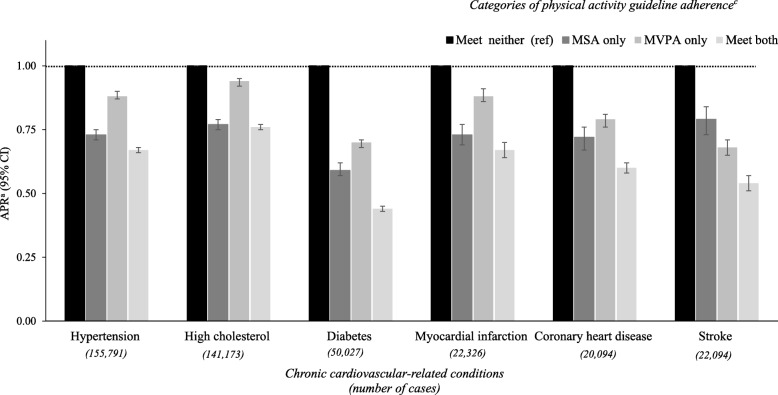
Fig. 1
Fig. 1
Adjusted prevalence ratiosa (APR; 95% CI) for cardiovascular-related conditionsb by categories of PA guideline adherence. aPrevalence ratio calculated using Poisson regression with a robust error variance and adjusted for sex, age, race/ethnicity, employment, education, income, smoking and BMI. bTo be classified as having an chronic health condition a respondent had to report having a “doctor, nurse or other health professional” diagnose each condition. c Physical activity guideline adherence: ‘Meet neither’: MVPA = 0–149 & MSA = 0–1 sessions/week; ‘MSA only’; MSA = ≥2 sessions/week & MVPA = 0–149 min/week); ‘MVPA only’ MVPA = ≥150 min/week & MSA = 0–1 sessions/week; and ‘Meet both’: MVPA = ≥150 min /week & MSA = ≥2 sessions/week. (Both unadjusted and adjusted PRs are shown in Additional file 2)
Fig. 2
Fig. 2
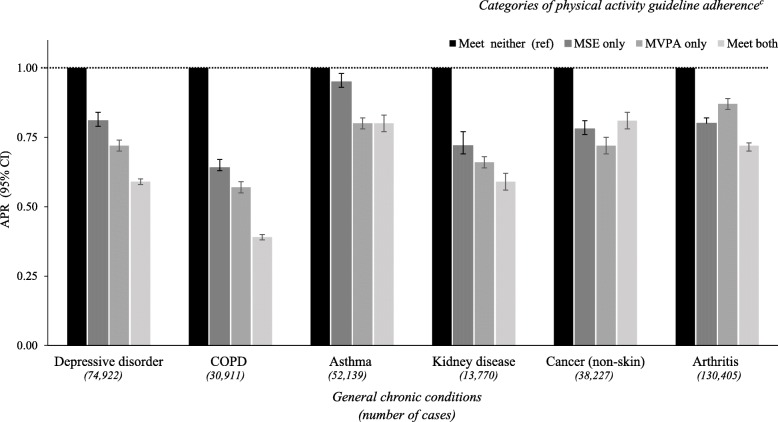
Adjusted prevalence ratiosa (APR; 95% CI) for general health conditionsb by categories of PA guideline adherence. a Prevalence ratio calculated using Poisson regression with a robust error variance and adjusted for sex, age, race/ethnicity, employment, education, income, smoking and BMI. b To be classified as having an chronic health condition a respondent had to report having a “doctor, nurse or other health professional” diagnose each condition. c Physical activity guideline adherence: ‘Meet neither’: MVPA = 0–149 & MSA = 0–1 sessions/week; ‘MSA only’; MSA = ≥2 sessions/week & MVPA = 0–149 min/week); ‘MVPA only’ MVPA = ≥150 min/week & MSA = 0–1 sessions/week; and ‘Meet both’: MVPA = ≥150 min /week & MSA = ≥2 sessions/week. (Both unadjusted and adjusted PRs are shown in Additional file 2)
Fig. 3
Fig. 3
Adjusted prevalence ratiosa (APR; 95% CI) for total number of health conditionsb by categories of PA guideline adherence. aPrevalence ratio calculated using Poisson regression with a robust error variance and adjusted for sex, age, race/ethnicity, employment, education, income, smoking and BMI. b To be classified as having an chronic health condition a respondent had to report having a “doctor, nurse or other health professional” diagnose each condition. Chronic health conditions = hypertension, high cholesterol, diabetes, myocardial infarction, coronary heart disease, stroke, depressive disorder, chronic obstructive pulmonary disease, asthma, kidney disease, cancer (non-skin) and arthritis. c Physical activity guideline adherence: ‘Meet neither’: MVPA = 0–149 & MSA = 0–1 sessions/week; ‘MSA only’; MSA = ≥2 sessions/week & MVPA = 0–149 min/week); ‘MVPA only’ MVPA = ≥150 min/week & MSA = 0–1 sessions/week; and ‘Meet both’: MVPA = ≥150 min /week & MSA = ≥2 sessions/week. dreference = ≤3 adverse conditions. ereference = ≤4 adverse conditions. f reference = ≤5 adverse conditions. (Both unadjusted and adjusted PRs are shown in Additional file 2)

References

    1. Lee IM, Shiroma EJ, Lobelo F, Puska P, Blair SN, Katzmarzyk PT. Effect of physical inactivity on major non-communicable diseases worldwide: an analysis of burden of disease and life expectancy. Lancet (London, England) 2012;380(9838):219–229. doi: 10.1016/S0140-6736(12)61031-9. - DOI - PMC - PubMed
    1. Morris JN, Crawford MD. Coronary heart disease and physical activity of work. Br Med J. 1958;2(5111):1485. doi: 10.1136/bmj.2.5111.1485. - DOI - PMC - PubMed
    1. Morris JN, Heady JA, Raffle PA, Roberts CG, Parks JW. Coronary heart-disease and physical activity of work. Lancet (London, England) 1953;265(6796):1111–1120. doi: 10.1016/S0140-6736(53)91495-0. - DOI - PubMed
    1. Paffenbarger RS, Jr, Hale WE. Work activity and coronary heart mortality. N Engl J Med. 1975;292(11):545–550. doi: 10.1056/NEJM197503132921101. - DOI - PubMed
    1. Paffenbarger RS, Hyde R, Wing AL. Hsieh C-c. physical activity, all-cause mortality, and longevity of college alumni. N Engl J Med. 1986;314(10):605–613. doi: 10.1056/NEJM198603063141003. - DOI - PubMed