


The influence of isokinetic peak torque and muscular power on the functional performance of active and inactive community-dwelling elderly: a cross-sectional study
- PMID: 31000175
- PMCID: PMC7253910
- DOI: 10.1016/j.bjpt.2019.03.003
The influence of isokinetic peak torque and muscular power on the functional performance of active and inactive community-dwelling elderly: a cross-sectional study
Abstract
Objective: To verify the importance of the isokinetic muscular torque and power of knee extensors and flexors on the functional performance of active and inactive elderly women.
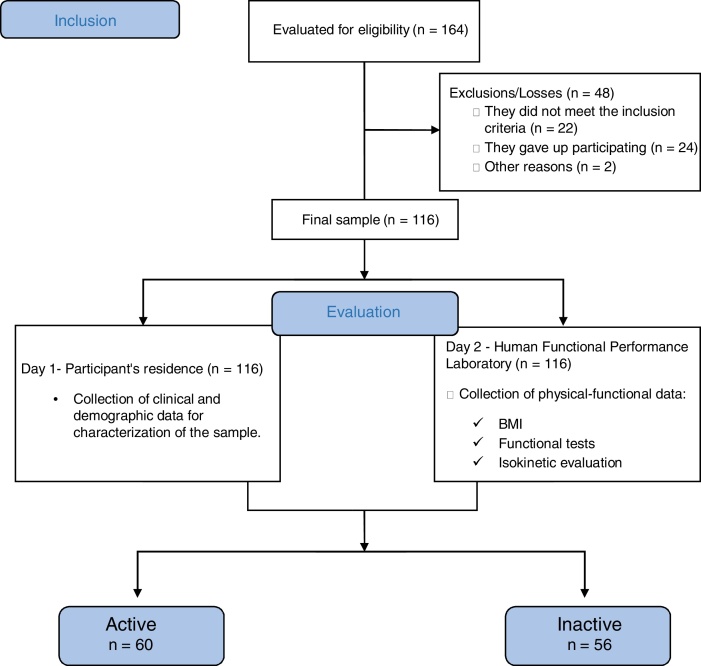
Methods: A cross-sectional observational study was conducted with 116 community-dwelling women (≥60 years old) without severe cognitive and/or motor dysfunction. Isokinetic muscle function was measured by peak torque and muscle power at 60°/s (5 repetitions) and 180°/s (15 repetitions), respectively. Mobility was evaluated by means of the Timed Up and Go test (TUG) and the Habitual Gait Speed (HGS) test. Balance was evaluated via the alternate step and semitandem tests. Lower limb strength was assessed using the Sit-to-stand test. Univariate and multivariate logistic regression analysis was used to determine association between independent and dependent variables (α=0.05).
Result: Active elderly women had better muscle function and functional performance than inactive elderly women for almost all variables. Peak torque and muscular power of knee extensor muscles explained the dynamic balance, mobility, and lower limb strength among inactive elderly women (OR: 0.89-0.95; p<0.05). Muscular power of knee flexors influenced tasks that required mobility and lower limb strength among active elderly (OR: 0.82-0.87; p<0.05).
Conclusions: The muscular power of knee flexors was shown to be more important for the functional performance of active elderly women. The muscular power of knee extensors had a stronger influence on the performance of the inactive elderly women.
Keywords: Aged; Exercise; Movement; Muscle strength; Physical fitness; Sedentary lifestyle.
Copyright © 2019 Associação Brasileira de Pesquisa e Pós-Graduação em Fisioterapia. Publicado por Elsevier Editora Ltda. All rights reserved.
References
-
- Rosenberg I.H. Symposium: Sarcopenia: diagnosis and mechanisms. J Nutr. 1997;127:990–991.
-
- Doherty T.J. Invited review: aging and sarcopenia. J Appl Physiol. 2003;95(4):1717–1727. - PubMed
-
- Garcia P.A., Dias J.M.D., Dias R.C. Estudo da relação entre função muscular, mobilidade funcional e nível de atividade física em idosos comunitários. Braz J Phys Ther. 2011;15(1):15–22.
-
- Barbat-Artigas S., Rolland Y., Cesari M. Clinical relevance of different muscle strength indexes and functional impairment in women aged 75 years and older. J Gerontol A Biol Sci Med Sci. 2013;68(7):811–819. - PubMed
MeSH terms
LinkOut - more resources
Full Text Sources
