


The Role of Plasmids in the Multiple Antibiotic Resistance Transfer in ESBLs-Producing Escherichia coli Isolated From Wastewater Treatment Plants
- PMID: 31001218
- PMCID: PMC6456708
- DOI: 10.3389/fmicb.2019.00633
The Role of Plasmids in the Multiple Antibiotic Resistance Transfer in ESBLs-Producing Escherichia coli Isolated From Wastewater Treatment Plants
Abstract
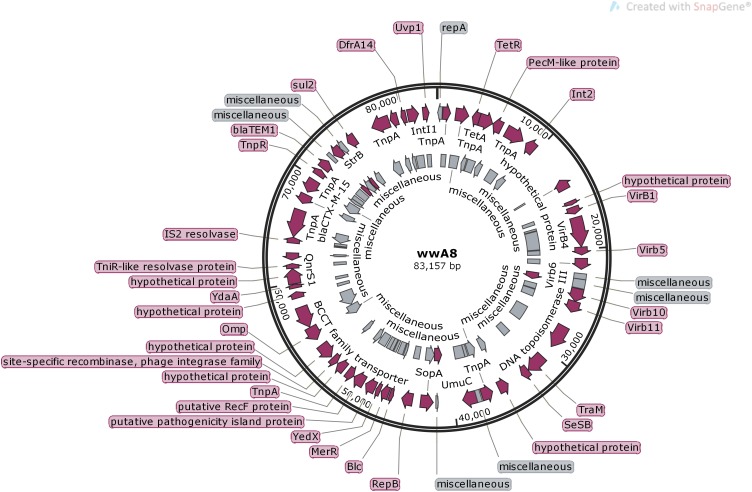
We compared the diversity of extended-spectrum β-lactamases (ESBLs) producing Escherichia coli (E. coli) in wastewater of a municipal wastewater treatment plant. This was done by analyzing multiple antibiotic resistant phenotypes and genotypes. Also, we investigated the antibiotic resistance transfer mechanism of the plasmid by comparing the antibiotic resistance gene linked transfer using a conjugative test, and by analyzing the full-length DNA sequence of one plasmid. The results showed that 50 ESBLs-producing E. coli isolates were isolated from 80 wastewater samples at the rate of 62.5% (50/80), out of which 35 transconjugants were obtained with the multiple antibiotic resistant transfer rate as high as 70.0% (35/50). Multiple antibiotic resistance was shown in all transconjugants and donor bacteria, which were capable of resistance to 11 out of 15 kinds of antibiotics. Both transconjugants and donors were capable of resistance to the Ampicillin and Cefalotin at a rate of 100.00% (35/35), while the total antibiotic resistant spectrum of transconjugants narrowed at the rate of 94.29% (33/35) and broadened at the rate of 5.71% (2/35) after conjugate to the donor bacteria. PCR showed that the resistant genotypes decreased or remained unchanged when compared to donor bacteria with transconjugants while the blaTEM and blaCTX-M genes were transferred and linked at a rate of 100.00% (35/35) and the blaSHV gene was at the rate as high as 94.29% (33/35). However, the qnrS gene was transferred at a low rate of 4.17% (1/24). In addition, the major resistance gene subtypes were blaTEM- 1, blaSHV -11 , and blaCTX-M-15 according to sequencing and Blast comparison. Plasmid wwA8 is a closed-loop DNA molecule with 83157 bp, and contains 45 predicted genes, including three antibiotic resistant resistance genes, blaCTX-M-15 , blaTEM-1 and qnrS1, which can be transferred with E. coli in vitro. This study shows that E. coli isolated from wastewater was capable of transferring resistance genes and producing antibiotic resistant phenotypes. The plasmids containing different resistance genes in E. coli play an important role in the multiple antibiotic resistant transfer. Most importantly, antibiotic resistant resistance genes have different transfer efficiencies, the blaTEM and blaCTX-M genes transferred at a rate of 100.00% and linked transfer in all 35 transconjugants.
Keywords: ESBLs; Escherichia coli; multiple antibiotic resistant; plasmid; transconjugants.
References
-
- Alexy R., Sommer A., Lange F. T., Kümmerer K. (2006). Local use of antibiotics and their input and fate in a small sewage treatment plant – significance of balancing and analysis on a local scale vs. nationwide scale. Clean 34 587–592. 10.1002/aheh.200400657 - DOI
-
- Ben Said L., Jouini A., Alonso C. A., Klibi N., Dziri R., Boudabous A., et al. (2016). Characteristics of extended-spectrum β-lactamase (ESBL)- and pAmpC beta- lactamase-producing enterobacteriaceae of water samples in Tunisia. Sci. Total Environ. 550 1103–1109. 10.1016/j.scitotenv.2016.01.042 - DOI - PubMed
-
- Ben-Shahar O., Obara I., Ary A. W., Ma N., Mangiardi M. A., Medina R. L., et al. (2012). Antimicrobial resistance of integron-harboring Escherichia coli isolates from clinical samples, wastewater treatment plant and river water. Sci. Total Environ. 414 680–685. - PubMed
LinkOut - more resources
Full Text Sources
Research Materials
