


Feto-Maternal Microchimerism: The Pre-eclampsia Conundrum
- PMID: 31001268
- PMCID: PMC6455070
- DOI: 10.3389/fimmu.2019.00659
Feto-Maternal Microchimerism: The Pre-eclampsia Conundrum
Abstract
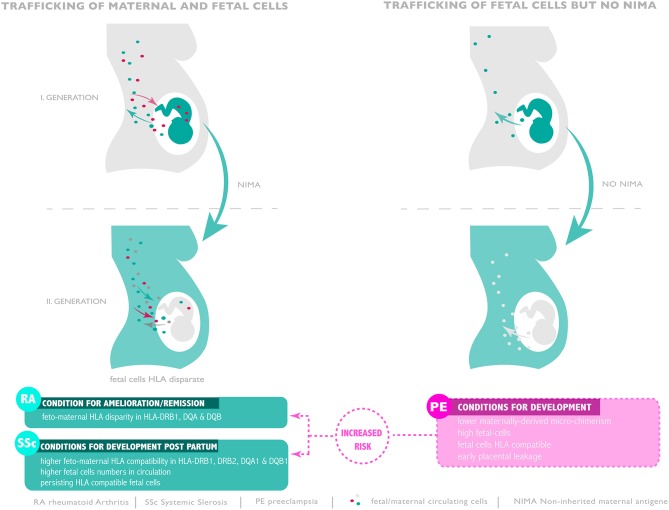
Feto-maternal microchimerism (FMM) involves bidirectional cross-placental trafficking during pregnancy, leading to a micro-chimeric state that can persist for decades. In this manner a pregnant woman will harbor cells from her mother, as well as, cells from her child. Historically, eclampsia, a severe disorder of pregnancy provided the basis for FMM following the detection of trophoblast cells in the lungs of deceased women. Bi-directional cell trafficking between mother and fetus is also altered in pre-eclampsia and has been suggested to contribute to the underlying etiology. FMM has been implicated in tolerance promotion, remission of auto-inflammatory disorders during pregnancy, or the development of autoimmune conditions post-partum. The underlying mechanism whereby the host immune system is modulated is unclear but appears to involve HLA class II molecules, in that incompatibility between mother and fetus promotes remission of rheumatoid arthritis, whereas feto-maternal HLA compatibility may assist in the post-partum initiation of scleroderma. Couples having a high degree of HLA class II compatibility have an increased risk for pre-eclampsia, while the occurrence of scleroderma and rheumatoid arthritis is greater in pre-eclamptic cases than in women with normal pregnancies, suggesting a long term autoimmune predisposition. Since pregnant women with pre-eclampsia exhibit significantly lower levels of maternally-derived micro-chimerism, the question arises whether pre-eclampsia and post-partum development of autoimmune conditions occur due to the failure of the grandmothers cells to adequately regulate an inappropriate micro-chimeric constellation.
Keywords: autoimmunity; cell-free DNA; feto-maternal microchimerism; non-inherited-maternal-antigens; pre-eclampsia.
Figures
References
Publication types
MeSH terms
LinkOut - more resources
Full Text Sources
Medical
Research Materials
