. 2019 Apr 2:10:350.
doi: 10.3389/fpls.2019.00350. eCollection 2019.

Architecture and Florogenesis in Female Cannabis sativa Plants

Affiliations

Architecture and Florogenesis in Female Cannabis sativa Plants

Ben Spitzer-Rimon et al. Front Plant Sci. .

Abstract

The inflorescence is the main product of medical cannabis. Hundreds of specialized metabolites with potential bioactivity are produced and accumulated in the glandular trichomes that are highly abundant mainly on female inflorescences. Understanding the morphophysiological and genetic mechanisms governing flower and inflorescence development is therefore of high scientific and practical importance. However, in-depth investigations of cannabis florogenesis are limited. Cannabis producers and researchers consider long photoperiod to be "non-inductive" or "vegetative," but under these growth conditions, the development of solitary flowers and bracts in shoot internodes clearly indicates that the plant cannot be defined as vegetative or non-inductive in the classical sense. Most probably, induction of solitary flowers is age-dependent and controlled by internal signals, but not by photoperiod. Short photoperiod induces intense branching, which results in the development of a compound raceme. Each inflorescence consists of condensed branchlets with the same phytomer structure as that of the larger phytomers developed under long day. Each phytomer consists of reduced leaves, bracts, one or two solitary flowers, and an axillary shoot (or inflorescence). Therefore, the effect of short photoperiod on cannabis florogenesis is not flower induction, but rather a dramatic change in shoot apex architecture to form a compound racemose inflorescence structure. An understanding of the morphophysiological characteristics of cannabis inflorescence will lay the foundation for biotechnological and physiological applications to modify architecture and to maximize plant productivity and uniformity in medical Cannabis.

Keywords: branching; cannabis; inflorescence; photoperiod; solitary flower.


Figures
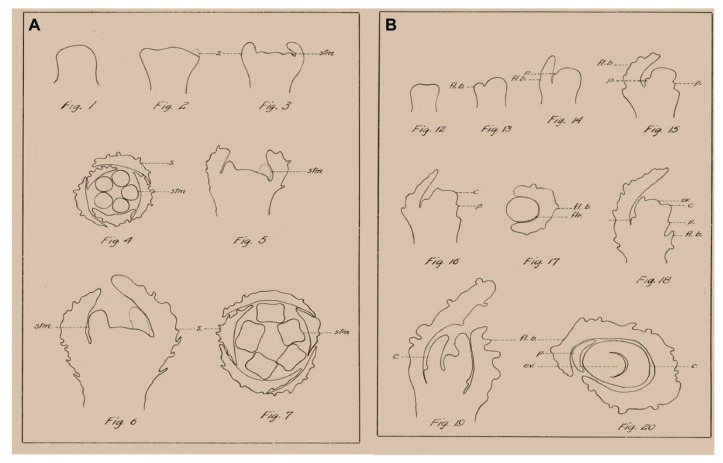
Figure 1
Figure 1
Examples of morphological analysis of Cannabis flowers by Camera Lucida, adapted from Reed (1914). (A) Morphogenesis of staminate flower. (B) Morphogenesis of pistillate flower. s., sepal; stm., stamen; fl. b., floral bract; p., perianth; c., carpel; flr., flower; ov., ovule.
Figure 2
Figure 2
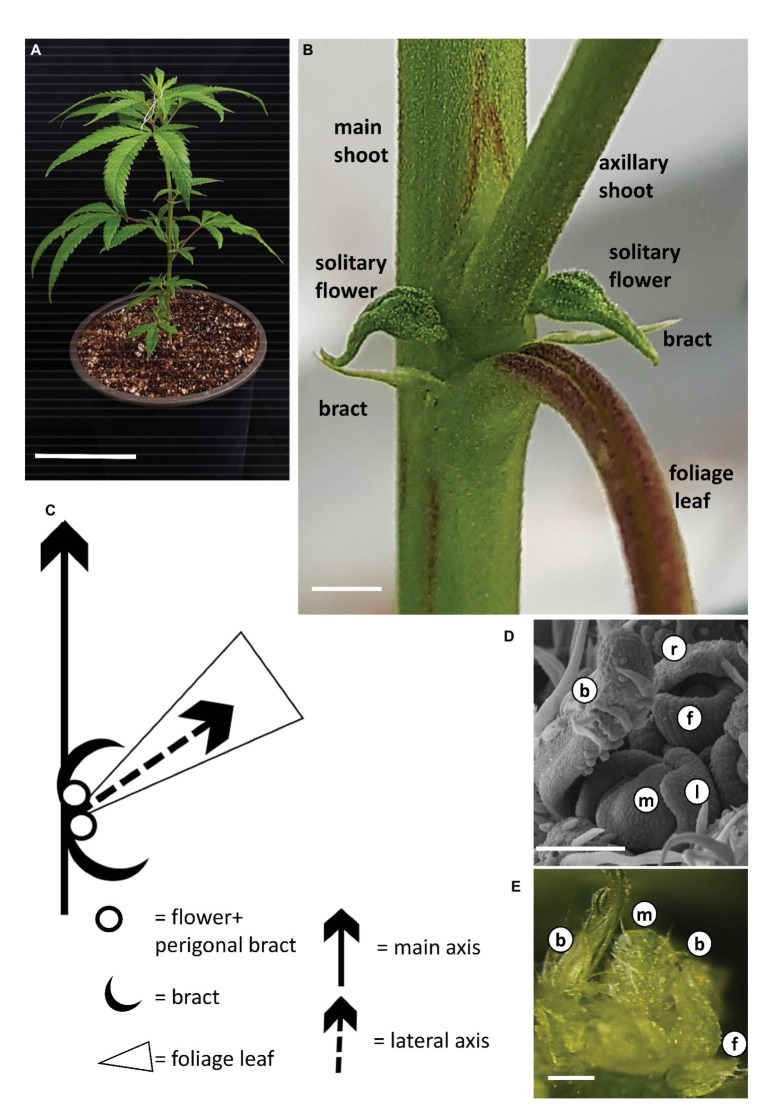
Growth and development of Cannabis under long photoperiod. (A) Young rooted cutting of cv. NB140 2 weeks after rooting. Bar = 10 cm. (B) Internode of cannabis plant. Axillary shoot, two bracts, and two solitary flowers are located in the axil of a foliage leaf. Bar = 0.2 cm. (C) Schematic representation of the basic phytomer, including internode, foliage (fan) leaf, two bracts, and two solitary flowers. (D) Scanning electron photomicrograph of cannabis apical meristem. Bar = 100 μm. (E) Stereoscope image of cannabis apical meristem producing leaves, solitary flowers, and bracts. External leaves removed to expose the meristem. Bar = 200 μm. b, bract primordium; f, flower primordium; l, leaf primordium; m, meristem; r, perigonal bract.
Figure 3
Figure 3
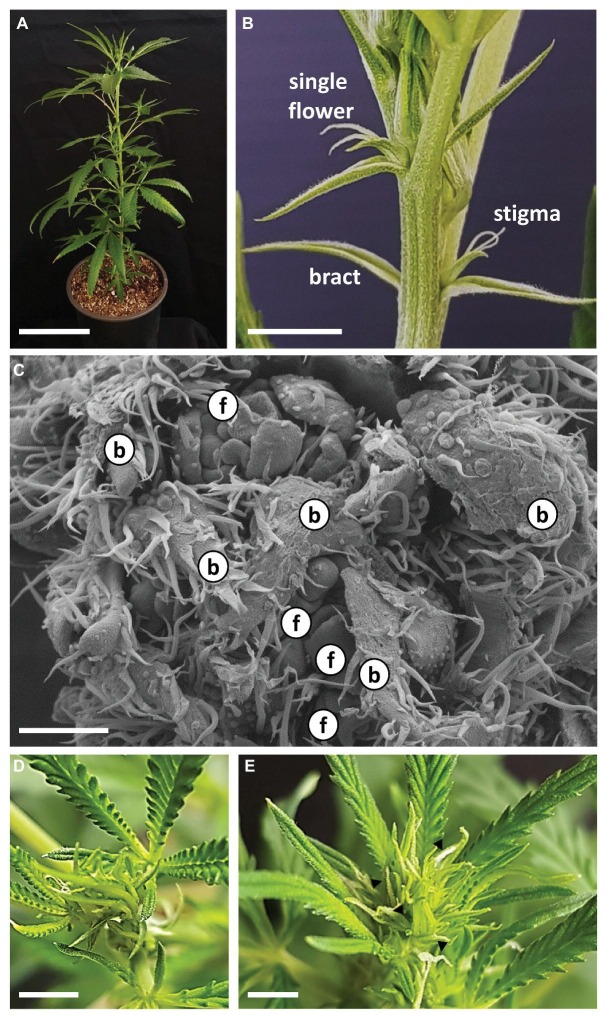
Growth and development of Cannabis following transition to short photoperiod conditions. (A) Cannabis plant “NB140,” 5 days after transition to short photoperiod conditions. Bar = 10 cm. (B) Apical part of main shoot of “NB140,” 5 days after transition to short photoperiod conditions. Bar = 0.5 cm. (C) Scanning electron photomicrographs of apical meristem after 7 days of growth under short photoperiod conditions. Bar = 200 μm. (D) and (E) Shoot apex of “NB140” after 11 and 12 days of growth under short photoperiod conditions. (E) Apex phase determined as first day of visible inflorescence. Bars = 0.5 cm. b, bract primordium; f, flower primordium; arrowheads, stigmata.
Figure 4
Figure 4
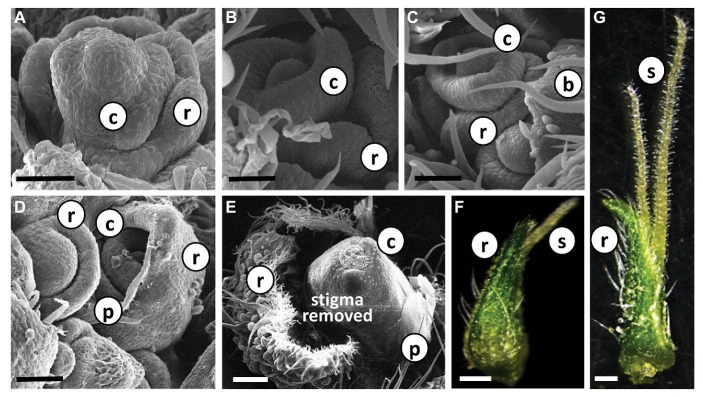
Differentiation and development of individual Cannabis flower. (A)–(E) Scanning electron photomicrographs of consecutive stages of differentiation of female flowers in “NB140.” Bars in (A–D) = 50 μm and (E) = 200 μm. (F) and (G) Stereoscope image of developed female flowers with visible glandular trichomes; pre-mature stigmata in (F) and fully mature stigmata in (G). Bars = 500 μm. b, bract; r, perigonal bract; c, carpel; p, perianth; s, stigma.
Figure 5
Figure 5
Architecture of Cannabis cv. NB140 following inflorescence development. (A) Representative image of leaves collected from branches of increasing orders. Bar = 5 cm. (B) Flowering cannabis plant “NB140,” 22 days after transition to short photoperiod conditions. Bar = 10 cm. (C) Representative image of second-order branch, 22 days after transition to short photoperiod conditions. Insert = disassembled third-order inflorescence. Bar = 5 cm. (D) Fifth-order phytomer. Bar = 2 mm. (E) Sixth-order phytomer (marked with * in D) with terminal flower and two solitary flowers and reduced leaf. Bar = 1 mm. l, reduced leaf; b, bracts; f, solitary flower; i, inflorescence; tf, terminal flower.
Figure 6
Figure 6
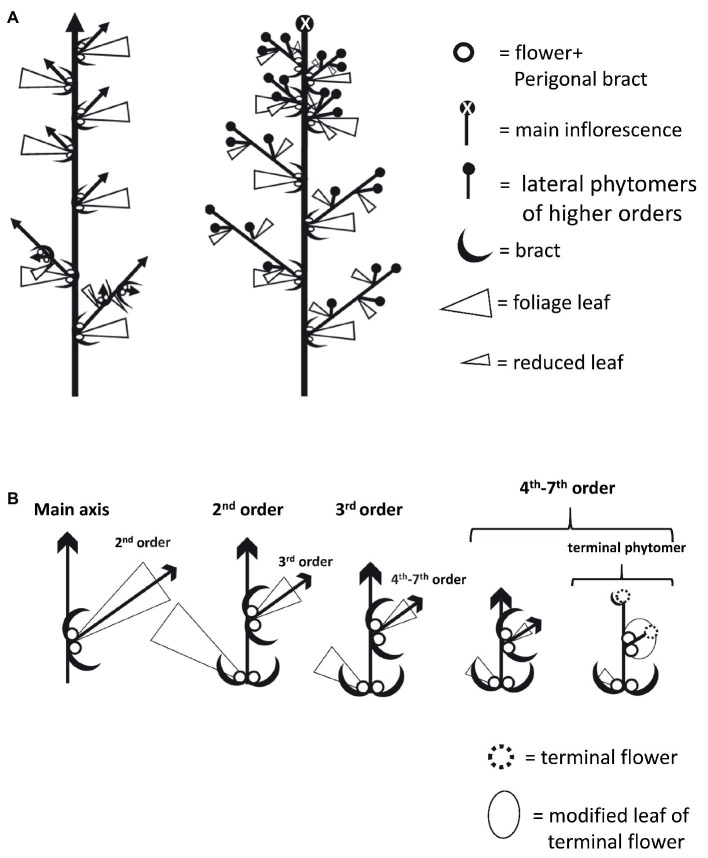
Schematic diagrams of Cannabis plant and inflorescence architecture. (A) Plant architecture under long photoperiod (left) and short photoperiod (right). (B) Architecture of branches and branchlets in increasing order. In terminal phytomer, the leaf is dramatically reduced into a structure that envelops the two solitary flowers and the terminal flowers developed instead of a shoot.
Figure 7
Figure 7
Natural variation in Cannabis plant architecture and inflorescence termination. (A)(C) Plant architecture of “NB140” (A), “NB150” (B), and “NB130” (C), grown under short day photoperiod for 1 month. Bars = 10 cm. (D) Inflorescence meristem of “NB130,” 5 weeks after flowering. (E) Terminal flower of “NB140.” Bar = 2 mm. (F) Decapitated hermaphrodite terminal flower of “NB150,” both pistils and anthers are differentiated. Bar = 500 μm. a, anther; pi, pistil.

References

    1. Andre C. M., Hausman J. F., Guerriero G. (2016). Cannabis sativa: the plant of the thousand and one molecules. Front. Plant Sci. 7:19. 10.3389/fpls.2016.00019, PMID: - DOI - PMC - PubMed
    1. Benlloch R., Berbel A., Serrano-Mislata A., Madueno F. (2007). Floral initiation and inflorescence architecture: a comparative view. Ann. Bot. 100, 659–676. 10.1093/aob/mcm146, PMID: - DOI - PMC - PubMed
    1. Bernstein N., Gorelick J., Koch S. (2019). Interplay between chemistry and morphology in medical cannabis (Cannabis sativa L.). Ind. Crop. Prod. 129, 185–194. 10.1016/j.indcrop.2018.11.039 - DOI
    1. Blümel M., Dally N., Jung C. (2015). Flowering time regulation in crops–what did we learn from Arabidopsis? Curr. Opin. Biotechnol. 32, 121–129. 10.1016/j.copbio.2014.11.023 - DOI - PubMed
    1. Caplan D., Stemeroff J., Dixon M., Zheng Y. (2018). Vegetative propagation of cannabis by stem cuttings: effects of leaf number, cutting position, rooting hormone, and leaf tip removal. Can. J. Plant Sci. 98, 1126–1132. 10.1139/cjps-2018-0038 - DOI