


Overview of Some Recent Advances in Improving Water and Energy Efficiencies in Food Processing Factories
- PMID: 31001534
- PMCID: PMC6454086
- DOI: 10.3389/fnut.2019.00020
Overview of Some Recent Advances in Improving Water and Energy Efficiencies in Food Processing Factories
Abstract
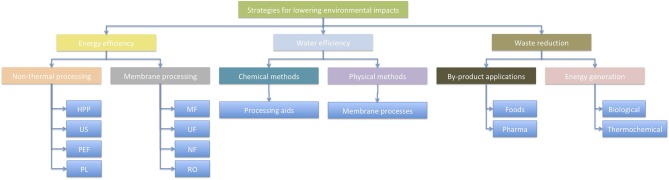
Rapid development of food factories in both developed and developing countries, owing to continued growth in the world population, plays a critical role in the food supply chain, including environmental issues such as pollution, emissions, energy and water consumption, and thus food system sustainability. The objective of this study was to briefly review various environmental aspects of food processing operations, including aquatic, atmospheric, and solid waste generation, and also to discuss several strategies that many companies are using to reduce these negative impacts as well as to improve water and energy efficiency. To obtain higher energy efficiencies in food processing factories, two key operations can play critical roles: non-thermal processing (e.g., high pressure processing) and membrane processes. For higher water efficiency, reconditioning treatments resulting in water reuse for other purposes can be conducted through chemical and/or physical treatments. With regards to reducing volumes of processing food waste, two approaches include value-added by-product applications (e.g., animal feed) and/or utilization of food waste for energy production. Finally, we present trends for lowering operational costs in food processing.
Keywords: efficiencies; energy; food; sustainability; water.
Figures
References
-
- FAO Feeding the World, Eradicating Hunger. World Summit on Food Security. Rome: Food and Agricultural Organization of the United Nations. WSFS 2009/INF/2.
-
- Clark JH. Introduction to green chemistry. Introduction to green chemistry. In: Proctor A. editor. Alternatives to Conventional Food Processing. London: Royal Society of Chemistry; (2010). p. 1–10. 10.1039/9781849730976-00001 - DOI
-
- Bradbear C, Friel S. Food systems and environmental sustainability: a review of the Australian evidence. NCEPH Working Paper. Canberra, ACT: Australian National University; (2011).
-
- De Mello Santana PH, Bajay SV. New approaches for improving energy efficiency in the Brazilian industry. Energy Rep. (2016) 2:62–6. 10.1016/j.egyr.2016.02.001 - DOI
-
- Meneses YE, Stratton J, Flores RA. Water reconditioning and reuse in the food processing industry: current situation and challenges. Trends Food Sci Technol. (2017) 61:72–9. 10.1016/j.tifs.2016.12.008 - DOI
Publication types
LinkOut - more resources
Full Text Sources
