Urine salts elucidate Early Neolithic animal management at Aşıklı Höyük, Turkey
- PMID: 31001590
- PMCID: PMC6469938
- DOI: 10.1126/sciadv.aaw0038
Urine salts elucidate Early Neolithic animal management at Aşıklı Höyük, Turkey
Abstract
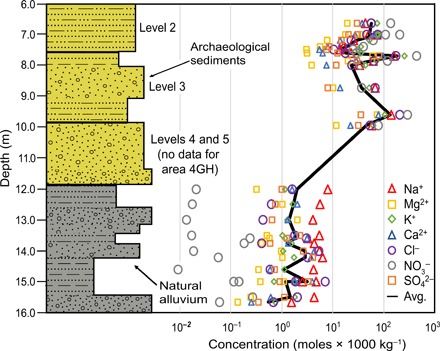
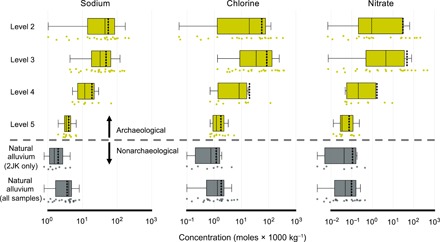
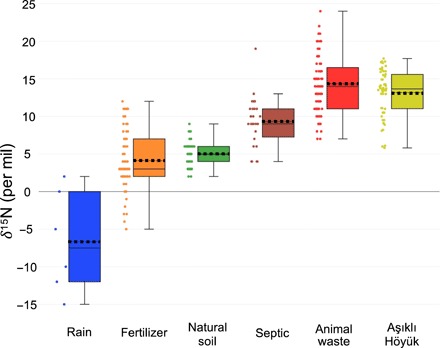
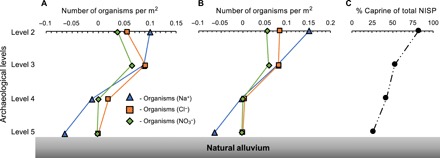
The process of sheep and goat (caprine) domestication began by 9000 to 8000 BCE in Southwest Asia. The early Neolithic site at Aşıklı Höyük in central Turkey preserves early archaeological evidence of this transformation, such as culling by age and sex and use of enclosures inside the settlement. People's strategies for managing caprines evolved at this site over a period of 1000 years, but changes in the scale of the practices are difficult to measure. Dung and midden layers at Aşıklı Höyük are highly enriched in soluble sodium, chlorine, nitrate, and nitrate-nitrogen isotope values, a pattern we attribute largely to urination by humans and animals onto the site. Here, we present an innovative mass balance approach to interpreting these unusual geochemical patterns that allows us to quantify the increase in caprine management over a ~1000-year period, an approach that should be applicable to other arid land tells.
Figures
References
-
- Reed C. A., Animal domestication in the prehistoric Near East. Science 130, 1629–1639 (1959). - PubMed
-
- Vigne J.-D., The origins of animal domestication and husbandry: A major change in the history of humanity and the biosphere. C. R. Biol. 334, 171–181 (2011). - PubMed
-
- Zeder M. A., Hesse B., The initial domestication of goats (Capra hircus) in the Zagros Mountains 10,000 years ago. Science 287, 2254–2257 (2000). - PubMed
-
- Esin U., Biçakçi E., Özbasaran M., Balkan-Atli N., Berker D., Yamur I., Korkurt A., Salvage excavations at the pre-pottery site of Asikli Höyük in Central Anatolia. Anatolica 17, 123–174 (1991).
-
- U. Esin, S. Harmankaya, Aşıklı, Neolithic in Turkey (Arkeoloji ve Sanat, 1999).
Publication types
MeSH terms
Substances
LinkOut - more resources
Full Text Sources