Outcomes of Bedaquiline Treatment in Patients with Multidrug-Resistant Tuberculosis
- PMID: 31002070
- PMCID: PMC6478224
- DOI: 10.3201/eid2505.181823
Outcomes of Bedaquiline Treatment in Patients with Multidrug-Resistant Tuberculosis
Abstract
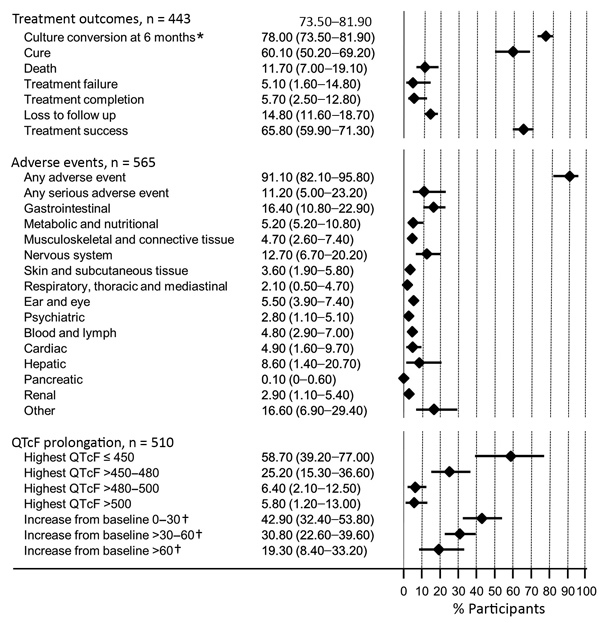
Bedaquiline is recommended by the World Health Organization for the treatment of multidrug-resistant (MDR) and extensively drug-resistant (XDR) tuberculosis (TB). We pooled data from 5 cohorts of patients treated with bedaquiline in France, Georgia, Armenia, and South Africa and in a multicountry study. The rate of culture conversion to negative at 6 months (by the end of 6 months of treatment) was 78% (95% CI 73.5%-81.9%), and the treatment success rate was 65.8% (95% CI 59.9%-71.3%). Death rate was 11.7% (95% CI 7.0%-19.1%). Up to 91.1% (95% CI 82.2%-95.8%) of the patients experienced >1 adverse event, and 11.2% (95% CI 5.0%-23.2%) experienced a serious adverse event. Lung cavitations were consistently associated with unfavorable outcomes. The use of bedaquiline in MDR and XDR TB treatment regimens appears to be effective and safe across different settings, although the certainty of evidence was assessed as very low.
Keywords: Armenia; Asia; China; Europe; France; Georgia; MDR; South Africa; TB; XDR; antimicrobial resistance; bacteria; bedaquiline; extensively drug resistant; individual patient data; multidrug resistant; tuberculosis; tuberculosis and other mycobacteria.
Figures
References
-
- World Health Organization. Global tuberculosis report 2018. 2018. [cited 2018 Dec 11]. https://www.who.int/tb/publications/global_report
-
- World Health Organization. Drug-resistant TB: totally drug-resistant TB FAQ. 2018. [cited 2018 12 Feb]. http://www.who.int/tb/areas-of-work/drug-resistant-tb/totally-drug-resis...
Publication types
MeSH terms
Substances
LinkOut - more resources
Full Text Sources