Association of Maternal Cigarette Smoking and Smoking Cessation With Preterm Birth
- PMID: 31002320
- PMCID: PMC6481448
- DOI: 10.1001/jamanetworkopen.2019.2514
Association of Maternal Cigarette Smoking and Smoking Cessation With Preterm Birth
Abstract
Importance: Cigarette smoking during pregnancy increases the risk of preterm birth, low birth weight, and infant mortality.
Objective: To assess the probability of preterm birth among expectant mothers who smoked cigarettes before pregnancy and quit smoking at the start or during pregnancy.
Design, setting, and participants: This cross-sectional study analyzed information provided on live birth certificates from 2011 through 2017 that were obtained from US states that implemented the 2003 revision of the US live birth certificate. In total, 25 233 503 expectant mothers who delivered live neonates and had known prepregnancy and trimester-specific cigarette smoking frequency were included in the analyses.
Exposures: Cigarette smoking frequency (1-9, 10-19, and ≥20 cigarettes per day) 3 months prior to pregnancy and for each trimester during pregnancy.
Main outcomes and measures: Cigarette smoking cessation throughout pregnancy, after the first trimester, after the second trimester, and during the third trimester irrespective of first and second trimester smoking. Probability of preterm birth (<37 weeks' gestation).
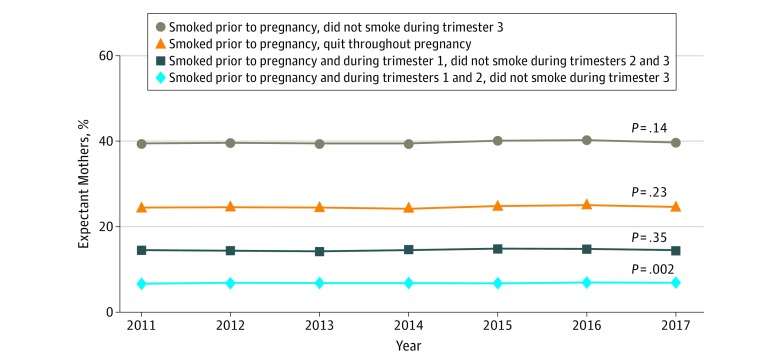
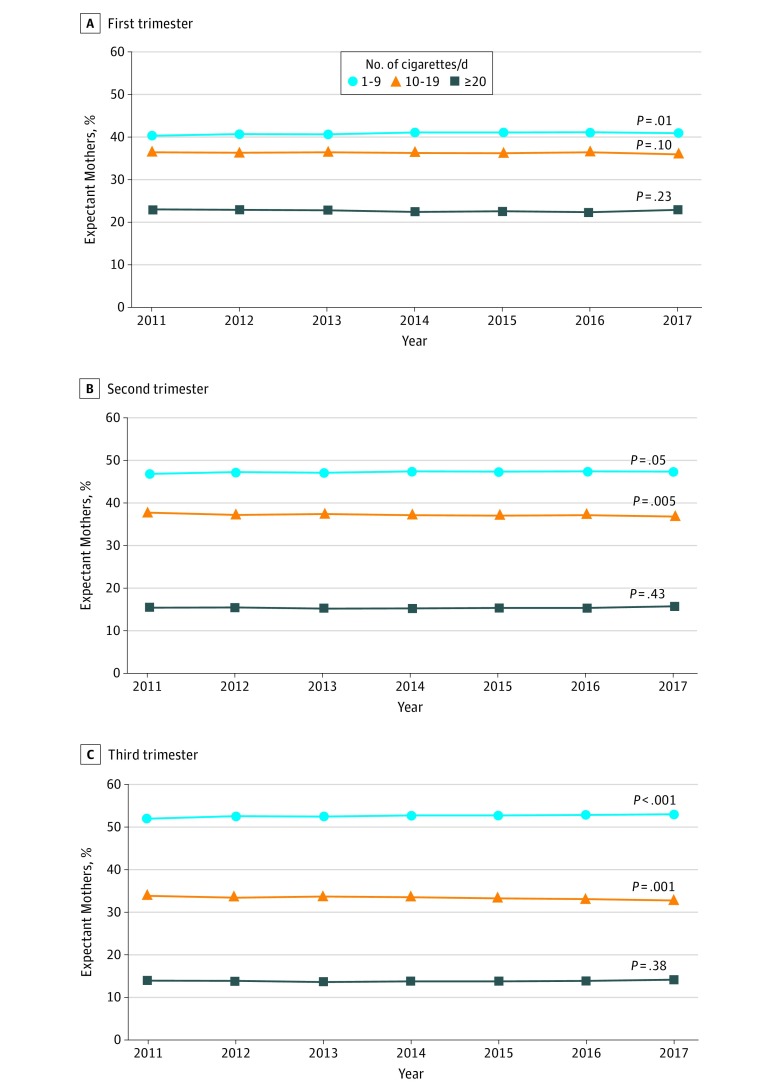
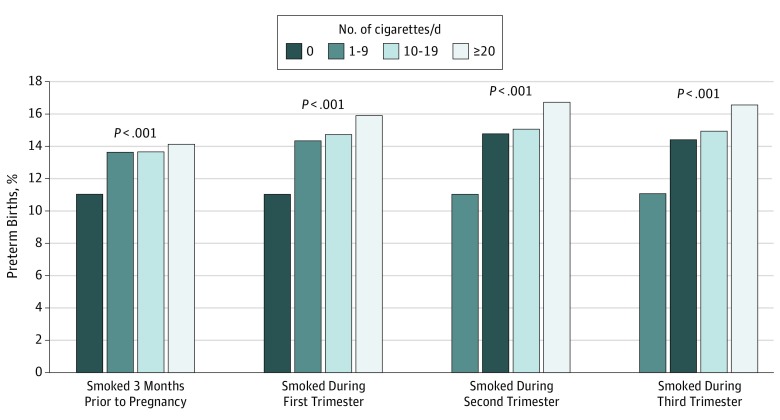
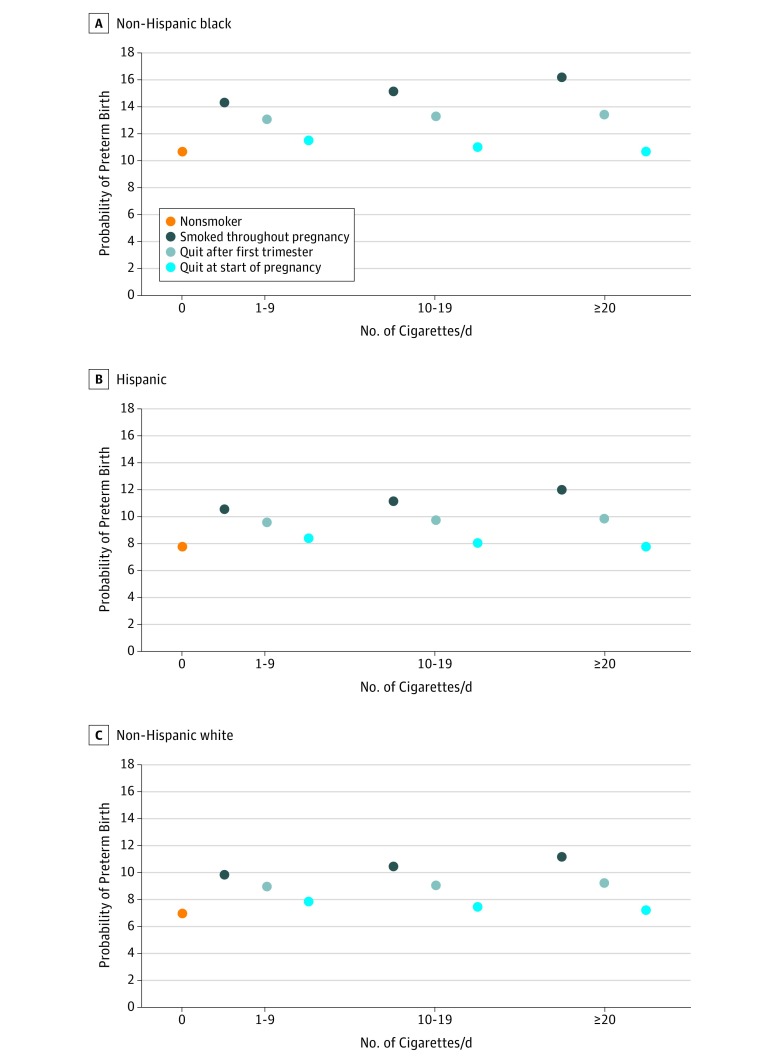
Results: Of 25 233 503 expectant mothers who delivered live neonates between 2011 and 2017, the modal age at delivery was 25 to 29 years; 52.9% were non-Hispanic white, 23.6% were Hispanic, and 14.2% were non-Hispanic black women; 22 600 196 mothers did not smoke during the 3 months prior to pregnancy, and 2 633 307 smoked during the 3 months prior to pregnancy. The proportion of prepregnancy smokers who quit throughout pregnancy was 24.3% in 2011 and 24.6% in 2017. The proportion of prepregnancy smokers who quit during the third trimester was 39.5% in 2011 and 39.7% in 2017. High-frequency cigarette smoking often occurred among expectant mothers who smoked during pregnancy (eg, 46.9% of third-trimester smokers smoked ≥10 cigarettes per day in 2017). The probability of preterm birth decreased more the earlier smoking cessation occurred in pregnancy. For example, the probability of preterm birth was 9.8% (95% CI, 9.7%-10.0%) among 25- to 29-year-old, non-Hispanic white, primigravida and primiparous expectant mothers (ie, pregnant for the first time and not yet delivered) who smoked 1 to 9 cigarettes per day prior to pregnancy and maintained this frequency throughout their pregnancy. The probability of preterm birth was 9.0% (95% CI, 8.8%-9.1%) if smoking cessation occurred at the start of the second trimester (an 8.9% relative decrease), and 7.8% (95% CI, 7.7%-8.0%) if cessation occurred at the start of pregnancy (a 20.3% relative decrease).
Conclusions and relevance: Quitting smoking-and quitting early in pregnancy-was associated with reduced risk of preterm birth even for high-frequency cigarette smokers.
Conflict of interest statement
Figures
Comment in
-
Childhood Oral Infections and Subclinical Atherosclerosis in Adulthood: Should We Wait for Causality or Just Treat?JAMA Netw Open. 2019 Apr 5;2(4):e192489. doi: 10.1001/jamanetworkopen.2019.2489. JAMA Netw Open. 2019. PMID: 31026019 No abstract available.
References
-
- Drake P, Driscoll A, Mathews TJ. Cigarette Smoking during Pregnancy: United States, 2016. Hyattsville, MD: National Center for Health Statistics; 2018. https://www.cdc.gov/nchs/products/databriefs/db305.htm. Accessed February 1, 2019. - PubMed
-
- Walsh RA. Effects of maternal smoking on adverse pregnancy outcomes: examination of the criteria of causation. Hum Biol. 1994;66(6):1059-1092. - PubMed
-
- Schoendorf KC, Kiely JL. Relationship of sudden infant death syndrome to maternal smoking during and after pregnancy. Pediatrics. 1992;90(6):905-908. - PubMed