. 2019 Apr 19;15(4):e1007723.
doi: 10.1371/journal.ppat.1007723. eCollection 2019 Apr.

Structure and mechanism of TagA, a novel membrane-associated glycosyltransferase that produces wall teichoic acids in pathogenic bacteria

Affiliations

Structure and mechanism of TagA, a novel membrane-associated glycosyltransferase that produces wall teichoic acids in pathogenic bacteria

Michele D Kattke et al. PLoS Pathog. .

Abstract

Staphylococcus aureus and other bacterial pathogens affix wall teichoic acids (WTAs) to their surface. These highly abundant anionic glycopolymers have critical functions in bacterial physiology and their susceptibility to β-lactam antibiotics. The membrane-associated TagA glycosyltransferase (GT) catalyzes the first-committed step in WTA biosynthesis and is a founding member of the WecB/TagA/CpsF GT family, more than 6,000 enzymes that synthesize a range of extracellular polysaccharides through a poorly understood mechanism. Crystal structures of TagA from T. italicus in its apo- and UDP-bound states reveal a novel GT fold, and coupled with biochemical and cellular data define the mechanism of catalysis. We propose that enzyme activity is regulated by interactions with the bilayer, which trigger a structural change that facilitates proper active site formation and recognition of the enzyme's lipid-linked substrate. These findings inform upon the molecular basis of WecB/TagA/CpsF activity and could guide the development of new anti-microbial drugs.


Conflict of interest statement

The authors have declared that no competing interests exist.

Figures
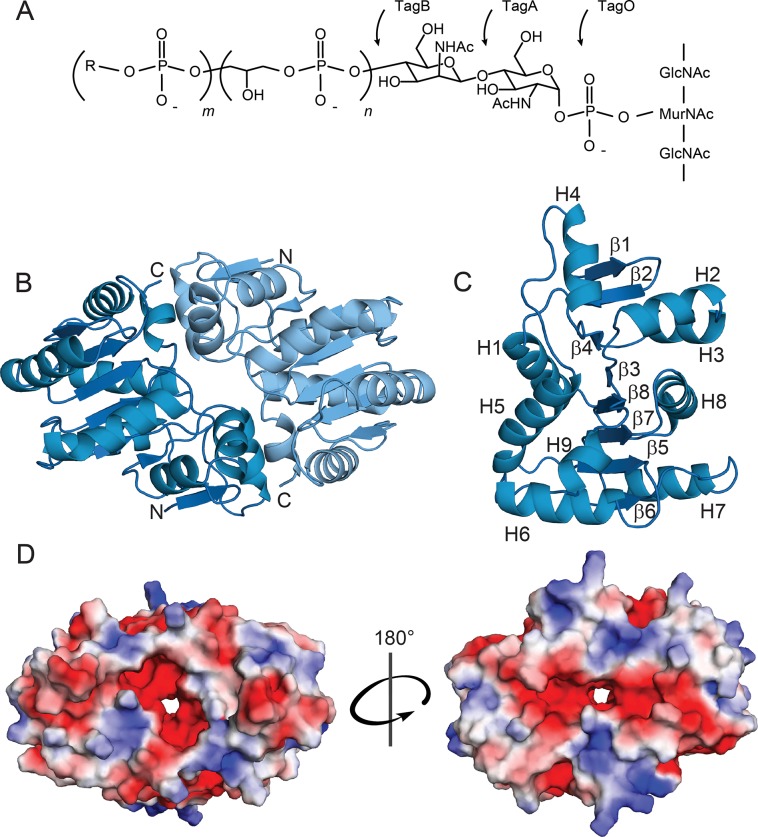
Fig 1
Fig 1. The WTA linkage unit and TagA structural characteristics.
(A) WTA linkage unit and polymer. The linkage unit is attached to the peptidoglycan via the C6-hydroxyl of N-acetylmuramic acid and is composed of a GlcNAc (TagO-catalyzed), ManNAc (TagA-catalyzed), and n = 2–3 glycerol phosphates (TagB- and TagF-catalyzed). R = glycerol or ribitol, m = 40–60. (B) Cartoon ribbon representation of TagAΔC from T. italicus. Apo-TagAΔC crystallizes as a dimer. The dimer interface is over 1000 Å in surface area and is formed by buried hydrophobic residues. (C) TagAΔC protomer with secondary structural elements indicated. H = alpha helix, β = beta strand. (D) Electrostatic surface representation of the TagAΔC dimer. Negatively charged (red), neutral (white), and positively charged (blue) residues are indicated. Rotation of 180° about the dimer interface allows visualization of the pore.
Fig 2
Fig 2. In silico substrate binding and mechanistic studies of TagA.
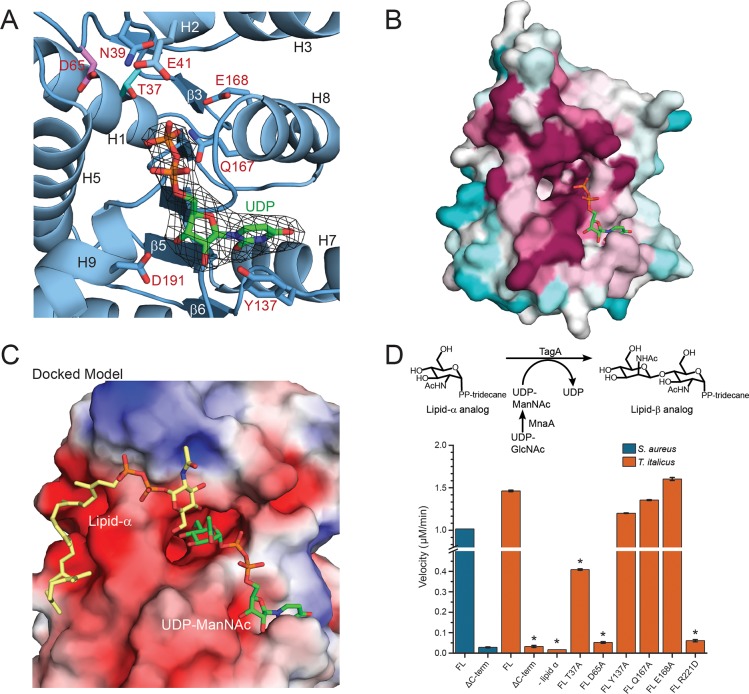
(A) Structure of the UDP:TagAΔC complex. A simulated annealing omit map contoured at 3σ reveals that the β-phosphate of UDP (orange) in the UDP:TagAΔC structure is adjacent to the proposed catalytic base, Asp65 (pink), and putative ManNAc stabilizing residue, Thr37 (cyan). The uracil nucleoside is pi-stacked over Tyr137. (B) Consurf analysis reveals that UDP projects its phosphates (orange) into the pocket and is coordinated by a pocket of highly conserved residues. Highly conserved (magenta), moderately conserved (white) and weakly conserved (teal) residues are indicated. (C) In silico generated model of TagAΔC bound to its substrates. The model contains a lipid-α analog (yellow) and UDP-ManNAc (green). The electrostatic surface of the protein is shown. Negatively charged residues (red), neutral residues (white), positively charged residues (blue) are shown. The coordinates of the model were generated using a two-step procedure. First, the coordinates of the ligand-bound UDP:TagAΔC crystal structure were used to restrain the positioning of UDP-ManNAc. Autodock vina was then used to dock lipid-α. The docking results positioned the non-reducing end of GlcNAc toward the C4 in ManNAc when bound to the TagAΔC dimer. (D) The upper panel indicates the reaction scheme used for the in vitro TagA activity assay. 200 nM TagA enzyme was incubated at 30°C with 100 μM lipid-α substrate analog and UDP-ManNAc produced in situ from UDP-GlcNAc by the epimerase MnaA, followed by quenching with 4M urea. Conversion of UDP-ManNAc to UDP is monitored at 271 nm using a DNAPak PA200 anion exchange column. The lower panel indicates activity measurements of T. italicus and S. aureus TagA enzymes from the in vitro TagA activity assay, as described above. Reactions with error bars were performed in triplicate, and asterisks indicate p<0.005 by Student’s T-test.
Fig 3
Fig 3. Computational and biochemical studies of the TagA enzyme inform cellular localization.
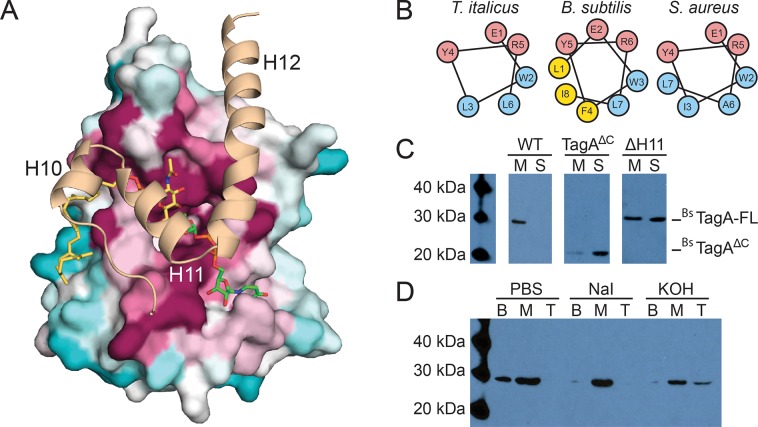
(A) A model of full-length TagA was constructed with experimentally determined TagAΔC (surface representation) and the C-terminal domain, which was modeled by GREMLIN structural prediction (cartoon representation). Three C-terminal helices appear to complete the active site and obstruct the dimeric interface of TagAΔC. Highly conserved (magenta), moderately conserved (white) and weakly conserved (teal) residues are indicated for the TagAΔC crystal structure. (B) Helical wheel projections of helix H11 in TagA homologs predict a putative amphipathic helix. (C) TagA associates with the bacterial cell membrane. Immunoblots of cellular fractionation indicate that B. subtilis TagA is exclusively localized to the membrane (M), while TagAΔC is primarily localized in the supernatant (S). Samples were fractionated by ultracentrifugation identically and the BsTagA-FL blot was exposed for 10 minutes, the BsTagA-V196 blot was exposed for 1 minute, and the BsTagA-ΔH11 blot was exposed for 30 seconds. (D) TagA is a peripheral membrane protein. Chaotropic and alkaline treatments of B. subtilis TagA reveal that the enzyme is peripherally associated with the membrane and is more effectively displaced by alkaline treatment. Treated membrane fractions were loaded onto a sucrose cushion, centrifuged, and carefully separated into bottom (B; pellet), middle (M; sucrose cushion volume), and top (T; sample volume).
Fig 4
Fig 4. Model of the TagA enzyme-substrate complex and mechanism of catalysis.
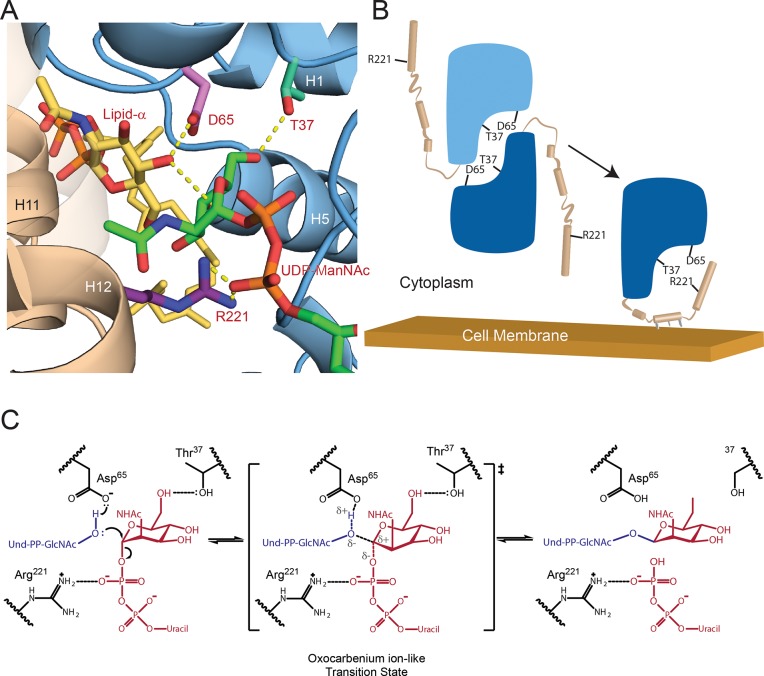
(A) The proposed active site of TagA co-localizes residues D65, T37, and R221. Lipid-α (yellow) is activated by the catalytic base D65 (pink), while ManNAc (green) is positioned by contacts between its C6 hydroxyl and T37 (cyan). The C-terminal helices (tan) are modeled according to GREMLIN structural predictions and place R221 (purple) adjacent to the phosphates of UDP-ManNAc (orange) to putatively stabilize the leaving group. (B) The TagA molecular mechanism is proposed to utilize a dimer to monomer transition to regulate glycosyltransferase activity. TagA is stabilized as a soluble dimer. Upon interaction with the cell membrane, the C-terminus adopts an ordered state and disrupts the dimer interface, which produces a competent active site by co-localizing D65, T37, and R221 to coordinate the soluble UDP-ManNAc and membrane-bound lipid-α substrates. (C) TagA reveals the catalytic mechanism of the GT26 family. Asp65 activates lipid-α, which proceeds to attack UDP-ManNAc in an SN2-like mechanism. Coordination between Arg221 and the phosphates of UDP stabilize the leaving group, permitting the oxocarbenium ion-like transition state. The mechanism is completed by glycosidic bond-formation between GlcNAc and ManNAc to form lipid-β.

References

    1. Formstone A, Carballido-Lopez R, Noirot P, Errington J, Scheffers DJ. Localization and Interactions of Teichoic Acid Synthetic Enzymes in Bacillus subtilis. Journal of Bacteriology. 2008;190(5):1812–21. 10.1128/JB.01394-07 - DOI - PMC - PubMed
    1. Brown S, Xia G, Luhachack LG, Campbell J, Meredith TC, Chen C, et al. Methicillin resistance in Staphylococcus aureus requires glycosylated wall teichoic acids. Proceedings of the National Academy of Sciences of the United States of America. 2012;109(46):18909–14. 10.1073/pnas.1209126109 - DOI - PMC - PubMed
    1. Farha MA, Leung A, Sewell EW, D'Elia MA, Allison SE, Ejim L, et al. Inhibition of WTA synthesis blocks the cooperative action of pbps and sensitizes MRSA to ??-lactams. ACS Chemical Biology. 2013;8(1):226–33. 10.1021/cb300413m - DOI - PMC - PubMed
    1. Heckels BJE, Lambert PA, Baddiley J. Binding of Magnesium Ions to Cell Wals of Bacillus subtilis W23 containing Teichoic Acid or Teichuronic Acid. 1977;162:359–65. - PMC - PubMed
    1. Holland LM, Conlon B, Gara JPO. Mutation of tagO reveals an essential role for wall teichoic acids in Staphylococcus epidermidis biofilm development. 2017;(2011):408–18. 10.1099/mic.0.042234-0 - DOI - PubMed

Publication types