Bacterial and Fungal Endophytic Microbiomes of Salicornia europaea
- PMID: 31003988
- PMCID: PMC6581177
- DOI: 10.1128/AEM.00305-19
Bacterial and Fungal Endophytic Microbiomes of Salicornia europaea
Abstract
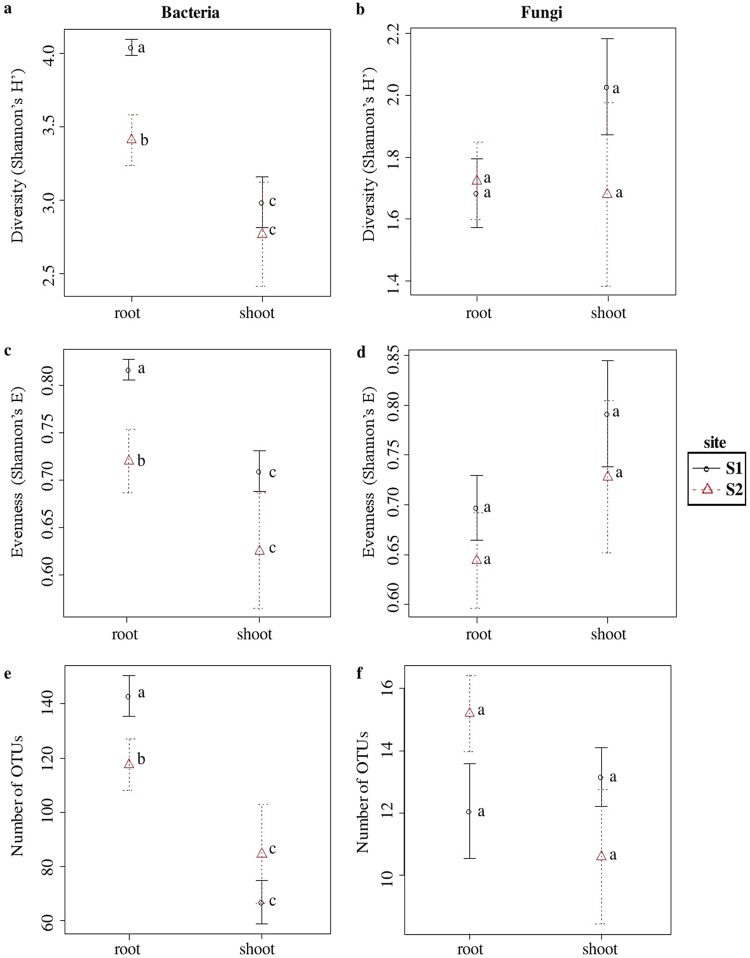
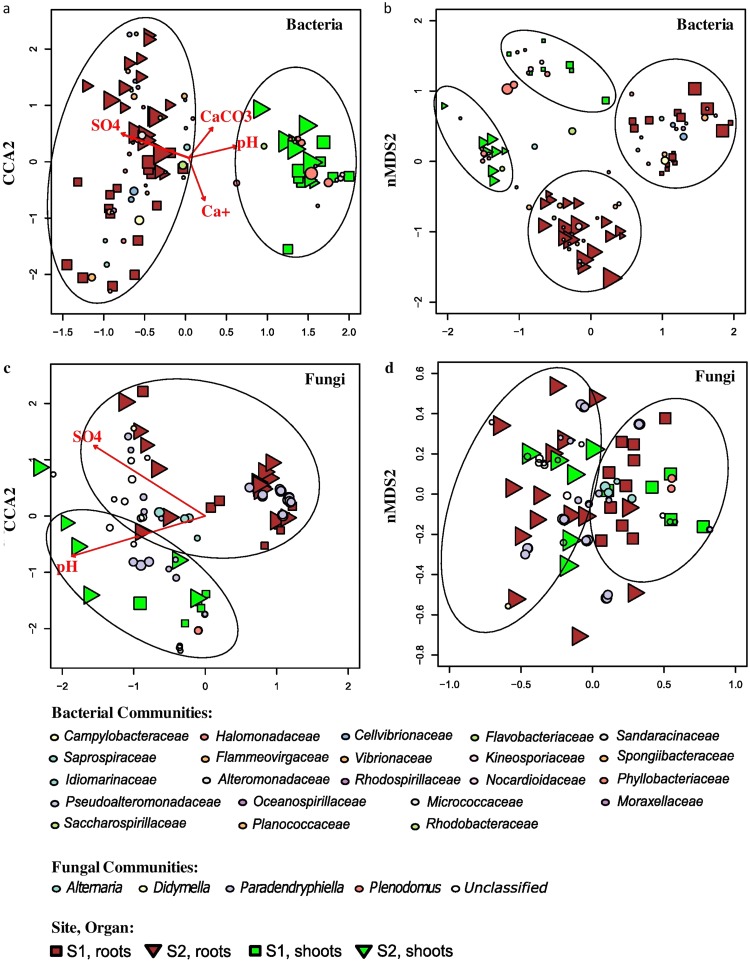
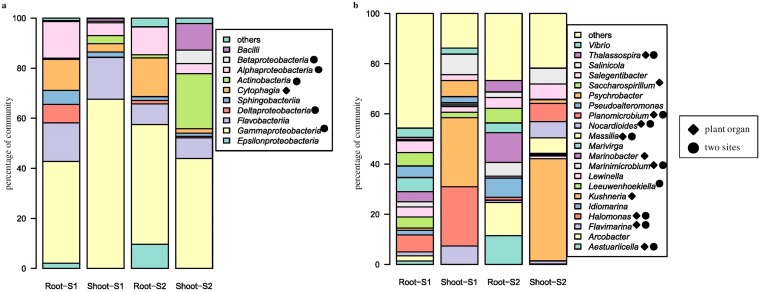
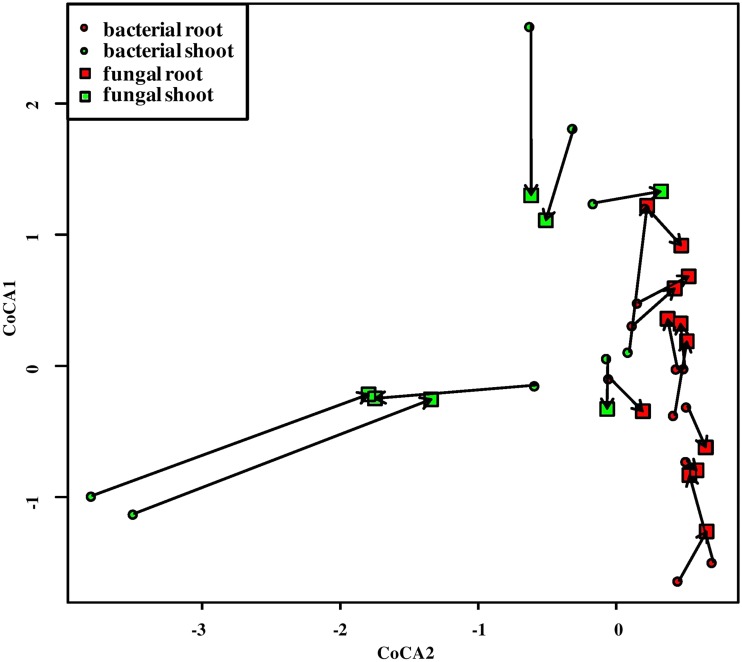
We examined Salicornia europaea, a nonmycorrhizal halophyte associated with specific and unique endophytic bacteria and fungi. The microbial community structure was analyzed at two sites differing in salinization history (anthropogenic and naturally saline site), in contrasting seasons (spring and fall) and in two plant organs (shoots and roots) via 16S rRNA and internal transcribed spacer amplicon sequencing. We observed distinct communities at the two sites, and in shoots and roots, while the season was of no importance. The bacterial community was less diverse in shoot libraries than in roots, regardless of the site and season, whereas no significant differences were observed for the fungal community. Proteobacteria and Bacteroidetes dominated bacterial assemblages, and Ascomycetes were the most frequent fungi. A root core microbiome operational taxonomic unit belonging to the genus Marinimicrobium was identified. We detected a significant influence of the Salicornia bacterial community on the fungal one by means of cocorrespondence analysis. In addition, pathways and potential functions of the bacterial community in Salicornia europaea were inferred and discussed. We can conclude that bacterial and fungal microbiomes of S. europaea are determined by the origin of salinity at the sites. Bacterial communities seemed to influence fungal ones, but not the other way around, which takes us closer to understanding of interactions between the two microbial groups. In addition, the plant organs of the halophyte filter the microbial community composition.IMPORTANCE Endophytes are particularly fascinating because of their multifaceted lifestyle, i.e., they may exist as either free-living soil microbes or saprobic ones or pathogens. Endophytic communities of halophytes may be different than those in other plants because salinity acts as an environmental filter. At the same time, they may contribute to the host's adaptation to adverse environmental conditions, which may be of importance in agriculture.
Keywords: 16S rRNA and ITS amplicon sequencing; endophyte; halophyte; microbial community structure; soil salinity.
Copyright © 2019 Furtado et al.
Figures
References
-
- Ushakova SA, Kovaleva NP, Gribovskaya IV, Dolgushev VA, Tikhomirova NA. 2005. Effect of NaCl concentration on productivity and mineral composition of Salicornia europaea as a potential crop for utilization NaCl in LSS. Adv Sp Res 36:1349–1353. doi: 10.1016/j.asr.2004.09.017. - DOI
-
- Oliveira V, Gomes NCM, Cleary DFR, Almeida A, Silva AMS, Simões MMQ, Silva H, Cunha Â. 2014. Halophyte plant colonization as a driver of the composition of bacterial communities in salt marshes chronically exposed to oil hydrocarbons. FEMS Microbiol Ecol 90:647–662. doi: 10.1111/1574-6941.12425. - DOI - PubMed
-
- Smillie C. 2015. Salicornia spp. as a biomonitor of Cu and Zn in salt marsh sediments. Ecol Indic 56:70–78. doi: 10.1016/j.ecolind.2015.03.010. - DOI
-
- Abrol YP, Wild A. 2004. Soils, land, and food: managing the land during the twenty-first century. Ann Bot 93:785–786. doi: 10.1093/aob/mch104. - DOI
Publication types
MeSH terms
Substances
LinkOut - more resources
Full Text Sources
Medical