. 2019 Apr 19;9(1):6332.
doi: 10.1038/s41598-019-42792-9.

Extinction risks of a Mediterranean neo-endemism complex of mountain vipers triggered by climate change

Affiliations

Extinction risks of a Mediterranean neo-endemism complex of mountain vipers triggered by climate change

Mohsen Ahmadi et al. Sci Rep. .

Abstract

Climate change is among the most important drivers of biodiversity decline through shift or shrinkage in suitable habitat of species. Mountain vipers of the genus Montivipera are under extreme risk from climate changes given their evolutionary history and geographic distribution. In this study, we divided all Montivipera species into three phylogenetic-geographic Montivipera clades (PGMC; Bornmuelleri, Raddei and Xanthina) and applied an ensemble ecological niche modelling (ENM) approach under different climatic scenarios to assess changes in projected suitable habitats of these species. Based on the predicted range losses, we assessed the projected extinction risk of the species relative to IUCN Red List Criteria. Our result revealed a strong decline in suitable habitats for all PGMCs (63.8%, 79.3% and 96.8% for Xanthina, Raddei and Bornmuelleri, respectively, by 2070 and under 8.5 RCP scenario) with patterns of altitudinal range shifts in response to projected climate change. We found that the mountains close to the Mediterranean Sea are exposed to the highest threats in the future (84.6 ± 9.1 percent range loss). We also revealed that disjunct populations of Montivipera will be additionally highly isolated and fragmented in the future. We argue that leveraging climate niche projections into the risk assessment provides the opportunity to implement IUCN criteria and better assess forthcoming extinction risks of species.


Conflict of interest statement

The authors declare no competing interests.

Figures
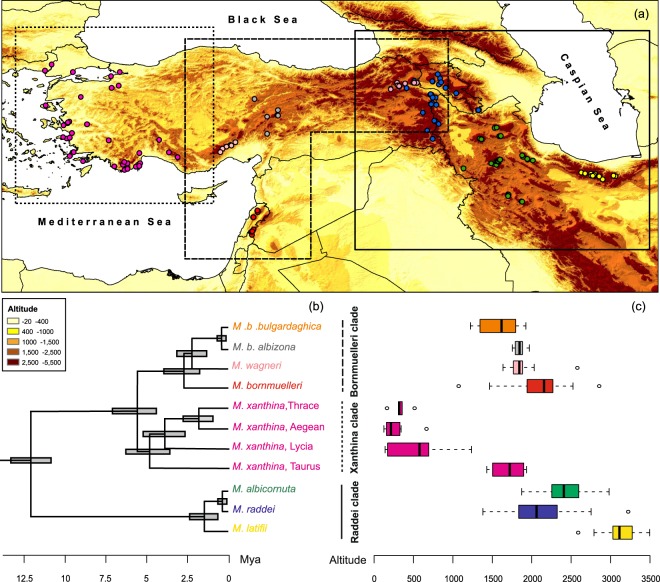
Figure 1
Figure 1
Global distribution of phylogeographic Montivipera clades (PGMCs) (a), their phylogenetic relationship based on Stümpel, et al. (b), and altitudinal distribution patterns in the study area (c).
Figure 2
Figure 2
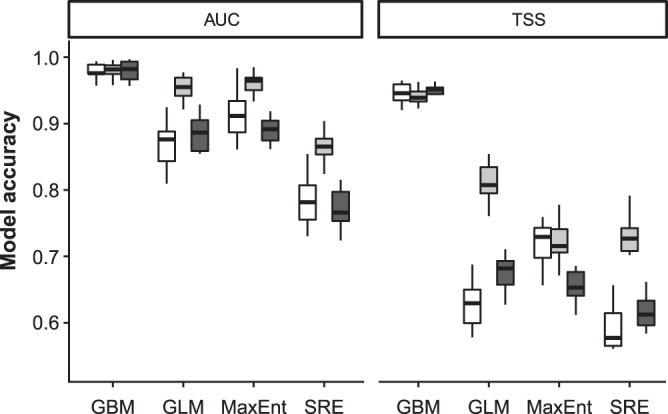
Values of the model’s accuracy based on AUC and TSS of the 10-replicated models for Bornmuelleri (white), Raddei (light gray) and Xanthina (dark grey) clades. GBM; generalized boosted model, GLM; generalized linear model, MaxEnt; maximum entropy, SRE; surface range envelop.
Figure 3
Figure 3
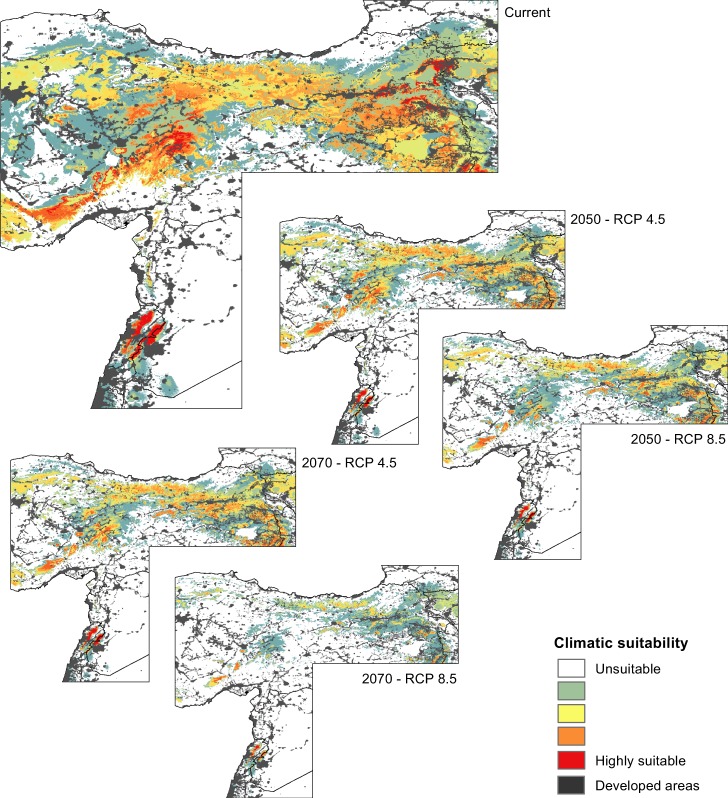
Predicted climatically suitable areas for the Bornmuelleri clade for current and future, 2050 and 2070, with two RCP scenarios. Suitability maps are average calculations of the four GCM models for each time period and RCP scenario. Grey colors show areas with human footprint greater than 50.
Figure 4
Figure 4
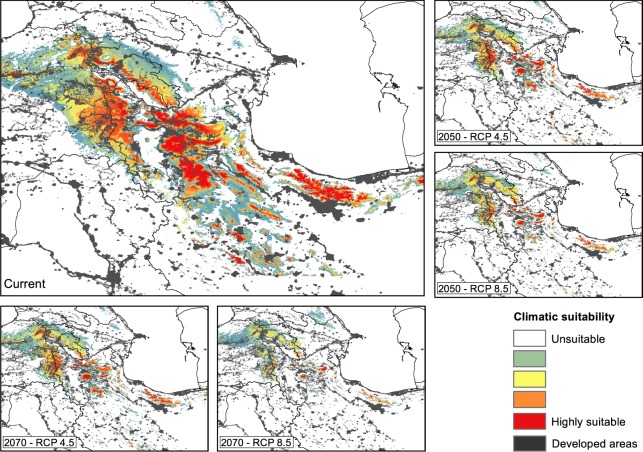
Predicted climatically suitable areas for the Raddei clade for current and future, 2050 and 2070, with two RCP scenarios. Suitability maps are average calculations of the four GCM models for each time period and RCP scenario. Grey colors show areas with human footprint greater than 50.
Figure 5
Figure 5
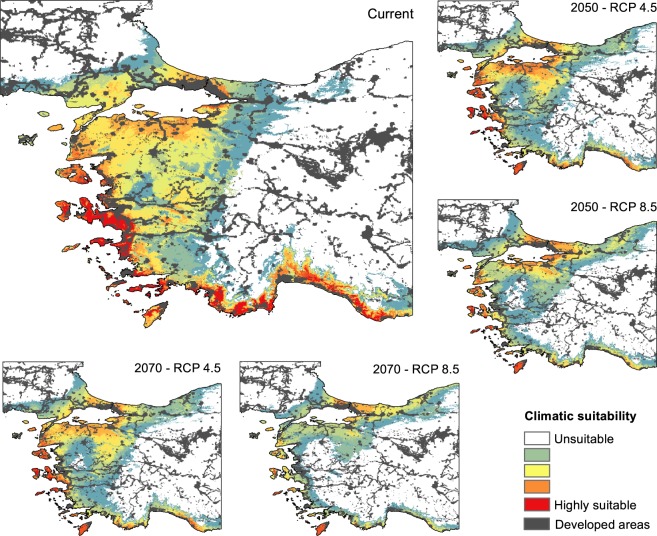
Predicted climatically suitable areas for the Xanthina clade for current and future, 2050 and 2070, with two RCP scenarios. Suitability maps are average calculations of the four GCM models for each time period and RCP scenario. Grey colors show areas with human footprint greater than 50.
Figure 6
Figure 6
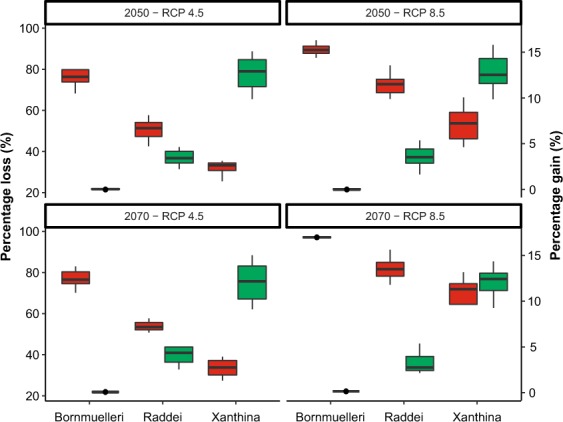
Boxplot of the comparison of percentage loss (red) and gain (green) of climatically suitable patches for the three Montivipera clades under climate change scenarios. Boxplots show variation between four GCM climate projection from ensemble models.
Figure 7
Figure 7
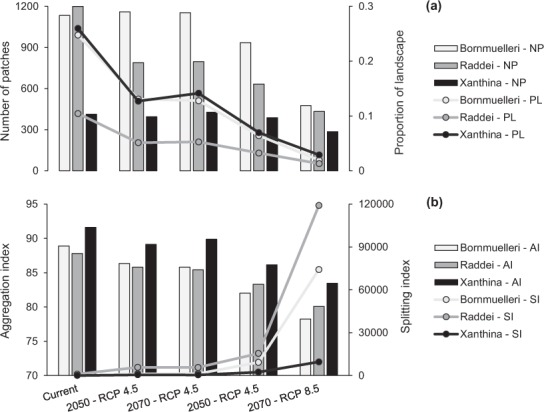
Projected changes in the landscape metrics number of patch (NP), proportion of the landscape (PL), aggregation index (AI) and splitting index (SI) of climatically suitable patches for Montivipera species in eastern Mediterranean Basin.

References

    1. Alroy J. Current extinction rates of reptiles and amphibians. Proc Natl Acad Sci USA. 2015;112:13003–13008. doi: 10.1073/pnas.1508681112. - DOI - PMC - PubMed
    1. Araújo MB, Thuiller W, Pearson RG. Climate warming and the decline of amphibians and reptiles in Europe. J. Biogeogr. 2006;33:1712–1728. doi: 10.1111/j.1365-2699.2006.01482.x. - DOI
    1. Pounds JA, et al. Widespread amphibian extinctions from epidemic disease driven by global warming. Nature. 2006;439:161–167. doi: 10.1038/nature04246. - DOI - PubMed
    1. Urban MC. Accelerating extinction risk from climate change. Science. 2015;348:571–573. doi: 10.1126/science.aaa4984. - DOI - PubMed
    1. Randin CF, et al. Climate change and plant distribution: local models predict high‐elevation persistence. Global Change Biol. 2009;15:1557–1569. doi: 10.1111/j.1365-2486.2008.01766.x. - DOI