. 2019 Apr 19;15(4):65.
doi: 10.1007/s11306-019-1527-0.

Pro- and anti-inflammatory eicosanoids in psoriatic arthritis

Affiliations

Pro- and anti-inflammatory eicosanoids in psoriatic arthritis

Roxana Coras et al. Metabolomics. .

Abstract

Introduction: Eicosanoids are biological lipids that serve as both activators and suppressors of inflammation. Eicosanoid pathways are implicated in synovitis and joint destruction in inflammatory arthritis, yet they might also have a protective function, underscoring the need for a comprehensive understanding of how eicosanoid pathways might be imbalanced. Until recently, sensitive and scalable methods for detecting and quantifying a high number of eicosanoids have not been available.

Objective: Here, we intend to describe a detailed eicosanoid profiling in patients with psoriatic arthritis (PsA) and evaluate correlations with parameters of disease activity.

Methods: Forty-one patients with PsA, all of whom satisfied the CASPAR classification criteria for PsA, were studied. Outcomes reflecting the activity of peripheral arthritis as well as skin psoriasis, Disease Activity Score (DAS)28, Clinical Disease Index (CDAI) and Body Surface Area (BSA) were assessed. Serum eicosanoids were determined by LC-MS, and the correlation between metabolite levels and disease scores was evaluated.

Results: Sixty-six eicosanoids were identified by reverse-phase LC/MS. Certain eicosanoids species including several pro-inflammatory eicosanoids such as PGE2, HXB3 or 6,15-dk,dh,PGF1a correlated with joint disease score. Several eicosapentaenoic acid (EPA)-derived eicosanoids, which associate with anti-inflammatory properties, such as 11-HEPE, 12-HEPE and 15-HEPE, correlated with DAS28 (Disease Activity Score) and CDAI (Clinical Disease Activity Index) as well. Of interest, resolvin D1, a DHA-derived anti-inflammatory eicosanoid, was down-regulated in patients with high disease activity.

Conclusion: Both pro- and anti-inflammatory eicosanoids were associated with joint disease score, potentially representing pathways of harm as well as benefit. Further studies are needed to determine whether these eicosanoid species might also play a role in the pathogenesis of joint inflammation in PsA.

Keywords: Biomarkers; Eicosanoids; Lipidomics; Psoriatic arthritis.


Conflict of interest statement

COMPETING INTERESTS

Roxana Coras declares that she has no conflict of interest.

Arthur Kavanaugh declares that he has no conflict of interest.

Tristan Boyd declares that he has no conflict of interest.

Quyen Huynh declares that she has no conflict of interest.

Brian Pedersen declares that he has no conflict of interest.

Aaron M Armando declares that he has no conflict of interest.

Signe Dahlberg-Wright declares that she has no conflict of interest.

Sara Marsal declares that she has no conflict of interest.

Mohit Jain declares that he has no conflict of interest.

Taraneh Paravar declares that she has no conflict of interest.

Oswald Quehenberger declares that he has no conflict of interest.

Monica Guma declares that she has no conflict of interest.

The authors report no conflict of interest.

Figures
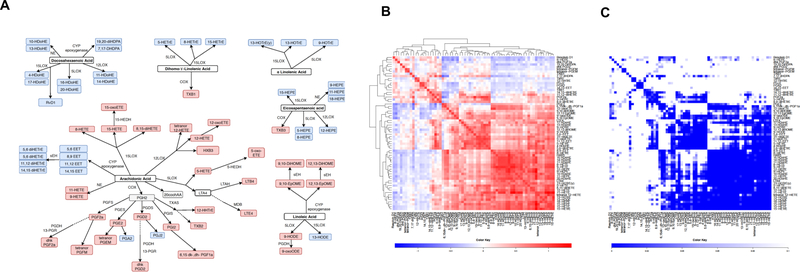
Fig. 1
Fig. 1. Pro-inflammatory and anti-inflammatory eicosanoids.
A) Pro-inflammatory and anti-inflammatory eicosanoids detected in our patients, divided by pathways and origin PUFA. In grey, metabolites not identified by MS COX – cyclooxygenase; LOX – lypooxigenase; CYP – cytochrome P450; NE – non-enzymatic; PGFS – prostaglandin F synthase; PGES – prostaglandin E synthase; PGDS – prostaglandin D synthase; PGIS – prostaglandin I synthase; TXAS – thromboxane A2 synthase; LTAH – leukotriene A4 hydrolase; MDB – membrane dipeptidase; HEDH - hydroxyeicosanoid dehydrogenase; PGDH - hydroxyprostaglandin dehydrogenase; 13-PGR – 15-ketoprostaglandin∆13 reductase; sEH – soluble epoxide hydrolase. B) Heat map and hierarchical cluster analysis indicate positive relationships between circulating eicosanoids identified in blood from PsA patients (the heatmap was created using regression coefficients adjusted for BMI, BSA, NSAIDs and biological therapy. C) Eicosanoid regression p-values are displayed in C, where the row and column order are preserved from B
Fig. 2
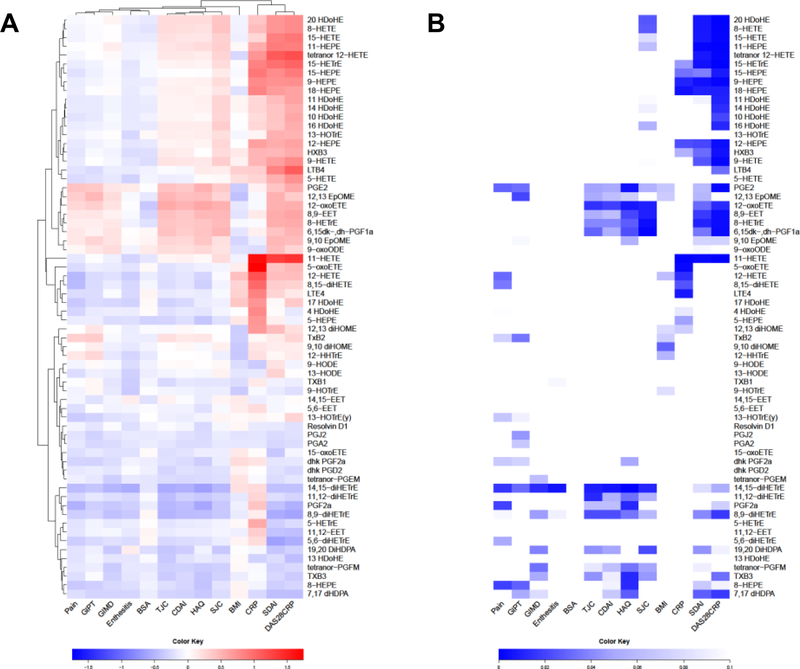
Fig. 2. Clinical score correlations with eicosanoids.
A) Linear regression was performed between each clinical score – eicosanoid pair, controlling for BMI, NSAIDs and biological therapy. We also adjusted joint disease scores (TJC, SJC, DAS28, CDAI and SDAI) for BSA, and BSA score was also adjusted for CDAI. Other factors, including comorbidities, gender and age were not found to influence eicosanoid levels and were not included in the model. The regression coefficients for each pair were used to form a clustered heatmap, to lend insight into which clinical scores were correlated with which groups of eicosanoids. Row clusters have been identified by cophenetic cutting of the row dendrogram. B) Metabolite regression p-values are displayed in Figure 2B, where the row and column order are preserved from Figure 2A TJC: tender joint count; SJC: swollen joint count; CDAI: clinical Disease Activity Index; SDAI: simple Disease Activity Index; HAQ: Health Assessment Questionnaire; GIMD: physician global assessment; GIPT: patient global assessment; BMI: body mass index; BSA: body surface area; DAS28CRP: disease assessment score 28; NSAIDS: non-steroidal anti-inflammatory drugs
Fig. 3
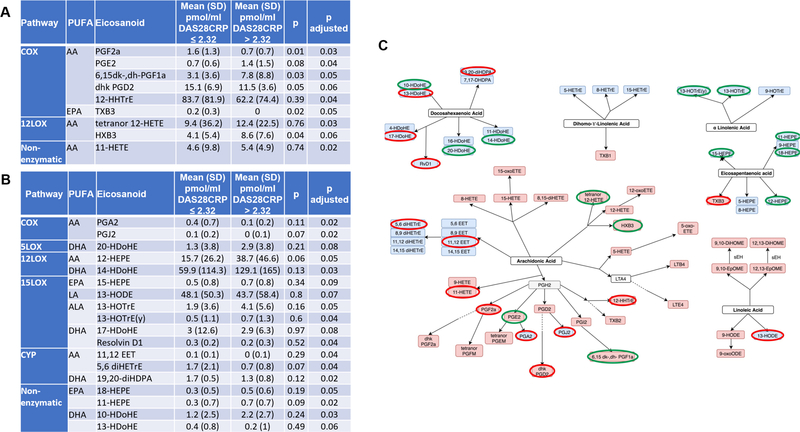
Fig. 3. Pro- and anti-inflammatory eicosanoids associated with DAS28-CRP.
Logistic regression was performed between each eicosanoid (pmol/ml) in patients with DAS ≤ 2.32 compared with patients with DAS > 2.32. A) Pro-inflammatory eicosanoids with p value < 0.1 after adjusting for BMI, BSA, NSAIDs and biological therapy. B) Anti-inflammatory eicosanoids with p value < 0.1 after adjusting for BMI, BSA, NSAIDs and biological therapy. Other factors, including comorbidities, gender and age were not found to influence eicosanoid levels and were not included in the model. C) Significant eicosanoids (p < 0.1) are circled in green if upregulated in patients with DAS > 2.32, and in red if downregulated in these patients. DAS28: disease activity score; NSAIDs: non-steroidal anti-inflammatory drugs

References

    1. Arnardottir HH, Dalli J, Norling LV, Colas RA, Perretti M and Serhan CN (2016) Resolvin D3 Is Dysregulated in Arthritis and Reduces Arthritic Inflammation. J Immunol 197, 2362–8. - PMC - PubMed
    1. Buczynski MW, Dumlao DS and Dennis EA (2009) Thematic Review Series: Proteomics. An integrated omics analysis of eicosanoid biology. J Lipid Res 50, 1015–38. - PMC - PubMed
    1. Chen M, Lam BK, Kanaoka Y, Nigrovic PA, Audoly LP, Austen KF and Lee DM (2006) Neutrophil-derived leukotriene B4 is required for inflammatory arthritis. J Exp Med 203, 837–42. - PMC - PubMed
    1. Dennis EA and Norris PC (2015) Eicosanoid storm in infection and inflammation. Nat Rev Immunol 15, 511–23. - PMC - PubMed
    1. Gheorghe KR, Korotkova M, Catrina AI, Backman L, af Klint E, Claesson HE, Radmark O and Jakobsson PJ (2009) Expression of 5-lipoxygenase and 15-lipoxygenase in rheumatoid arthritis synovium and effects of intraarticular glucocorticoids. Arthritis Res Ther 11, R83. - PMC - PubMed

Publication types