Review
. 2019 Jul:25:11-19.
doi: 10.1016/j.molmet.2019.04.002. Epub 2019 Apr 10.

Redox control of non-shivering thermogenesis

Affiliations
Review

Redox control of non-shivering thermogenesis

Daniele Lettieri-Barbato. Mol Metab. 2019 Jul.

Abstract

Background: Thermogenic adipocytes reorganize their metabolism during cold exposure. Metabolic reprogramming requires readily available bioenergetics substrates, such as glucose and fatty acids, to increase mitochondrial respiration and produce heat via the uncoupling protein 1 (UCP1). This condition generates a finely-tuned production of mitochondrial reactive oxygen species (ROS) that support non-shivering thermogenesis.

Scope of review: Herein, the findings underlining the mechanisms that regulate ROS production and control of the adaptive responses tuning thermogenesis in adipocytes are described. Furthermore, this review describes the metabolic responses to substrate availability and the consequence of mitochondrial failure to switch fuel oxidation in response to changes in nutrient availability. A framework to control mitochondrial ROS threshold to maximize non-shivering thermogenesis in adipocytes is provided.

Major conclusions: Thermogenesis synchronizes fuel oxidation with an acute and transient increase of mitochondrial ROS that promotes the activation of redox-sensitive thermogenic signaling cascade and UCP1. However, an overload of substrate flux to mitochondria causes a massive and damaging mitochondrial ROS production that affects mitochondrial flexibility. Finding novel thermogenic redox targets and manipulating ROS concentration in adipocytes appears to be a promising avenue of research for improving thermogenesis and counteracting metabolic diseases.

Keywords: Adipocyte; Adipose tissue; Mitochondrial metabolism; Obesity; Type 2 diabetes.


Figures

Figure 1
Figure 1
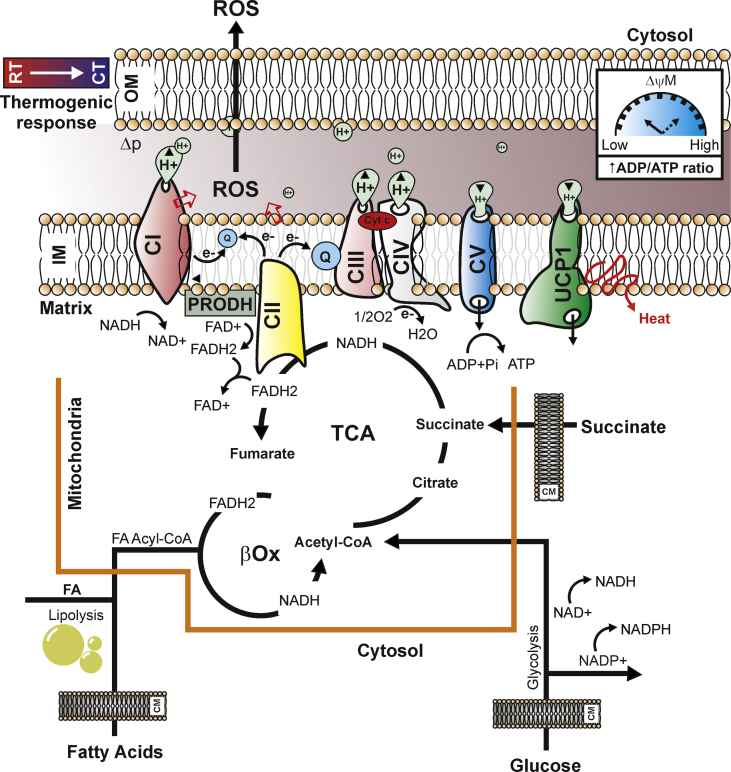
Cold exposure induces mitochondrial metabolism reprogramming in adipose cells. Exposure to cool temperatures enhances glucose, fatty acids, and succinate uptake in brown adipocytes, which boosts tricarboxylic acid cycle (TCA) providing reducing equivalents (NADH and FADH2) and acetyl-CoA. In parallel, intracellular lipolysis helps funnel fatty acids towards β-oxidation producing additional NADH, FADH2, and acetyl-CoA units. The enhanced metabolite availability is coupled to an increased redox pressure (high NADH/NAD+, FADH2/FAD+) generating the proton motive force (Δp) and electron transport flux, which are mandatory for heat production through uncoupled respiration (low ΔψM). During thermogenesis, the massive oxygen consumption and the low energy production caused by UCP1 activation could activate proline dehydrogenase (PRODH) thus producing other FADH2 molecules that donate electrons to Complex II (CII). Under such metabolic circumstance the ubiquinone (Q) receives electrons from complex I (CI) and CII, and the electrons mainly leak to produce superoxide from the CI during the oxidation of NADH to NAD+. The consequent, transient production of functional mitochondrial ROS represents an epiphenomenon of the mitochondrial reprogramming required to sustain thermogenesis. RT: Room Temperature; CT: Cool Temperature; IM: Inner Mitochondrial Membrane; OM: Outer Mitochondrial Membrane; CM: Cell Membrane; UCP1: Uncoupling Protein 1.
Figure 2
Figure 2
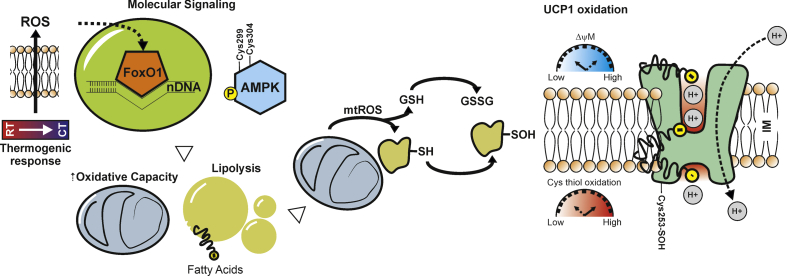
Thermogenic mitochondrial ROS drive metabolic and molecular pathways in adipocytes. Thermal shift toward cooler temperature leads to a transient production of mitochondrial ROS that induces FoxO1 nuclear redistribution and AMPK activation. This molecular signaling increases fatty acids availability (increased lipolysis and fatty acids uptake) to enhance the conductance of UCP1 to H+ sustaining the uncoupled respiration though mitochondrial oxidative flux. The thermogenic action of mitochondrial ROS seems to be mediated by reversible thiol (−SH) oxidations such as sulfenylation (−SOH) of effector mitochondrial proteins (e.g. UCP1). RT: Room Temperature; CT: Cool Temperature; GSH: reduced glutathione; GSSG: oxidized glutathione.
Figure 3
Figure 3
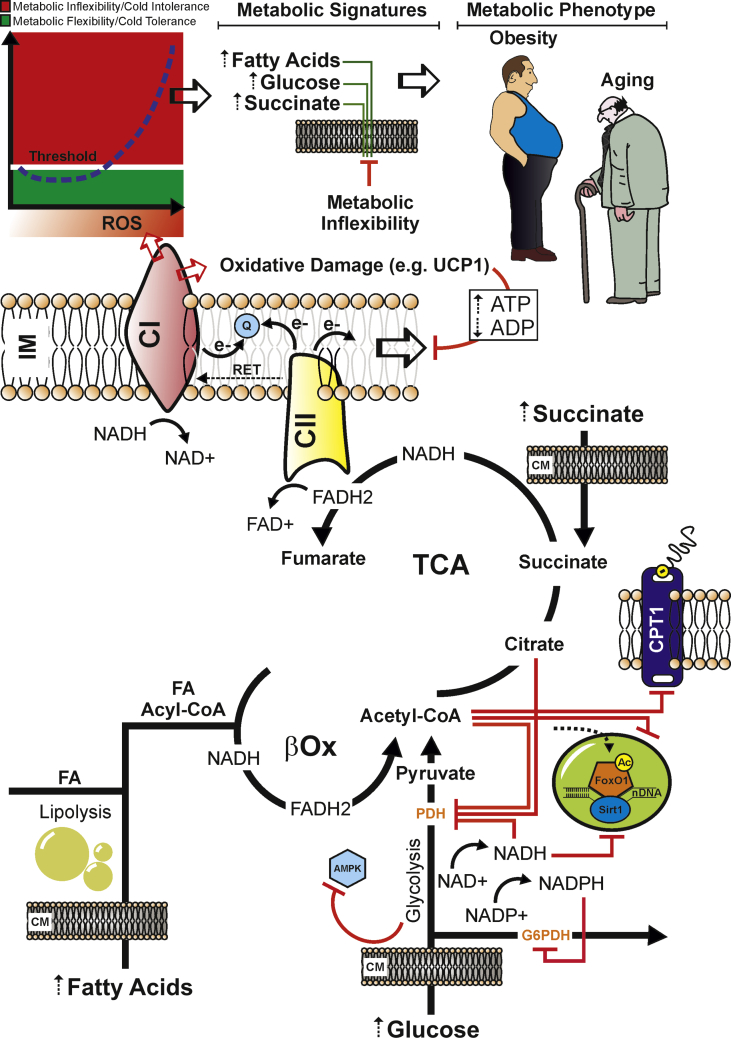
Persistent nutrient overload promotes mitochondrial exhaustion and an uncontrolled ROS production that culminates in a systemic metabolic inflexibility. Dietary nutrient overload (e.g. fats and carbohydrates excess) enhances mitochondrial redox pressure (high NADH and FADH2) and electron flow. Under such stressful conditions, Q pool becomes over-reduced, and a high membrane potential drives the reverse transfer of electrons from Q to complex I (CI) in a process called reverse electron transport (RET). During RET electrons leak at CI generating a significant amount of superoxide. Overcoming the functional redox threshold induces mitochondrial oxidative damage in the redox sensitive proteins (e.g. UCP1), affecting the uncoupled respiration. This could increase the ATP levels, thus slowing-down (negative feed-back) the mitochondria electron transfer and proton pump. Nutrient overload also causes acetyl-CoA, citrate, NADH, FADH2, and NADPH accumulation, which allosterically inhibits the metabolic checkpoints, i.e. pyruvate dehydrogenase (PDH), glucose-6-posphate dehydrogenase (G6PDH), and carnitine palmitoyltransferase I (CPT1). Hence, AMPK could be phospho-inactivated and the nuclear FoxO1 could be hyperacetylated (as consequence of NAD+-dependent Sirt1 inhibition). This metabolic and molecular setting could promote the overwhelming of the redox threshold (red zone), which is causative of cold intolerance, metabolic inflexibility and mitochondrial substrate indecision. This condition leads to a systemic impairment of fuel utilization and elevation of circulating levels of glucose, fatty acids, and succinate, which represent typical metabolic hallmarks of obesity, type 2 diabetes and aging. IM: Inner Mitochondrial Membrane; CM: Cell Membrane.

References

    1. Chouchani E.T., Kazak L., Spiegelman B.M. New advances in adaptive thermogenesis: UCP1 and beyond. Cell Metabolism. 2019;29:27–37. - PubMed
    1. Jastroch M., Oelkrug R., Keipert S. Insights into brown adipose tissue evolution and function from non-model organisms. Journal of Experimental Biology. 2018;221 - PubMed
    1. Gerkema M.P., Davies W.I., Foster R.G., Menaker M., Hut R.A. The nocturnal bottleneck and the evolution of activity patterns in mammals. Proceedings of the Royal Society B: Biological Sciences. 2013;280:20130508. - PMC - PubMed
    1. Genin F., Nibbelink M., Galand M., Perret M., Ambid L. Brown fat and nonshivering thermogenesis in the gray mouse lemur (Microcebus murinus) American Journal of Physiology – Regulatory, Integrative and Comparative Physiology. 2003;284:R811–R818. - PubMed
    1. van Marken Lichtenbelt W.D., Vanhommerig J.W., Smulders N.M., Drossaerts J.M., Kemerink G.J., Bouvy N.D. Cold-activated brown adipose tissue in healthy men. New England Journal of Medicine. 2009;360:1500–1508. - PubMed

Publication types

MeSH terms

Substances