Antiproliferative Effects of Matricine in Gemcitabine-Resistant Human Pancreatic Carcinoma Cells Are Mediated via Mitochondrial-Mediated Apoptosis, Inhibition of Cell Migration, Invasion Suppression, and Mammalian Target of Rapamycin (mTOR)-TOR/PI3K/AKT Signalling Pathway
- PMID: 31005960
- PMCID: PMC6489536
- DOI: 10.12659/MSM.914244
Antiproliferative Effects of Matricine in Gemcitabine-Resistant Human Pancreatic Carcinoma Cells Are Mediated via Mitochondrial-Mediated Apoptosis, Inhibition of Cell Migration, Invasion Suppression, and Mammalian Target of Rapamycin (mTOR)-TOR/PI3K/AKT Signalling Pathway
Retraction in
-
Retracted: Antiproliferative Effects of Matricine in Gemcitabine-Resistant Human Pancreatic Carcinoma Cells Are Mediated via Mitochondrial-Mediated Apoptosis, Inhibition of Cell Migration, Invasion Suppression, and Mammalian Target of Rapamycin (mTOR)-TOR/PI3K/AKT Signalling Pathway.Med Sci Monit. 2021 Mar 25;27:e932342. doi: 10.12659/MSM.932342. Med Sci Monit. 2021. PMID: 33762568 Free PMC article.
Abstract
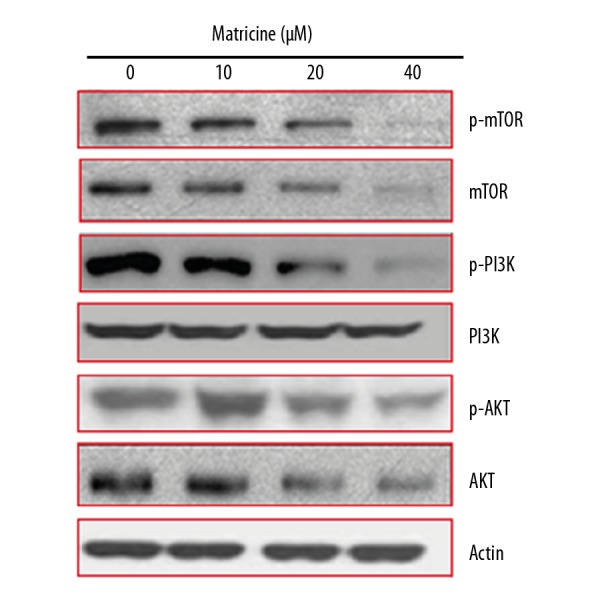
BACKGROUND Pancreatic cancer is a major cause of mortality worldwide. Inefficient drugs, their adverse effects, and the development of drug resistance make it difficult to curb the growing incidence of pancreatic cancer. Against this backdrop, the development new drug regimens with no or negligible adverse effects is imperative. We assessed the anticancer effects of a plant-derived sesquiterpene - matricine - against capan-2 pancreatic cancer cells. MATERIAL AND METHODS Cell viability was determined by MTT assay. AO/EB, DAPI, and annexin V/PI staining were used to detect apoptosis. Transwell assays were used for monitoring of cell migration and invasion. Immunoblotting was used to examine the expression of proteins. RESULTS The results showed that matricine halted the proliferation of capan-2 cells, with minimal toxic effects on normal pancreatic cells. The anticancer effects were due to the induction of apoptotic cell death, which was allied with activation of caspases 3 and 9, upregulation of Bax, and downregulation of Bcl-2. Moreover, matricine suppressed the migration and invasive abilities of pancreatic cancer cells at IC50. We also assessed the effects of matricine on the mTOR/PI3K/AKT signalling pathway. We found that matricine efficiently blocked this pathway, suggesting the anticancer potential of matricine. CONCLUSIONS Matricine induced antiproliferative effects in capan-2 human pancreatic cancer cells through inducing apoptosis, caspase activation, inhibition of cell migration and invasion, and blocking the mTOR/PI3K/AKT signalling pathway.
Conflict of interest statement
None.
Figures


References
-
- Phillipson JD. Natural products as drugs. Trans R Soc Trop Med Hyg. 1994;88(Suppl 1):17–19. - PubMed
-
- Tietze LF, Modi A. Multicomponent domino reactions for the synthesis of biologically active natural products and drugs. Med Res Rev. 2000;20(4):304–22. - PubMed
-
- Choi EJ, Lee JI, Kim GH. Evaluation of the anticancer activities of thioflavanone and thioflavone in human breast cancer cell lines. Int J Mol Med. 2012;29(2):252–56. - PubMed
-
- Han R. Highlight on the studies of anticancer drugs derived from plants in China. Stem Cells. 1994;12(1):53–63. - PubMed
-
- Moraes DF, de Mesquita LS, do Amaral FM, et al. Biotechnology and production of anti-cancer compounds. Springer; Cham: 2017. Anticancer drugs from plants; pp. 121–42.
Publication types
MeSH terms
Substances
LinkOut - more resources
Full Text Sources
Medical
Research Materials
Miscellaneous