Changes in Shape and Size Discrimination and State Anxiety After Alternate-Nostril Yoga Breathing and Breath Awareness in One Session Each
- PMID: 31006767
- PMCID: PMC6496972
- DOI: 10.12659/MSMBR.914956
Changes in Shape and Size Discrimination and State Anxiety After Alternate-Nostril Yoga Breathing and Breath Awareness in One Session Each
Abstract
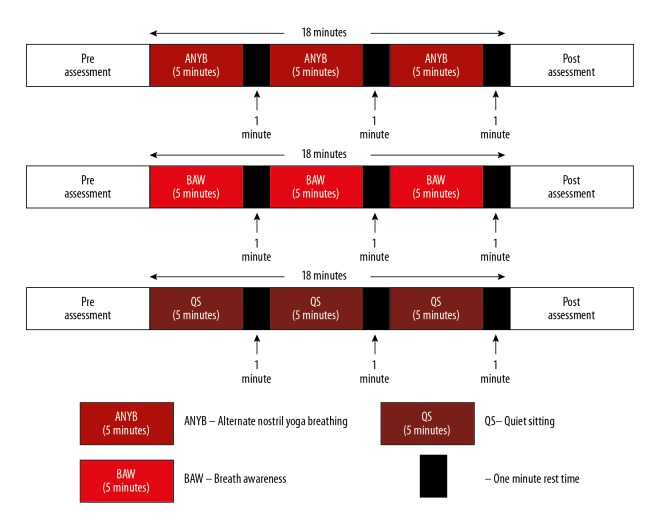
BACKGROUND Yoga breathing techniques like high-frequency yoga breathing (HFYB) and breath awareness (BAW) have been associated with improved performance in the shape and size discrimination task. A PubMed search of the literature revealed that alternate-nostril breathing has been shown to improve performance in attention tasks, but the effect on tactile perception has not been studied. Hence, the present study was designed to assess the immediate effects of alternate-nostril yoga breathing (ANYB) compared to breath awareness on shape and size discrimination and state anxiety. MATERIAL AND METHODS Fifty healthy male volunteers ages 20-50 years (group mean ±S.D., 28.4±8.2 years) were recruited. Each participant was assessed in 3 sessions conducted on 3 separate days at the same time of day. The 3 sessions were (i) alternate-nostril yoga breathing (ANYB), (ii) breath awareness (BAW), and (iii) quiet sitting (QS), and the sequence of the sessions was randomly allocated. The shape and size discrimination task and state anxiety were assessed before and after all 3 sessions. Repeated measures analysis of variance (RM-ANOVA) followed by post hoc tests for multiple comparisons, which were Bonferroni-adjusted, were performed to compare data before and after all 3 sessions using SPSS version 18.0. RESULTS The errors scores in the shape and size discrimination task showed a significant reduction after the ANYB session (p<0.001). A significant reduction was found in the level of state anxiety after breath awareness (p<0.05) and quiet sitting sessions (p<0.001). CONCLUSIONS The present results suggest that ANYB: (i) improves performance in a task which requires perceptual sensitivity and focused attention, but (ii) does not reduce state anxiety following this task.
Conflict of interest statement
None.
Figures
References
-
- Moore CM, Yantis S, Vaughan B. Object-based visual selection: Evidence from perceptual completion. Psychol Sci. 1988;9:104–10.
-
- Balas BJ. Texture synthesis and perception: Using computational models to study texture representations in the human visual system. Vision Res. 2006;46:299–309. - PubMed
-
- Lederman SJ, Klatzky RL. Extracting object properties through haptic exploration. Acta Psychol. 1993;84:29–40. - PubMed
-
- Grunwald M. Human haptic perception-basics and applications. Berlin (Germany): Birkhauser; 2008.
-
- Brown DP. A model for the levels of concentrative meditation. Int J Clin Exp Hypn. 1977;25:236–73. - PubMed