


Trends in obesity prevalence among total hip arthroplasty patients and the effect on surgical outcomes, 2008-2016
- PMID: 31007457
- PMCID: PMC6458338
- DOI: 10.1016/j.jor.2019.03.024
Trends in obesity prevalence among total hip arthroplasty patients and the effect on surgical outcomes, 2008-2016
Erratum in
-
Erratum regarding missing Declaration of Competing Interest statements in previously published articles.J Orthop. 2020 Dec 15;24:293. doi: 10.1016/j.jor.2020.12.006. eCollection 2021 Mar-Apr. J Orthop. 2020. PMID: 33994702 Free PMC article.
Abstract
Introduction: The prevalence of obesity continues to rise in parallel with demand for total hip arthroplasty (THA). This study aims to report obesity trends in primary THA and its effects on procedure outcomes in the United States, stratifying based on Body Mass Index (BMI).
Methods: Primary THA procedures were identified in the American College of Surgeons National Surgical Quality Improvement Program (ACS-NSQIP) database (2008-2016). Patient demographic (including BMI), primary outcomes (death; serious morbidity), and secondary outcome variables were analyzed. Using BMI comparison groups (Obese: BMI > 30 [O]; Morbidly Obese: BMI > 40 [MO]) for case populations, univariate, propensity score-matched, and multivariate logistic regression analyses were performed.
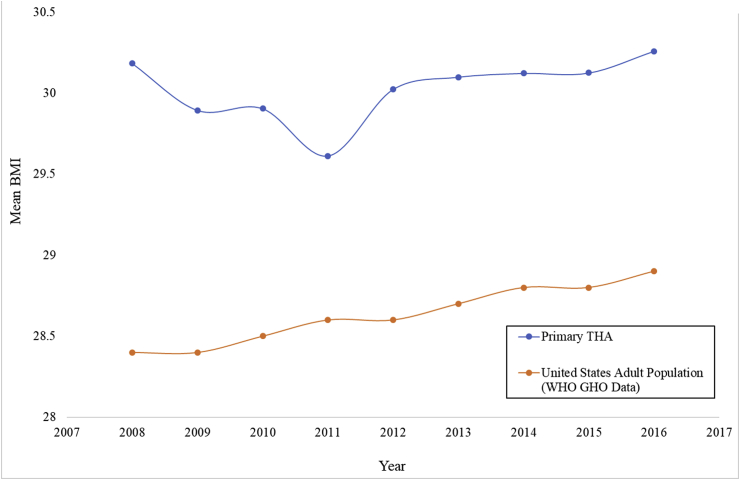
Results: The prevalence of obesity increased among primary THA (2008: 546/1200 [45.5%], 2016: 16,078/34,137 [47.1%]) cases. Data on 135,013 primary THA cases were analyzed. Propensity score-matched analyses demonstrated that both serious morbidity (O: OR = 0.73, p < 0.001; MO: OR = 0.84, p = 0.001) and frequency of discharges home (O: OR = 0.90, p < 0.001; MO: OR = 0.71, p < 0.001) were significantly reduced. Instead, long operative times (O: OR = 1.30, p < 0.001; MO: OR = 1.53, p < 0.001), readmission (O: OR = 1.27, p < 0.001; MO: OR = 1.49, p < 0.001), and reoperation (O: OR = 1.44, p < 0.001, MO: OR = 1.96, p < 0.001) were all significantly increased in both obese and morbidly obese cases. Death (OR = 0.29; p = 0.016) was decreased in the MO cohort, while length of stay (OR = 1.19, p = 0.004) was increased in the MO cohort.
Conclusion: Both obese and morbidly obese primary THA patient populations were associated with variably increased complication risks; morbidly obese patients had higher complication rates relative to obese patients. Orthopaedic surgeons should continue to consider obesity as a risk factor for THA complications. However, given similar functional outcomes and satisfaction levels as non-obese patients, denying patients THA surgery based on BMI alone may merit reconsideration.
Keywords: Complications; NSQIP; Obesity; Outcomes; Propensity score-matching; Total hip arthroplasty.
Figures
References
-
- World Health Organization (WHO . Health; 2017. Obesity and Overweight Factsheet from the WHO.
-
- Ogden C.L., Carroll M.D., Fryar C.D., Flegal K.M. US Department of Health and Human Services, Centers for Disease Control and Prevention, National Center for Health Statistics; 2015. Prevalence of Obesity Among Adults and Youth: United States, 2011-2014.
-
- Kurtz S., Ong K., Lau E., Mowat F., Halpern M. Projections of primary and revision hip and knee arthroplasty in the United States from 2005 to 2030. J Bone Joint Surg Am. 2007;89(4):780–785. doi: 89/4/780 [pii] - PubMed
-
- Kulkarni K., Karssiens T., Kumar V., Pandit H. Obesity and osteoarthritis. Maturitas. 2016;89:22–28. - PubMed
-
- Liu W., Wahafu T., Cheng M., Cheng T., Zhang Y., Zhang X. The influence of obesity on primary total hip arthroplasty outcomes: a meta-analysis of prospective cohort studies. Orthop Traumatol: Surg Res. 2015;101(3):289–296. - PubMed
LinkOut - more resources
Full Text Sources
