


Yield responses of arable crops to liming - An evaluation of relationships between yields and soil pH from a long-term liming experiment
- PMID: 31007524
- PMCID: PMC6472519
- DOI: 10.1016/j.eja.2019.02.016
Yield responses of arable crops to liming - An evaluation of relationships between yields and soil pH from a long-term liming experiment
Erratum in
-
Corrigendum to "Yield responses of arable crops to liming - An evaluation of relationships between yields and soil pH from a long-term liming experiment" [Eur. J. Agron. 105 (2019) 176-188].Eur J Agron. 2024 Sep;159:None. doi: 10.1016/j.eja.2024.127221. Eur J Agron. 2024. PMID: 39220369 Free PMC article.
Abstract
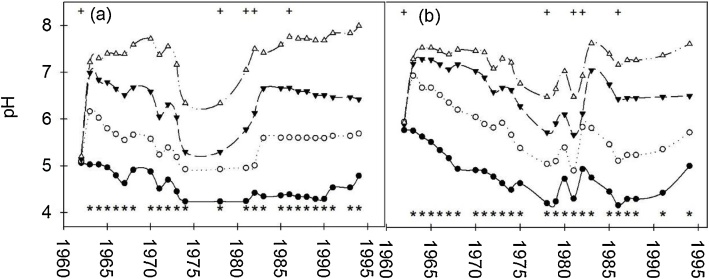
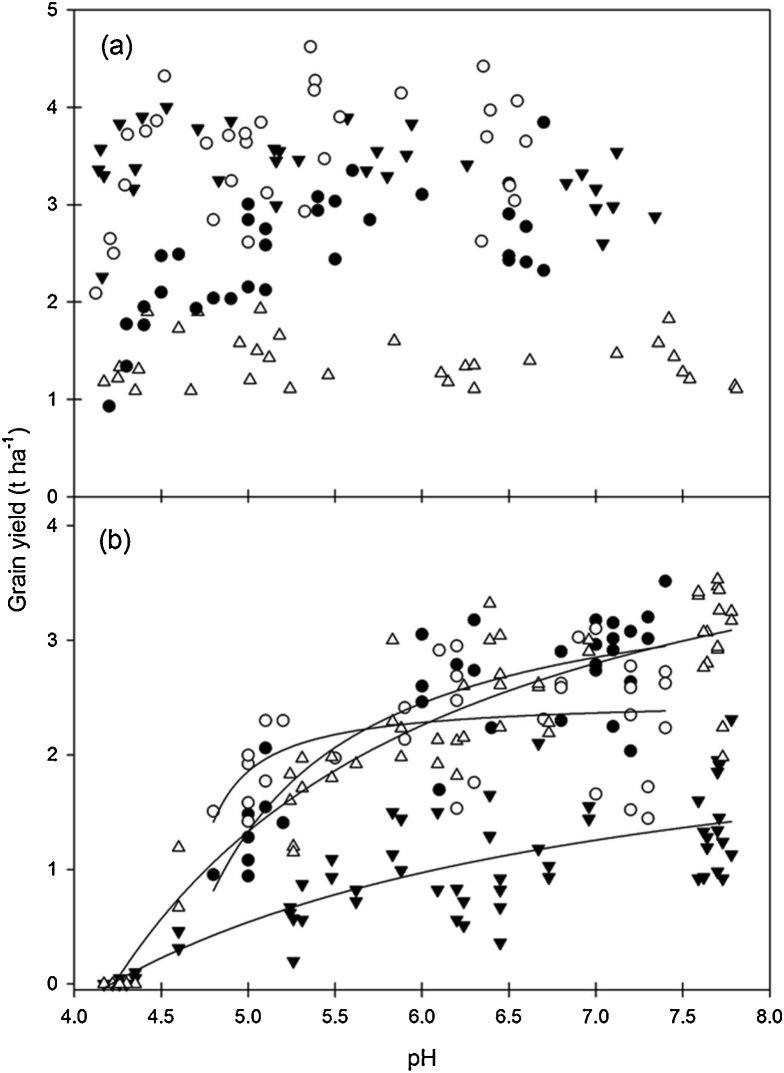
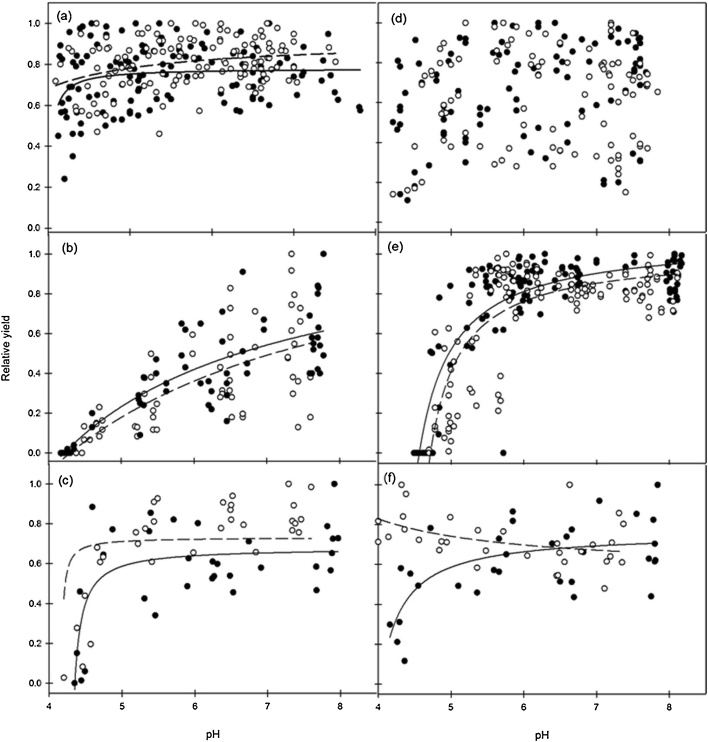
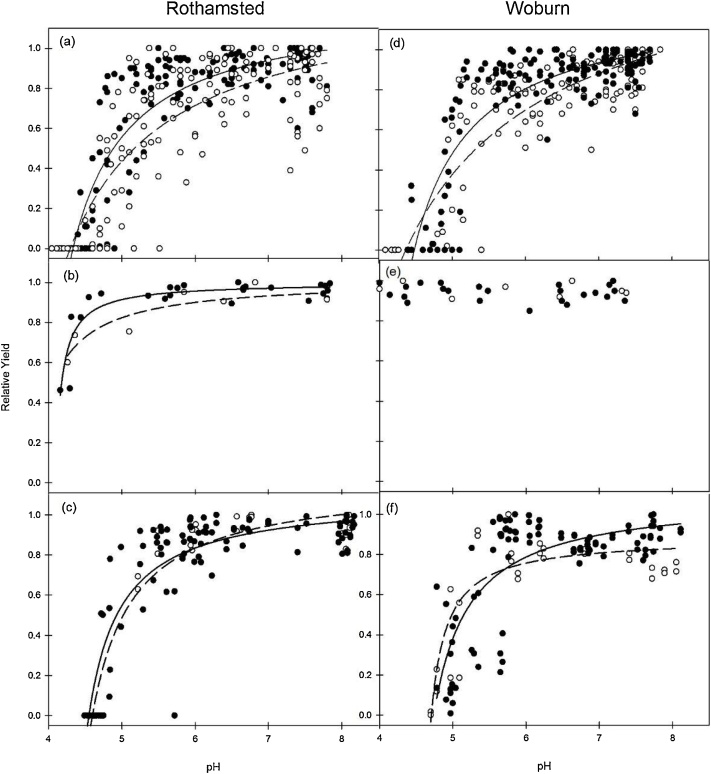
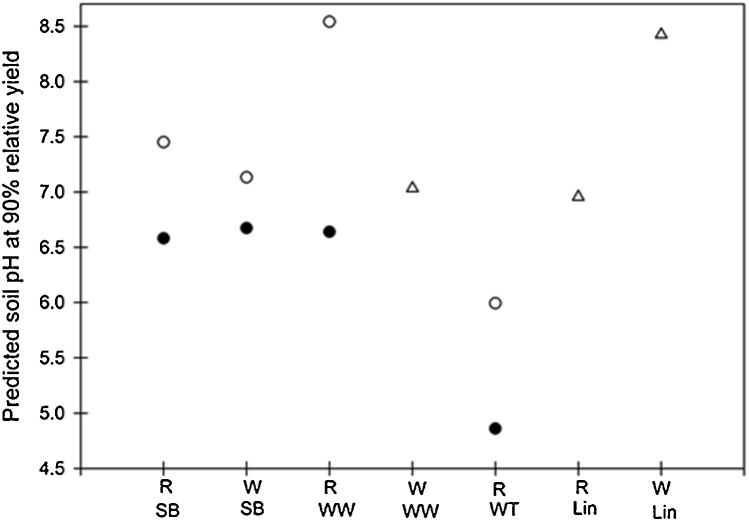
The management of optimal soil pH is fundamental to sustainable crop production. Understanding the lime requirement for arable crops has developed gradually over the last several decades. The aim of this study was to examine the yield-pH relationship for a range of arable crops to understand their response to liming, based on the Long-Term Liming experiments established in 1962 at Rothamsted Research, UK. The main treatments of four different rates of lime and, therefore, four distinctly different soil pH levels were maintained for 35 years at two sites (Rothamsted and Woburn). The pH ranged from 4.4 to 8.0. The lime response was tested on the following crops: spring barley, spring oats, spring beans, spring lupins, winter lupins, potatoes, linseed, winter oilseed rape, winter triticale and winter wheat. Relative yield (RY) was used for non-linear regression analysis to detect site, year and phosphorus (P) fertiliser effects on the relationship with pH. Liming had a highly significant positive effect on soil pH, but overall there was no consistent increase or decrease in soil extractable P (Olsen) or exchangeable K. There were significant site effects detected for RY for most crops which reflect differences in the two soil types. Spring oats and potatoes had very weak responses to lime within the pH range tested. For spring barley, winter triticale, winter wheat and winter oilseed rape significant effects of P fertiliser on the yield-pH relationship were found, although the nature of effects differed between crops and sites. Findings from the Long-Term Liming experiment are invaluable in improving the fundamental understanding on the yield-pH relationship for important arable crops and this has significant implications on selecting crops for rotations. The pH at 90% RY was calculated for selected crops and the beneficial effect of fertiliser P was detected in significantly reducing the critical pH value.
Keywords: Crop yield response function; Crop-soil interactions; Long-term experiment; Soil acidity.
Figures
References
-
- Addiscott T., Johnston A. Potassium in soils under different cropping systems: 3. Non-exchangeable potassium in soils from long-term experiments at Rothamsted and Woburn. J. Agric. Sci. 1975;84:513–524.
-
- AHDB . Agriculture and Horticulture Development Board; Kenilworth, UK: 2013. Crop Nutrition for Potatoes.
-
- AHDB . Agriculture and Horticulture Development Board; Stoneleigh Park, Warwickshire: 2017. Nutrient Management Guide (RB209)
-
- Alemu G., Desalegn T., Debele T., Adela A., Taye G., Yirga C. Effect of lime and phosphorus fertilizer on acid soil properties and barley grain yield at Bedi in Western Ethiopia. Afr. J. Agric. Res. 2017;12:3005–3012.
-
- Avery B.W., Catt J.A. Lawes Agricultural Trust Co. Ltd; Harpenden UK: 1995. The Soil at Rothamsted. 44pp + map.
LinkOut - more resources
Full Text Sources
Research Materials