


Radiofrequency catheter ablation of premature ventricular contractions from near the His-bundle
- PMID: 31007790
- PMCID: PMC6457375
- DOI: 10.1002/joa3.12167
Radiofrequency catheter ablation of premature ventricular contractions from near the His-bundle
Abstract
Objective: This study aimed to investigate the effects of radiofrequency catheter ablation (RFCA) and clinical and electrophysiological characteristics in symptomatic patients with premature ventricular contractions (PVCs) from near the His-bundle (His-PVCs).
Methods: The patient characteristics, prevalence of complications with any life style related disease (ALSRD) including hypertension, dyslipidemia, or diabetes mellitus, and/or cardiovascular disease (CVD) including coronary artery disease, cerebrovascular disease, renal dysfunction, or cardiomyopathy, clinical status, frequency of PVCs evaluated by 24hour Holter monitoring, echocardiography including the left ventricular diastolic dysfunction (LVDD) parameters, and electrophysiological findings were evaluated in 14 consecutive symptomatic patients with His-PVCs.
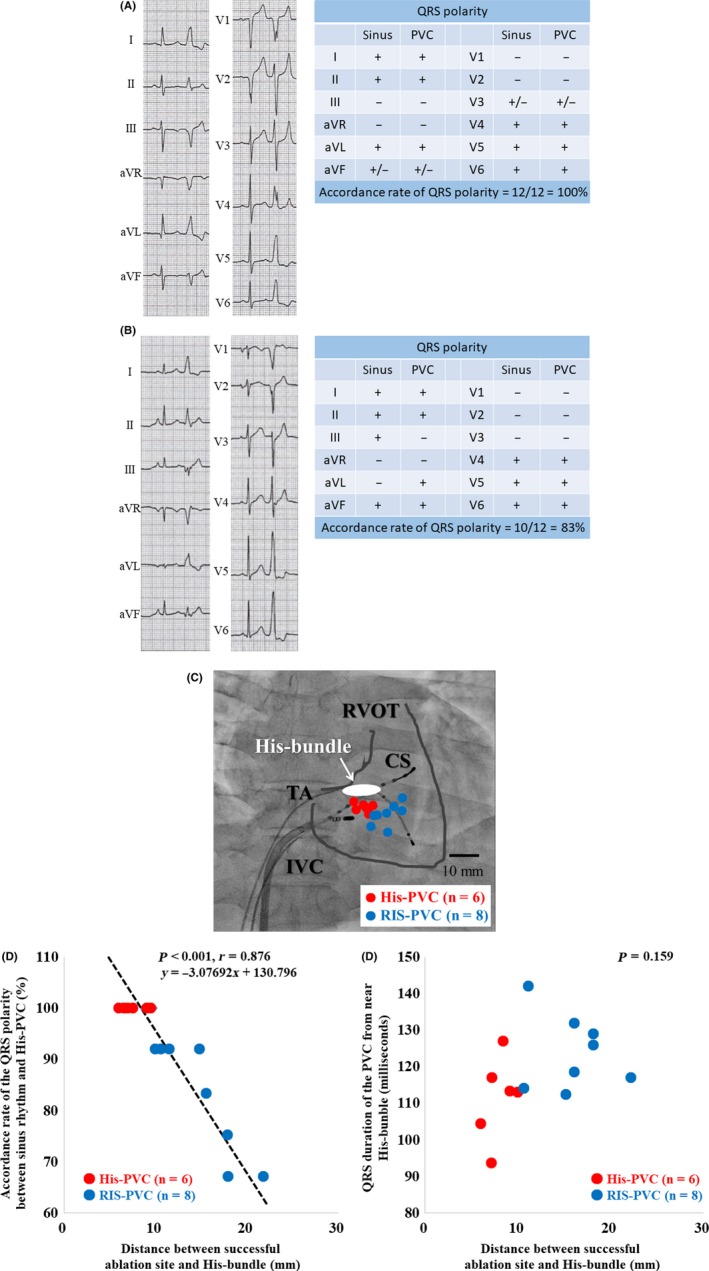
Results: The prevalence of males, being elderly and/or slightly obese, current and/or history of smoking, ALSRD or CVD related complications, and LVDD probably resulting from ALSRD and/or CVD complications were higher in patients with His-PVCs. RFCA of His-PVCs steadily decreased the PVC frequency and improved the systolic function, LV dilation, and clinical status, but not the LVDD. There was a significant relationship between the accordance rate of the QRS polarity between sinus rhythm and His-PVCs and the distance between the successful ablation site and His-bundle.
Conclusion: The analysis of the QRS duration and accordance rate of the QRS polarity between sinus rhythm and His-PVCs before the RFCA may help to determine the distance between the origin of the PVCs and His-bundle. Further, the appropriate ablation catheter may be selected during the RFCA procedure. Finally, RFCA may be one of the most effective, feasible, and safest therapies for symptomatic patients with His-PVCs.
Keywords: His‐bundle; catheter ablation; clinical characteristics; clinical status; premature ventricular contraction.
Conflict of interest statement
Authors declare no conflict of interests for this article.
Figures
References
-
- Takemoto M, Yoshimura H, Ohba Y, et al. Radiofrequency catheter ablation of premature ventricular complexes from right ventricular outflow tract improves left ventricular dilation and clinical status in patients without structural heart disease. J Am Coll Cardiol. 2005;45:1259–65. - PubMed
-
- Akhtar M, Breithardt G, Camm AJ, et al. Implications of the Cardiac Arrhythmia Suppression Trial. Task Force of the Working Group on Arrhythmias of the European Society of Cardiology. Circulation. 1990;81:1123–27. - PubMed
-
- Yamauchi Y, Aonuma K, Takahashi A, et al. Electrocardiographic characteristics of repetitive monomorphic right ventricular tachycardia originating near the His‐bundle. J Cardiovasc Electrophysiol. 2005;16:1041–48. - PubMed
-
- Hachiya H, Hirao K, Sasaki T, et al. Novel ECG predictor of difficult cases of outflow tract ventricular tachycardia: peak deflection index on an inferior lead. Circ J. 2010;74:256–61. - PubMed
LinkOut - more resources
Full Text Sources
