


Southern Ocean Biogeochemical Float Deployment Strategy, With Example From the Greenwich Meridian Line (GO-SHIP A12)
- PMID: 31007997
- PMCID: PMC6472510
- DOI: 10.1029/2018JC014059
Southern Ocean Biogeochemical Float Deployment Strategy, With Example From the Greenwich Meridian Line (GO-SHIP A12)
Abstract
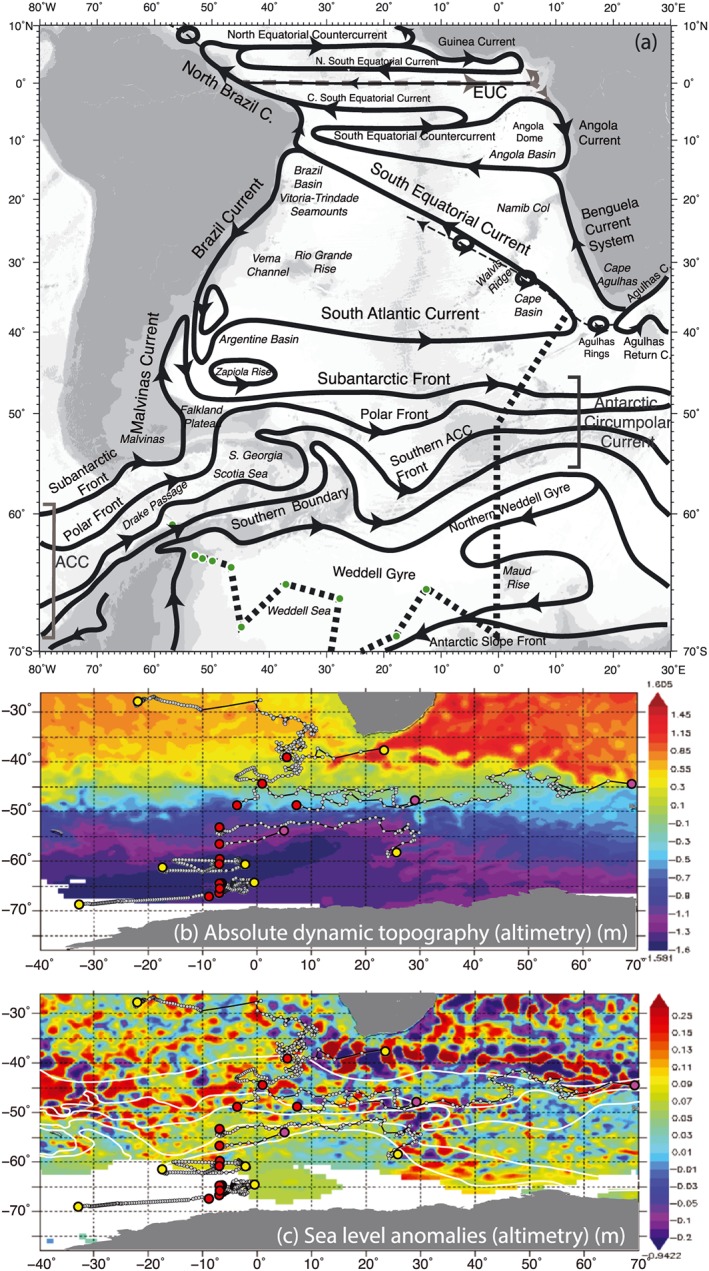
Biogeochemical Argo floats, profiling to 2,000-m depth, are being deployed throughout the Southern Ocean by the Southern Ocean Carbon and Climate Observations and Modeling program (SOCCOM). The goal is 200 floats by 2020, to provide the first full set of annual cycles of carbon, oxygen, nitrate, and optical properties across multiple oceanographic regimes. Building from no prior coverage to a sparse array, deployments are based on prior knowledge of water mass properties, mean frontal locations, mean circulation and eddy variability, winds, air-sea heat/freshwater/carbon exchange, prior Argo trajectories, and float simulations in the Southern Ocean State Estimate and Hybrid Coordinate Ocean Model (HYCOM). Twelve floats deployed from the 2014-2015 Polarstern cruise from South Africa to Antarctica are used as a test case to evaluate the deployment strategy adopted for SOCCOM's 20 deployment cruises and 126 floats to date. After several years, these floats continue to represent the deployment zones targeted in advance: (1) Weddell Gyre sea ice zone, observing the Antarctic Slope Front, and a decadally-rare polynya over Maud Rise; (2) Antarctic Circumpolar Current (ACC) including the topographically steered Southern Zone chimney where upwelling carbon/nutrient-rich deep waters produce surprisingly large carbon dioxide outgassing; (3) Subantarctic and Subtropical zones between the ACC and Africa; and (4) Cape Basin. Argo floats and eddy-resolving HYCOM simulations were the best predictors of individual SOCCOM float pathways, with uncertainty after 2 years of order 1,000 km in the sea ice zone and more than double that in and north of the ACC.
Keywords: Southern Ocean; biogeochemical floats; carbon cycle; circulation; sea ice; water masses.
Figures




References
-
- Abernathey, R. P. , Cerovecki, I. , Holland, P. , Newsom, E. , Mazloff, M. , & Talley, L. D. (2016). Water mass transformation by sea ice in the upper branch of the Southern Ocean overturning. Nature Geoscience, 9, 596–601. 10.1038/ngeo2749 - DOI
-
- Ardyna, M. , Claustre, H. , Sallée, J.‐B. , D'Ovidio, F. , Gentili, B. , van Dijken, G. , et al. (2017). Delineating environmental control of phytoplankton biomass and phenology in the Southern Ocean. Geophysical Research Letters, 44, 5016–5024. 10.1002/2016GL072428 - DOI
-
- Arteaga, L. , Haëntjens, N. , Boss, E. , Johnson, K. S. , & Sarmiento, J. L. (2018). Assessment of export efficiency equations in the southern ocean applied to satellite‐based net primary production. Journal of Geophysical Research: Oceans, 123, 2945–2964. 10.1002/2018JC013787 - DOI
-
- Bakker, D. C. E. , Hoppema, M. , Schroder, M. , Geibert, W. , & deBaar H. J. W. (2008). A rapid transition from ice covered CO2‐rich waters to a biologically mediated CO2 sink in the eastern Weddell Gyre. Biogeosciences, 5, 1373–1386. 10.5194/bg-5-1373-2008 - DOI
-
- Balch, W. M. , Drapeau, D. T. , Bowler, B. C. , Lyczskowski, E. , Booth, E. S. , & Alley, D. (2011). The contribution of coccolithophores to the optical and inorganic carbon budgets during the Southern Ocean Gas Exchange Experiment: New evidence in support of the “Great Calcite Belt” hypothesis. Journal of Geophysical Research, 116, C00F06 10.1029/2011JC006941 - DOI