


Platelet and peripheral white blood cell counts at diagnosis predict the response of adult immune thrombocytopenia to recombinant human interleukin-11: A retrospective, single-center, case-control study
- PMID: 31008943
- PMCID: PMC6494275
- DOI: 10.1097/MD.0000000000015195
Platelet and peripheral white blood cell counts at diagnosis predict the response of adult immune thrombocytopenia to recombinant human interleukin-11: A retrospective, single-center, case-control study
Abstract
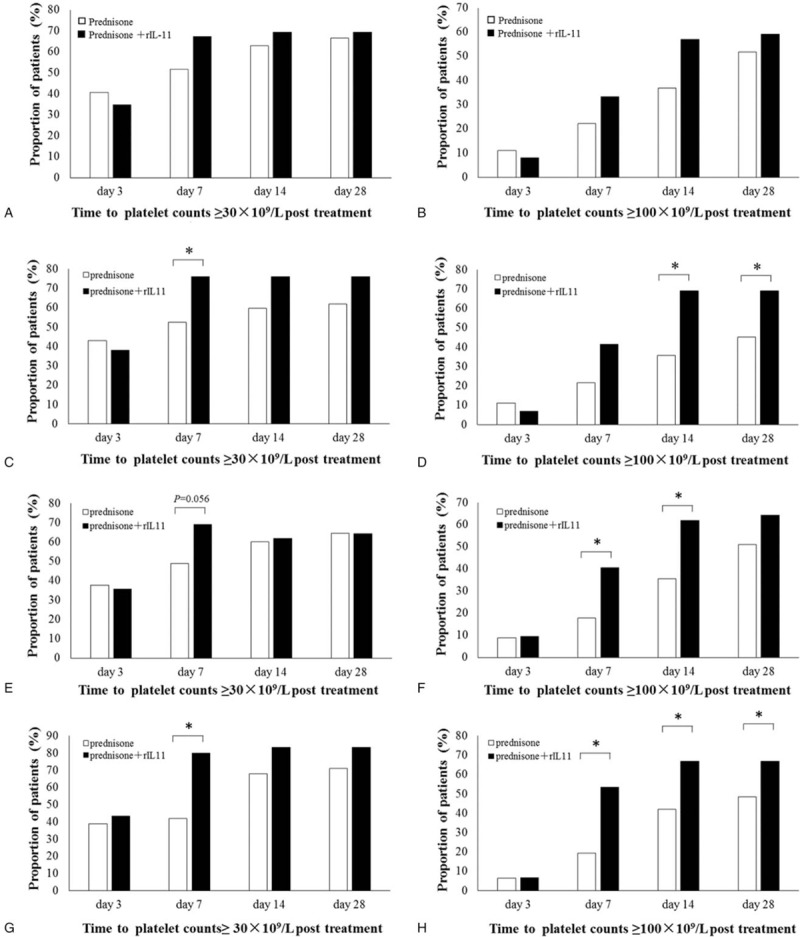
This study evaluated the effectiveness of recombinant human interleukin-11 (rhIL-11) in the treatment of immune thrombocytopenia (ITP) and determined whether clinical and laboratory findings predicted the treatment response.This retrospective, single-center, case-control study included 103 adult patients with ITP treated between July 2010 and April 2014 at Jiangxi Province People's Hospital. About 49 patients in the pred+IL group received prednisone (conventional dose) combined with an rhIL-11 regimen, and 54 patients in the pred alone group received prednisone (conventional dose) alone. Demographic data, initial and follow-up platelet counts, proportions of patients achieving platelet counts ≥30 × 10/L (response) and ≥100 × 10/L (complete response) at different time points, and adverse reactions were compared between groups.Complete response rates were similar between groups overall but higher in the pred+IL group than in the pred alone group for newly diagnosed patients and those with severe ITP (P < .05). Proportions of patients achieving response or complete response at different time points were similar between groups overall but higher in the pred+IL group than in the pred alone group for newly diagnosed patients and those with severe ITP (P < .05). Posttreatment platelet count correlated negatively with platelet count at diagnosis and white blood cell (WBC) count at diagnosis in patients with newly diagnosed ITP (r = -0.337, P = .073 and r = -0.367, P = .050, respectively) or ITP with bleeding-related episodes (r = -0.357, P = .020 and r = -0.434, P = .004, respectively). No immediate or postinfusion severe adverse reactions were observed.rhIL-11 increased CR and improved hemostasis in patients with newly diagnosed or severe ITP. Platelet and WBC counts at diagnosis can predict the response to rhIL-11.
Conflict of interest statement
The authors have no conflicts of interest to disclose.
Figures


References
-
- Rodeghiero F, Stasi R, Gernsheimer T, et al. Standardization of terminology, definitions and outcome criteria in immune thrombocytopenic purpura of adults and children: report from an international working group. Blood 2009;113:2386–93. - PubMed
-
- Ghanima W, Godeau B, Cines DB, et al. How I treat immune thrombocytopenia: the choice between splenectomy or a medical therapy as a second-line treatment. Blood 2012;120:960–9. - PubMed
-
- Tanimukai S, Kimura T, Sakabe H, et al. Recombinant human c-Mpl ligand (thrombopoietin) not only acts on megakaryocyte progenitors, but also on erythroid and multipotential progenitors in vitro. Exp Hematol 1997;25:1025–33. - PubMed
-
- Fibbe WE, Heemskerk DP, Laterveer L, et al. Accelerated reconstitution of platelets and erythrocytes after syngeneic transplantation of bone marrow cells derived from thrombopoietin pretreated donor mice. Blood 1995;86:3308–13. - PubMed
-
- Cui ZG, Liu XG, Qin P, et al. Recombinant human thrombopoietin in combination with cyclosporin A as a novel therapy in corticosteroid-resistant primary immune thrombocytopenia. Chin Med J (Engl) 2013;126:4145–8. - PubMed
MeSH terms
Substances
LinkOut - more resources
Full Text Sources
Miscellaneous
