


C9orf72 repeat expansions in South Africans with amyotrophic lateral sclerosis
- PMID: 31009932
- PMCID: PMC6556408
- DOI: 10.1016/j.jns.2019.04.026
C9orf72 repeat expansions in South Africans with amyotrophic lateral sclerosis
Abstract
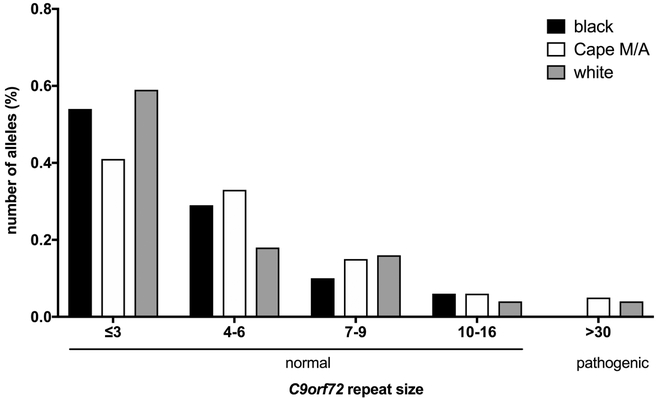
The hexanucleotide repeat expansion in the C9orf72 gene is the most common genetic variant found in individuals with sporadic amyotrophic lateral sclerosis (ALS), occurring at a frequency of between 7 and 11% in cohorts of European ancestry. While limited data suggest that C9-expansions (>30 repeats) are less frequent in African-Americans with ALS, there is no data on the frequency of C9-expansions among ALS subjects residing in Africa. We therefore investigated the frequency of this expansion mutation (using repeat-primed PCR) in a cohort of 143 South Africans (SA) with ALS. The cohort included different genetic ancestry subgroups who self-identified as black African (n = 24), Cape mixed-African (M/A) (n = 65), white European ancestry (n = 51), and Indian ancestry (n = 3). Three M/A individuals had a family history of ALS (2%) and all had normal C9orf72 alleles. Of the 140 individuals with sporadic ALS who were successfully genotyped, 10 (7%) carried pathogenic C9-expansions; four white and six M/A ancestry individuals, respectively. Our results highlight the importance of including Africans in genetic studies aimed at unravelling the genomic architecture in ALS and suggest pathogenetic mechanisms other than the C9orf72 expansion in black Africans with ALS.
Keywords: Africa; C9orf72; Gene; Motor neuron disease; Mutation.
Copyright © 2019 Elsevier B.V. All rights reserved.
Conflict of interest statement
Declarations of interest: None
Figures
References
-
- Woollacott IO, Mead S. The C90RF72 expansion mutation: gene structure, phenotypic and diagnostic issues. Acta Neuropathol 2014;127:319–32. - PubMed
MeSH terms
Substances
Grants and funding
LinkOut - more resources
Full Text Sources
Medical
Research Materials
Miscellaneous
