


Pathophysiological, Molecular and Therapeutic Issues of Nonalcoholic Fatty Liver Disease: An Overview
- PMID: 31010049
- PMCID: PMC6514656
- DOI: 10.3390/ijms20081948
Pathophysiological, Molecular and Therapeutic Issues of Nonalcoholic Fatty Liver Disease: An Overview
Abstract
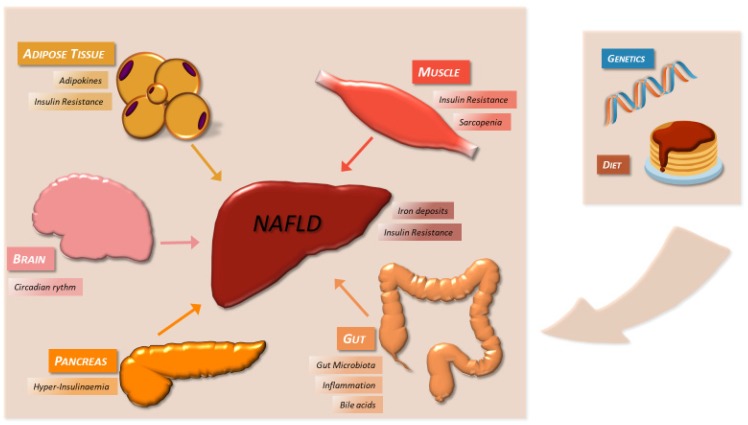
Nonalcoholic Fatty Liver Disease (NAFLD) represents the leading cause of liver disease in developed countries but its diffusion is currently also emerging in Asian countries, in South America and in other developing countries. It is progressively becoming one of the main diseases responsible for hepatic insufficiency, hepatocarcinoma and the need for orthotopic liver transplantation. NAFLD is linked with metabolic syndrome in a close and bidirectional relationship. To date, NAFLD is a diagnosis of exclusion, and liver biopsy is the gold standard for diagnosis. NAFLD pathogenesis is complex and multifactorial, mainly involving genetic, metabolic and environmental factors. New concepts are constantly arising in the literature promising new diagnostic and therapeutic tools. One of the challenges will be to better characterize not only NAFLD development but overall NAFLD progression, in order to better identify NAFLD patients at higher risk of metabolic, cardiovascular and neoplastic complications. This review analyses NAFLD epidemiology and the different prevalence of the disease in distinct groups, particularly according to sex, age, body mass index, type 2 diabetes and dyslipidemia. Furthermore, the work expands on the pathophysiology of NAFLD, examining multiple-hit pathogenesis and the role of different factors in hepatic steatosis development and progression: genetics, metabolic factors and insulin resistance, diet, adipose tissue, gut microbiota, iron deposits, bile acids and circadian clock. In conclusion, the current available therapies for NAFLD will be discussed.
Keywords: insulin resistance; metabolic syndrome; molecular mechanisms; nonalcoholic fatty liver disease; pathogenesis; steatosis; therapy.
Conflict of interest statement
The authors declare no conflict of interest.
Figures
References
-
- European Association for the Study of the Liver (EASL) European Association for the Study of Diabetes (EASD) European Association for the Study of Obesity (EASO) EASL–EASD–EASO Clinical Practice Guidelines for the management of non-alcoholic fatty liver disease. J. Hepatol. 2016;64:1388–1402. doi: 10.1016/j.jhep.2015.11.004. - DOI - PubMed
-
- Ballestri S., Nascimbeni F., Baldelli E., Marrazzo A., Romagnoli D., Targher G., Lonardo A. Ultrasonographic fatty liver indicator detects mild steatosis and correlates with metabolic/histological parameters in various liver diseases. Metabolism. 2017;72:57–65. doi: 10.1016/j.metabol.2017.04.003. - DOI - PubMed
Publication types
MeSH terms
LinkOut - more resources
Full Text Sources
Other Literature Sources
Medical
