


Aminoacyl-tRNA Synthetases and tRNAs for an Expanded Genetic Code: What Makes them Orthogonal?
- PMID: 31010123
- PMCID: PMC6515474
- DOI: 10.3390/ijms20081929
Aminoacyl-tRNA Synthetases and tRNAs for an Expanded Genetic Code: What Makes them Orthogonal?
Abstract
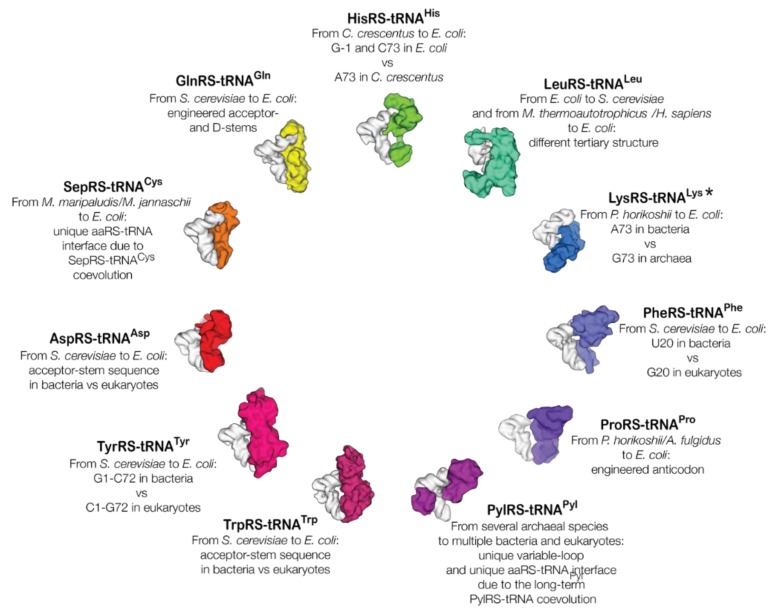
In the past two decades, tRNA molecules and their corresponding aminoacyl-tRNA synthetases (aaRS) have been extensively used in synthetic biology to genetically encode post-translationally modified and unnatural amino acids. In this review, we briefly examine one fundamental requirement for the successful application of tRNA/aaRS pairs for expanding the genetic code. This requirement is known as "orthogonality"-the ability of a tRNA and its corresponding aaRS to interact exclusively with each other and avoid cross-reactions with additional types of tRNAs and aaRSs in a given organism.
Keywords: aminoacyl-tRNA synthetases; expanded genetic code; orthogonal translation systems; synthetic biology; tRNA.
Conflict of interest statement
The authors declare no conflict of interest.
Figures
References
-
- Kisselev L.L. The role of the anticodon in recognition of tRNA by aminoacyl-tRNA synthetases. Prog. Nucleic Acid Res. Mol. Biol. 1985;32:237–266. - PubMed
Publication types
MeSH terms
Substances
Grants and funding
LinkOut - more resources
Full Text Sources
Other Literature Sources
Miscellaneous
