


Dietary Lead Exposure and Associated Health Risks in Guangzhou, China
- PMID: 31010248
- PMCID: PMC6517897
- DOI: 10.3390/ijerph16081417
Dietary Lead Exposure and Associated Health Risks in Guangzhou, China
Abstract
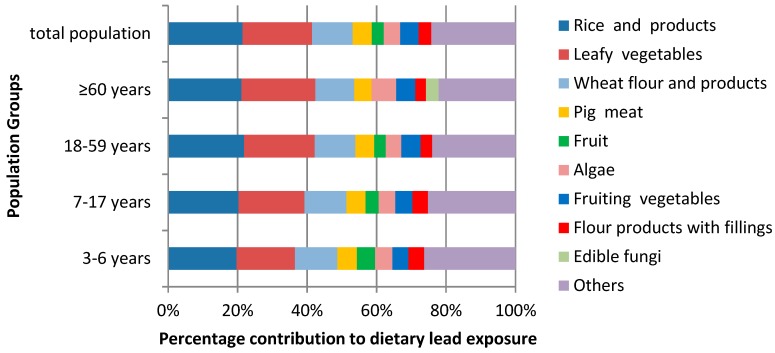
Lead exposure is associated with a wide range of adverse effects on human health. The principal exposure route in the general population is through the diet. In this study, we estimate the dietary lead intake and associated health risks among the residents of Guangzhou, China. Data on lead concentrations were derived from the food safety risk monitoring system, which included 6339 samples from 27 food categories collected in 2014-2017. Food consumption data were taken from a 2011 dietary survey of 2960 Guangzhou residents from 998 households. Dietary lead intake was estimated by age group (3-6, 7-17, 18-59, and ≥60 years), and relevant health risks were assessed using the margin of exposure (MOE) method. The mean and 95th percentiles (P95) of dietary lead intake were respectively 0.7466 and 2.4525 μg/kg body weight per day for preschool children aged 3-6 years; 0.4739 and 1.5522 μg/kg bw/day for school children aged 7-17 years; 0.3759 and 1.1832 μg/kg bw/day for adults aged 18-59 years; and 0.4031 and 1.3589 μg/kg bw/day for adults aged ≥60 years. The MOE value was less than 1 for preschool children at the mean exposure level and for all age groups at the P95 exposure level. Rice and its products, leafy vegetables, and wheat flour and its products were found to be the primary food sources of lead exposure. Our findings suggest that the health risk from dietary lead exposure is low for Guangzhou residents overall, but that young children and consumers of certain foods may be at increased risk. Continued efforts are needed to reduce the dietary lead exposure in Guangzhou.
Keywords: dietary exposure; food; lead; margin of exposure; risk assessment.
Conflict of interest statement
The authors declare no conflict of interest.
Figures
References
-
- Xiao C.K. Analysis of Present Situation about Lead Pollution in China. Environ. Sustain. Dev. 2017;42:91–92. doi: 10.19758/j.cnki.issn1673-288x.2017.05.028. - DOI
-
- European Food Safety Authority Lead dietary exposure in the European population. EFSA J. 2012;10:2831–2889. doi: 10.2903/j.efsa.2012.2831. - DOI
-
- Abadin H., Ashizawa A., Stevens Y.W., Llados F., Diamond G., Sage G., Citra M., Quinones A., Bosch S.J., Swarts S.G. Toxicological Profile for Lead. Agency for Toxic Substances and Disease Registry (US); Atlanta, GA, USA: 2007. pp. 1–31. - PubMed
Publication types
MeSH terms
Substances
LinkOut - more resources
Full Text Sources
Medical
Research Materials
Miscellaneous
