


Global warming has increased global economic inequality
- PMID: 31010922
- PMCID: PMC6525504
- DOI: 10.1073/pnas.1816020116
Global warming has increased global economic inequality
Abstract
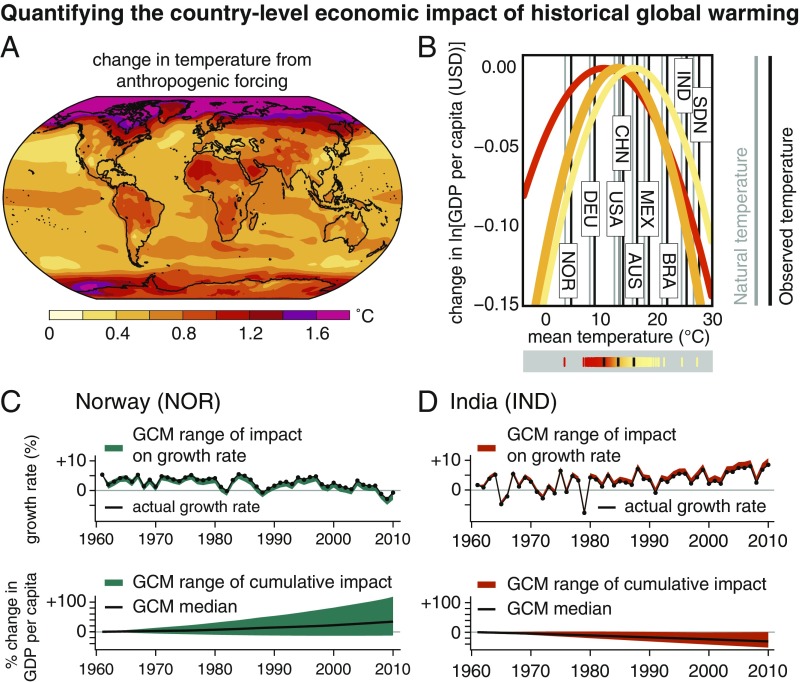
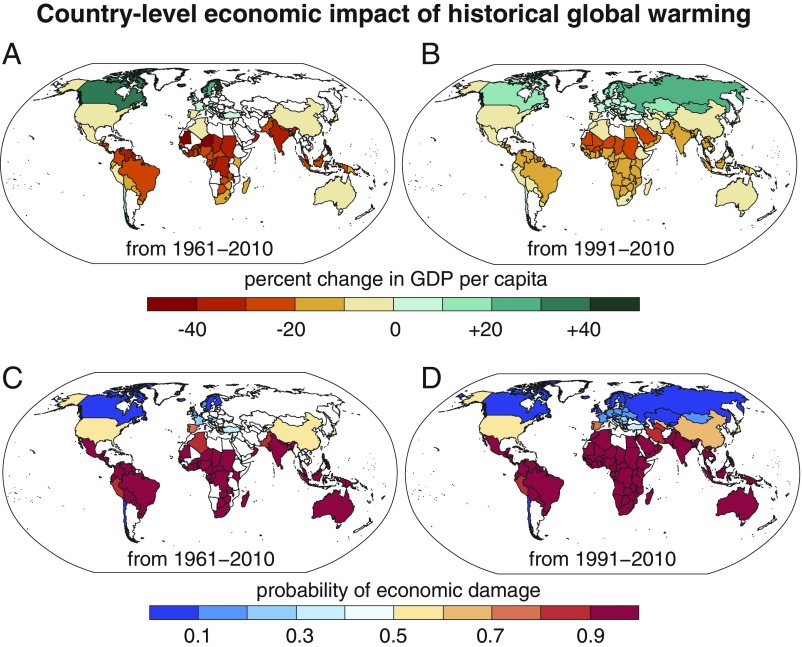
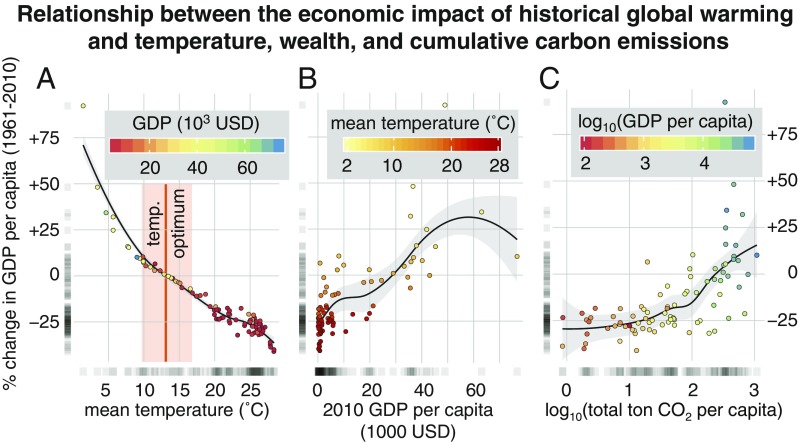
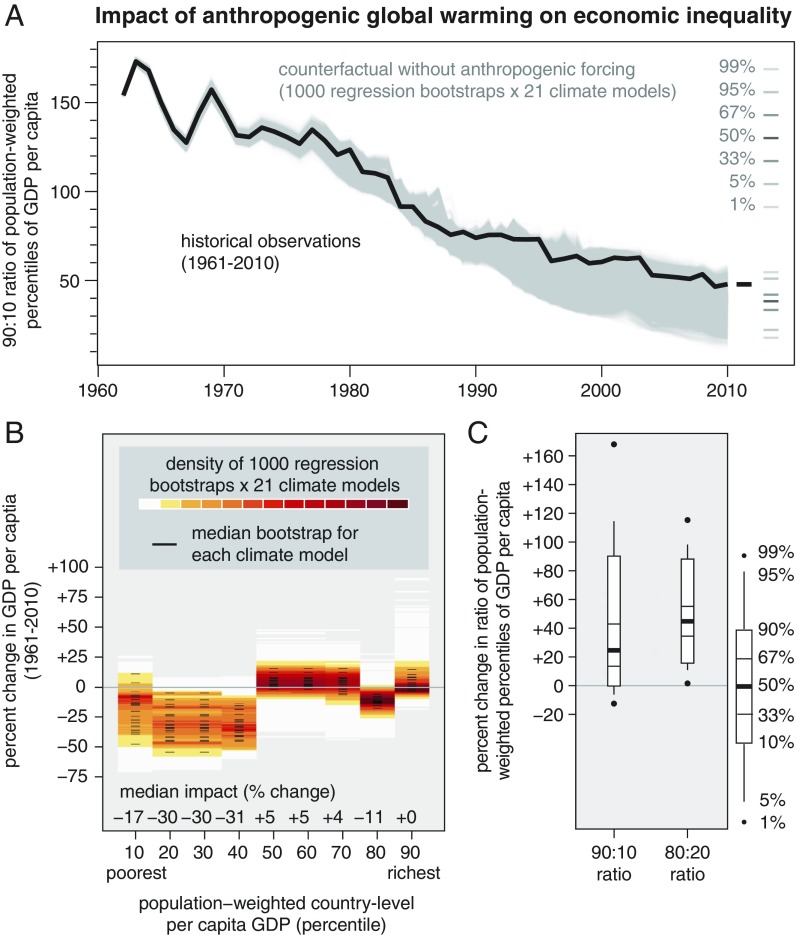
Understanding the causes of economic inequality is critical for achieving equitable economic development. To investigate whether global warming has affected the recent evolution of inequality, we combine counterfactual historical temperature trajectories from a suite of global climate models with extensively replicated empirical evidence of the relationship between historical temperature fluctuations and economic growth. Together, these allow us to generate probabilistic country-level estimates of the influence of anthropogenic climate forcing on historical economic output. We find very high likelihood that anthropogenic climate forcing has increased economic inequality between countries. For example, per capita gross domestic product (GDP) has been reduced 17-31% at the poorest four deciles of the population-weighted country-level per capita GDP distribution, yielding a ratio between the top and bottom deciles that is 25% larger than in a world without global warming. As a result, although between-country inequality has decreased over the past half century, there is ∼90% likelihood that global warming has slowed that decrease. The primary driver is the parabolic relationship between temperature and economic growth, with warming increasing growth in cool countries and decreasing growth in warm countries. Although there is uncertainty in whether historical warming has benefited some temperate, rich countries, for most poor countries there is >90% likelihood that per capita GDP is lower today than if global warming had not occurred. Thus, our results show that, in addition to not sharing equally in the direct benefits of fossil fuel use, many poor countries have been significantly harmed by the warming arising from wealthy countries' energy consumption.
Keywords: CMIP5; climate change attribution; economic inequality; global warming.
Copyright © 2019 the Author(s). Published by PNAS.
Conflict of interest statement
The authors declare no conflict of interest.
Figures
Comment in
-
Reply to Rosen: Temperature-growth relationship is robust.Proc Natl Acad Sci U S A. 2019 Aug 13;116(33):16171-16172. doi: 10.1073/pnas.1908772116. Epub 2019 Aug 2. Proc Natl Acad Sci U S A. 2019. PMID: 31375623 Free PMC article. No abstract available.
-
Temperature impact on GDP growth is overestimated.Proc Natl Acad Sci U S A. 2019 Aug 13;116(33):16170. doi: 10.1073/pnas.1908081116. Epub 2019 Aug 2. Proc Natl Acad Sci U S A. 2019. PMID: 31375624 Free PMC article. No abstract available.
References
-
- Intergovernmental Panel on Climate Change . In: Climate Change 2014: Impacts, Adaptation, and Vulnerability. Contribution of Working Group II to the Fifth Assessment Report of the Intergovernmental Panel on Climate Change. Field CB, et al., editors. Cambridge Univ Press; Cambridge, UK: 2014. pp. 1–32.
-
- Hallegatte S, Rozenberg J. Climate change through a poverty lens. Nat Clim Chang. 2017;7:250–256.
-
- Intergovernmental Panel on Climate Change . In: Managing the Risks of Extreme Events and Disasters to Advance Climate Change Adaptation. Field CB, et al., editors. Cambridge Univ Press; Cambridge, UK: 2012.
-
- Burke M, Hsiang SM, Miguel E. Global non-linear effect of temperature on economic production. Nature. 2015;527:235–239. - PubMed
-
- Hsiang S, et al. Estimating economic damage from climate change in the United States. Science. 2017;356:1362–1369. - PubMed
Publication types
LinkOut - more resources
Full Text Sources
Research Materials
Miscellaneous
