. 2019 Apr 23;9(1):6389.
doi: 10.1038/s41598-019-42691-z.

Ancestral Stress Alters Lifetime Mental Health Trajectories and Cortical Neuromorphology via Epigenetic Regulation

Affiliations

Ancestral Stress Alters Lifetime Mental Health Trajectories and Cortical Neuromorphology via Epigenetic Regulation

Mirela Ambeskovic et al. Sci Rep. .

Abstract

Experiences during early development are powerful determinants of lifetime mental health. Here we investigated if ancestral stress regulates the brain's epigenetic memory to alter neuromorphology and emotionality in the remote F4 progeny. Pregnant female rat dams of the parental F0 generation were exposed to stress on gestational days 12-18. To generate a transgenerational stress lineage, their pregnant daughters (F1), grand-daughters (F2) and great-grand-daughters (F3) remained undisturbed. To generate a multigenerational stress lineage, pregnant dams of each generation (F1-F3) were stressed. A lineage of non-stress controls (F0-F3) was also produced. Multigenerational stress exceeded the impact of transgenerational stress by increasing anxiety-like behaviours and stress response in young and middle-aged F4 males but not females. Functional changes were accompanied by reduced spine density in the male medial prefrontal cortex with opposite effects in the orbital frontal cortex. Ancestral stress regulated cortical miR-221 and miR-26 expression and their target genes, thus downregulating ntrk2 and map1a genes in males while downregulating crh and upregulating map1a genes in females. These miRNA-dependent pathways are candidates for developmental programming of lifetime mental health. Thus, multigenerational stress in particular determines sexually dimorphic predisposition to stress vulnerability and generates a phenotype resembling symptoms of post-traumatic stress disorder.


Conflict of interest statement

The authors declare no competing interests.

Figures
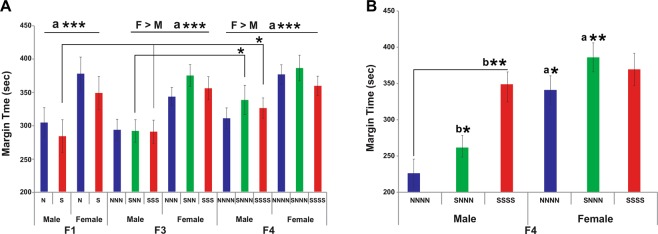
Figure 1
Figure 1
Effects of prenatal stress across generations on anxiety-like behaviour. Anxiety-like behaviour was indicated by the amount of time a rat spent in the margins of an open field task. (A) Both trans- and multigenerational stress increased levels of anxiety-like behaviours in F3 and F4 generation male but not female rats at postnatal day (P) 90. (B) Multigenerational stress cumulatively exacerbated anxiety-like behaviours, as F4-SSSS males spent more time in margins than SNNN (transgenerational) or NNNN (non-stressed) rats at P180. Asterisks indicate significances: *P < 0.05, **P < 0.01, ***P < 0.001. All data presented as mean ± SEM. “a” indicates sex effect; “b” indicates stress effect.
Figure 2
Figure 2
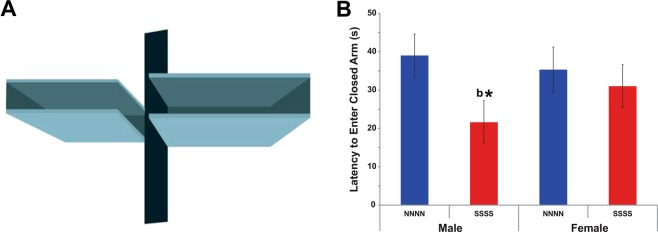
Effects of multigenerational prenatal stress on anxiety-like behaviours in the elevated plus maze (EPM) at P180. Anxiety-like behaviour was indicated by the latency to enter or escape into a closed arm. (A) A representative photograph of a rat escaping into a closed arm of the EPM. (B) Multigenerational stress decreased latency to enter closed arm in F4-SSSS males in comparison to non-stressed males. Asterisks indicate significances: *P < 0.05. All data are presented as mean ± SEM. “b” indicates stress effect.
Figure 3
Figure 3
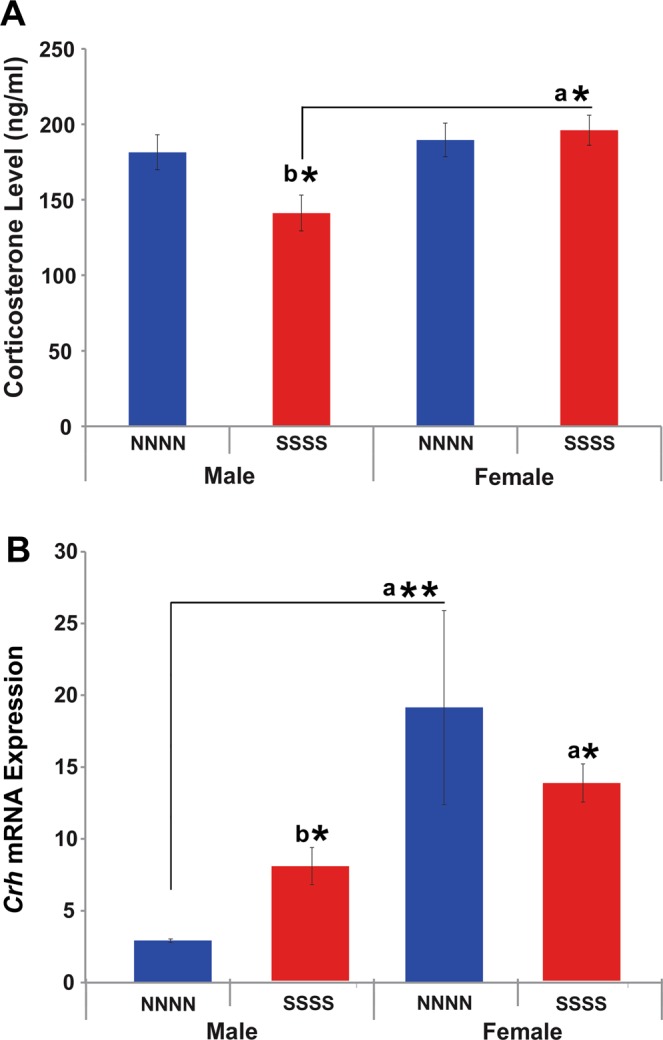
Effects of multigenerational stress on stress response systems. (A) Multigenerational stress reduced circulating corticosterone levels in males, while no changes were observed in female rats. (B) Deep sequencing of frontal cortex revealed that multigenerational stress upregulated Crh mRNA expression in males, with slight but non-significant downregulation in female rats. Asterisks indicate significances: *P < 0.05, **P < 0.01. All data are presented as mean ± SEM. “a” indicates sex effect; “b” indicates stress effect.
Figure 4
Figure 4
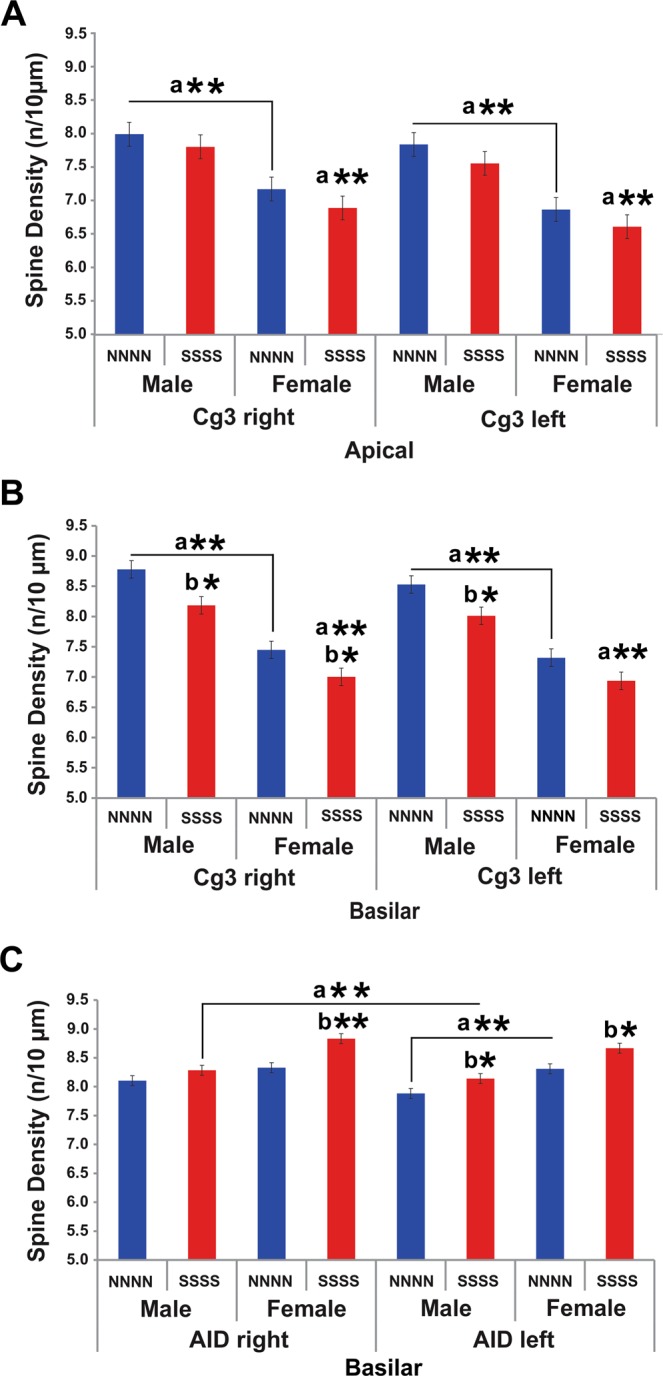
Dendritic spine organization of the medial prefrontal cortex (Cg3) and orbital frontal cortex (AID) in response to multigenerational stress. Multigenerational stress induced sexually dimorphic effects in Cg3 and AID dendritic spine density. (A) Cg3 spine density in the apical field was higher in non-stressed and stressed males compared to females. (B) Multigenerational stress decreased the number of spines in the Cg3 basilar field in male and female rats. Males had higher spine density than stressed (SSSS) and non-stressed (NNNN) females. (C) Mutigenerational stress increased the number of spines in the AID in males and females. Cg3 dendritic spine density in females were higher than in males. Multigenerationally stressed females had most dendritic spines in the right hemisphere of the AID. Asterisks indicate significances: *P < 0.05, **P < 0.01. All data are presented as mean ± SEM. “a” indicates sex effect; “b” indicates stress effect.
Figure 5
Figure 5
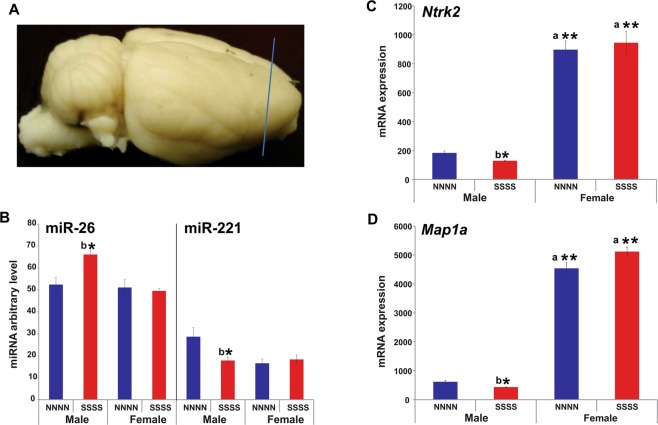
MiRNA and mRNA expression in the frontal cortex. Multigenerational stress altered epigenetic regulation of miR-221 and miR-26 and mRNA (ntrk2, map1a) in a sex-specific manner. (A) Location of frontal cortex tissue sample used for deep sequencing. (B). Multigenerational stress downregulated miR-221expression and upregulated miR-26 expression in males. (C) Multigenerational stress significantly decreased the ntrk2 mRNA expression in males, while a slight upregulation was observed in female rats. Females showed four times higher expression of Ntrk2 than males. (D) Multigenerational stress downregulated map1a expression in males. Asterisks indicate significances: *P < 0.05, **P < 0.01. All data are presented as mean ± SEM. “a” indicates sex effect; “b” indicates stress effect.
Figure 6
Figure 6
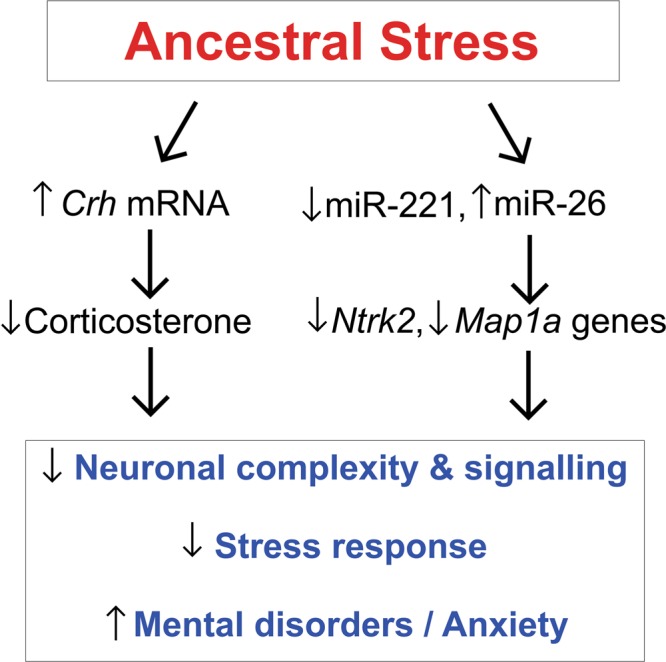
Diagram illustrating potential epigenetic mechanisms by which ancestral stress may regulate neuromorphology and mental health. In pathway #1 ancestral stress alters expression of miR-221 and miR-26. Upregulated mir-26 results in downregulated ntrk2 and map1a expression which ultimately reduces neuronal complexity and adaptive stress response. In pathway #2 ancestral stress alters crh mRNA expression in frontal cortex that leads to HPA axis impairment with blunted corticosterone levels, as found in PTSD. This ultimately alters neuronal morphology and stress system as hallmarks of mental health.
Figure 7
Figure 7
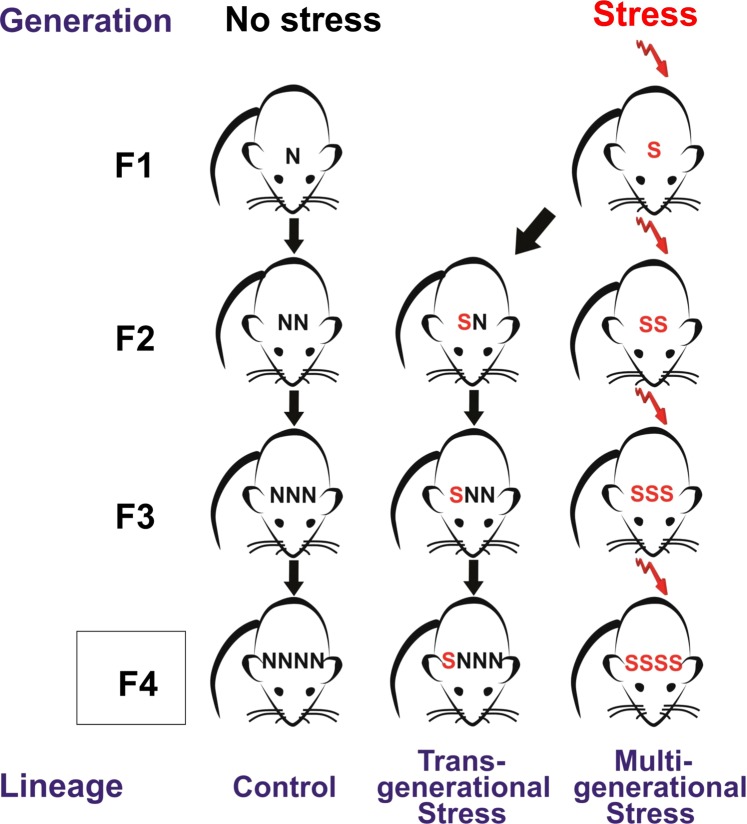
Trans- and multigenerational stress lineages. Naïve dams were stressed during timed pregnancy to generate the F1 prenatally stressed offspring (F1-S). For the F4 generation, transgenerationally stressed (F4-SNNN) offspring came from a lineage where only great-great grandmothers were exposed to stress during pregnancy, while multigenerationally stressed offspring (F4-SSSS) came from a lineage where 4 consecutive generations of pregnant mothers were subjected to stress. Housing, handling, testing and tissue sampling conditions were harmonized across generations. Each generation was outcrossed, and family trees were closely monitored by the JAX Colony Management System (JCMS).
Figure 8
Figure 8
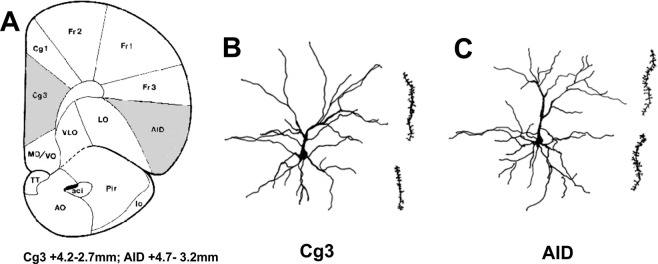
Morphometry of Golgi-stained pyramidal neurons in the medial prefrontal cortex (Cg3) and the orbital frontal cortex (AID). (A) Schematic diagram of a coronal section illustrating the location of Cg3 and AID (shaded areas). (B) Representative Cg3 pyramidal neuron showing apical and basilar dendrites and dendritic segment with spines. (C) Representative AID neuron showing basilar dendrites and dendritic segment with spines.

References

    1. Whiteford HA, et al. Global burden of disease attributable to mental and substance use disorders: findings from the Global Burden of Disease Study 2010. Lancet. 2013;382:1575–1586. doi: 10.1016/S0140-6736(13)61611-6. - DOI - PubMed
    1. Lewis AJ, Galbally M, Gannon T, Symeonides C. Early life programming as a target for prevention of child and adolescent mental disorders. BMC Med. 2014;12:33. doi: 10.1186/1741-7015-12-33. - DOI - PMC - PubMed
    1. Barker DJ, et al. Fetal nutrition and cardiovascular disease in adult life. Lancet. 1993;341:938–941. doi: 10.1016/0140-6736(93)91224-A. - DOI - PubMed
    1. Yehuda R, Bierer LM. Transgenerational transmission of cortisol and PTSD risk. Prog. Brain Res. 2007;167:121–135. doi: 10.1016/S0079-6123(07)67009-5. - DOI - PubMed
    1. Welberg LAM, Seckl JR. Prenatal Stress, Glucocorticoids and the Programming of the Brain. J. Neuroendocrinol. 2008;13:113–128. doi: 10.1111/j.1365-2826.2001.00601.x. - DOI - PubMed

Publication types

MeSH terms