Review
. 2019 Apr 13:12:84.
doi: 10.1186/s13068-019-1424-9. eCollection 2019.

Biosynthesis, regulation, and engineering of microbially produced branched biofuels

Affiliations
Review

Biosynthesis, regulation, and engineering of microbially produced branched biofuels

Wenqin Bai et al. Biotechnol Biofuels. .

Abstract

The steadily increasing demand on transportation fuels calls for renewable fuel replacements. This has attracted a growing amount of research to develop advanced biofuels that have similar physical, chemical, and combustion properties with petroleum-derived fossil fuels. Early generations of biofuels, such as ethanol, butanol, and straight-chain fatty acid-derived esters or hydrocarbons suffer from various undesirable properties and can only be blended in limited amounts. Recent research has shifted to the production of branched-chain biofuels that, compared to straight-chain fuels, have higher octane values, better cold flow, and lower cloud points, making them more suitable for existing engines, particularly for diesel and jet engines. This review focuses on several types of branched-chain biofuels and their immediate precursors, including branched short-chain (C4-C8) and long-chain (C15-C19)-alcohols, alkanes, and esters. We discuss their biosynthesis, regulation, and recent efforts in their overproduction by engineered microbes.

Keywords: Advanced biofuels; Branched alcohols; Branched fatty acids; Branched fuels; Cyclopropane fatty acid.


Conflict of interest statement

The authors declare that they have no competing interests.

Figures
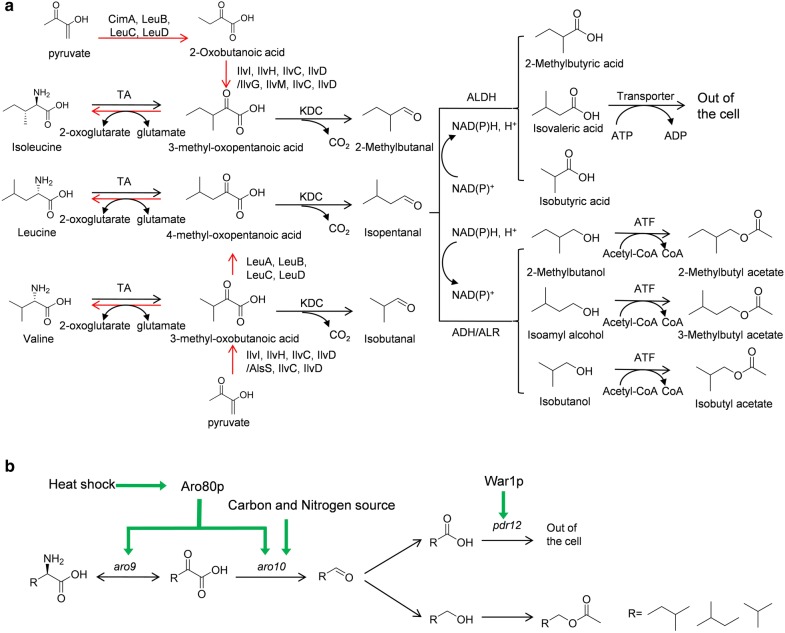
Fig. 1
Fig. 1
Biosynthetic pathways of branched short-chain alcohols and esters and their regulation in S. cerevisiae. a Biosynthesis of branched-chain amino acids from pryurate is shown by red arrows. IlvI: acetolactate synthase large subunit; IlvH: acetolactate synthase small subunit; IlvC: 2-hydroxy-3-ketol-acid reductoisomerase; IlvD: dihydroxy-acid hydratase; AlsS: acetolactate synthase; IlvG: acetolactate synthase II large subunit; IlvM: acetolactate synthase II large subunit; LeuA: 2-isopropylmalate synthase; LeuB: 3-propylmalate dehydrogenase; LeuC/D: isopropylmalate isomerase; CimA: citramalate synthase. The Ehrlich pathway in S. cerevisiae is shown in black arrows. TA: transaminase; KDC: α-ketoacid decarboxylase; ADH: alcohol dehydrogenases; ALDH: aldehyde dehydrogenase; ALR: aldehyde reductase; ATF: alcohol acetyltransferases. b A schematic overview of the regulation of branched short-chain alcohols and esters biosynthesis in S. cerevisiae
Fig. 2
Fig. 2
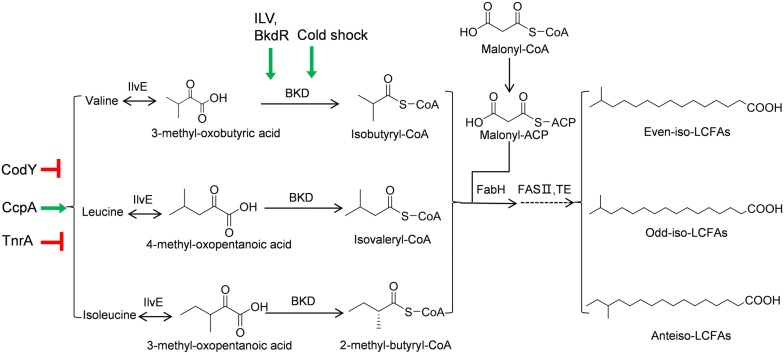
Terminally branched long-chain fatty acid biosynthetic pathways and its regulation in B. subtilis. IlvE: branched-chain aminotransferase; BKD: branched-chain α-keto acid dehydrogenase: BKD is composed of two E1 subunits (E1α: dehydrogenase; E1β: decarboxylase, encoded by bkdAA and bkdAB), one E2 subunit (lipoamide acyltransferase, encoded by bkdB), and one E3 subunit (dihydrolipoamide dehydrogenase, encodedby lpdV); FabH: β-ketoacyl-acyl carrier protein synthase III; FASII: type II fatty acid synthase (FabG, FabA/FabZ, FabI, and FabB/FabF); TE: thioesterase. Repression is show by red lines, and activation is shown by a green arrow
Fig. 3
Fig. 3
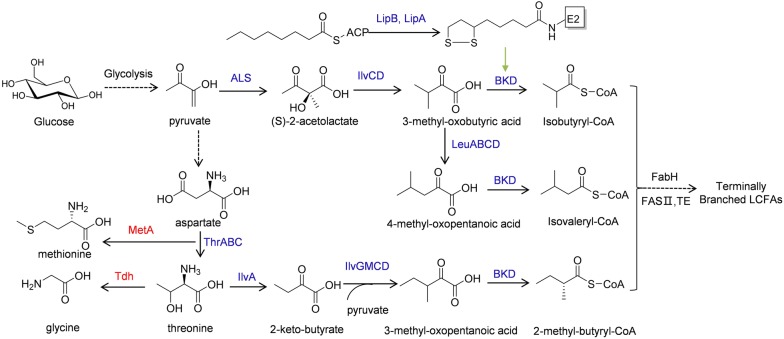
Engineering E. coli to produce terminally branched LCFAs directly from glucose. Overexpressed enzymes are shown by blue color; enzymes whose genes have been deleted from the chromosome are shown by red color. ALS: acetolactate synthase; BKD: branched-chain α-keto acid dehydrogenase; ThrA: aspartate kinase I/homoserine dehydrogenase I; ThrB: homoserine kinase; ThrC: threonine synthase; MetA: homoserine O-succinyltransferase; Tdh: threonine dehydrogenase; LipB: lipoyl transferase; LipA: lipoyl synthase
Fig. 4
Fig. 4
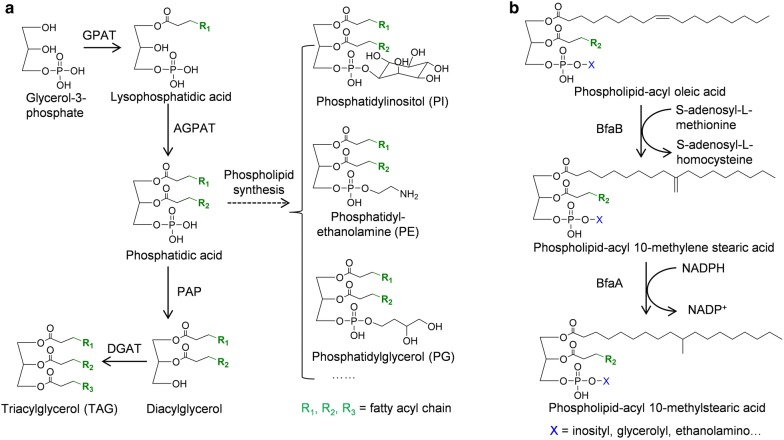
Phospholipid and tuberculostearic acid biosynthetic pathway. a The Kennedy pathway for triacylglycerol and phospholipid biosynthesis. GPAT: glycerol-3-phosphate acyl transferase; AGPAT: acylglycerol-3-phosphate acyl transferase; PAP: phosphatidic acid phosphatase; DGAT: diacylglycerol acyl transferase. b Proposed pathway for tuberculostearic acid biosynthesis. BfaB: S-adenosyl-l-methionine-dependent methyltransferase; BfaA: FAD-binding oxidoreductase
Fig. 5
Fig. 5
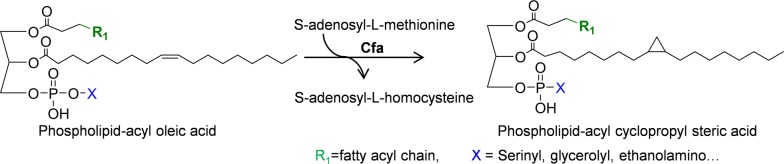
Pathway for cyclopropane fatty acid biosynthesis. Cfa: cyclopropane fatty acid synthase

References

    1. Hill J, Nelson E, Tilman D, Polasky S, Tiffany D. Environmental, economic, and energetic costs and benefits of biodiesel and ethanol biofuels. Proc Natl Acad Sci U S A. 2006;103:11206–11210. doi: 10.1073/pnas.0604600103. - DOI - PMC - PubMed
    1. Kerr RA, Service RF What can replace cheap oil—and when. Science. 2005;309:101–101. doi: 10.1126/science.309.5731.101. - DOI - PubMed
    1. Atsumi S, Hanai T, Liao JC. Non-fermentative pathways for synthesis of branched-chain higher alcohols as biofuels. Nature. 2008;451:86–89. doi: 10.1038/nature06450. - DOI - PubMed
    1. Connor MR, Cann AF, Liao JC. 3-Methyl-1-butanol production in Escherichia coli: random mutagenesis and two-phase fermentation. Appl Microbiol Biotechnol. 2010;86:1155–1164. doi: 10.1007/s00253-009-2401-1. - DOI - PMC - PubMed
    1. Wang B, Wang J, Zhang W, Meldrum DR. Application of synthetic biology in cyanobacteria and algae. Front Microbiol. 2012;3:344. - PMC - PubMed

LinkOut - more resources