


A longitudinal analysis of urological chronic pelvic pain syndrome flares in the Multidisciplinary Approach to the Study of Chronic Pelvic Pain (MAPP) Research Network
- PMID: 31012513
- PMCID: PMC6706296
- DOI: 10.1111/bju.14783
A longitudinal analysis of urological chronic pelvic pain syndrome flares in the Multidisciplinary Approach to the Study of Chronic Pelvic Pain (MAPP) Research Network
Abstract
Objective: To describe the frequency, intensity and duration of urological chronic pelvic pain syndrome symptom exacerbations ('flares'), as well as risk factors for these features, in the Multidisciplinary Approach to the Study of Chronic Pelvic Pain Epidemiology and Phenotyping longitudinal study.
Participants and methods: Current flare status ('urological or pelvic pain symptoms that are much worse than usual') was ascertained at each bi-weekly assessment. Flare characteristics, including start date, and current intensity of pelvic pain, urgency and frequency (scales of 0-10), were assessed for participants' first three flares and at three randomly selected times when they did not report a flare. Generalized linear and mixed effects models were used to investigate flare risk factors.
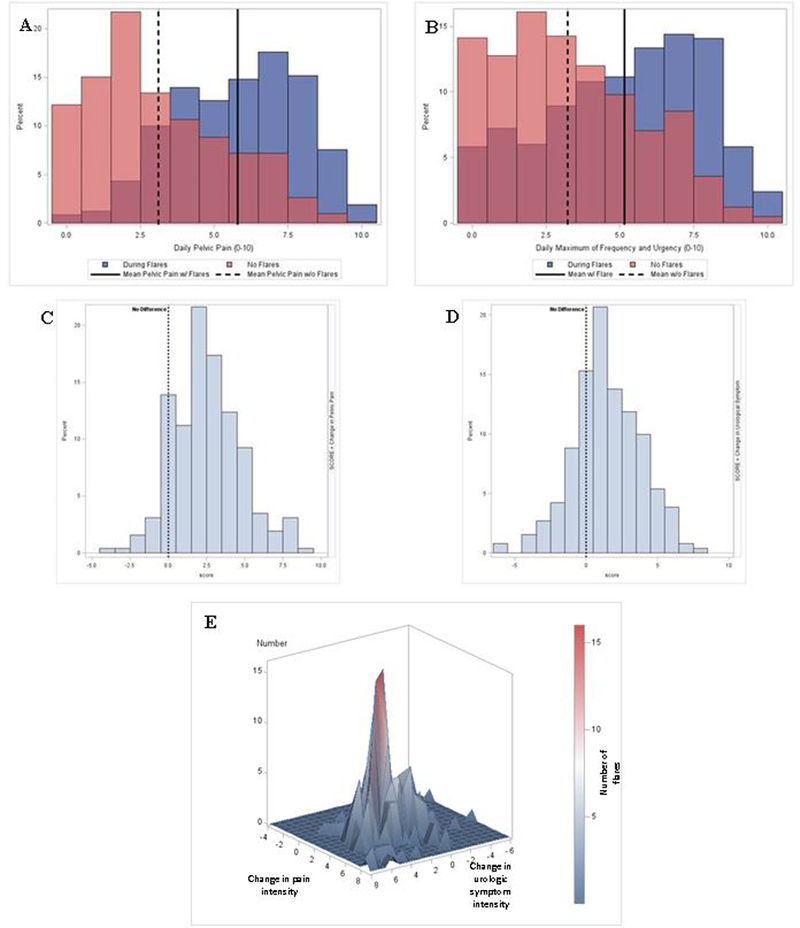
Results: Of the 385 eligible participants, 24.2% reported no flares, 22.9% reported one flare, 28.3% reported 2-3 flares, and 24.6% reported ≥4 flares, up to a maximum of 18 during the 11-month follow-up (median incidence rate = 0.13/bi-weekly assessment, range = 0.00-1.00). Pelvic pain (mean = 2.63-point increase) and urological symptoms (mean = 1.72) were both significantly worse during most flares (60.6%), with considerable within-participant variability (26.2-37.8%). Flare duration varied from 1 to 150 days (94.3% within-participant variability). In adjusted analyses, flares were more common, symptomatic, and/or longer-lasting in women and in those with worse non-flare symptoms, bladder hypersensitivity, and chronic overlapping pain conditions.
Conclusion: In this foundational flare study, we found that pelvic pain and urological symptom flares were common, but variable in frequency and manifestation. We also identified subgroups of participants with more frequent, symptomatic, and/or longer-lasting flares for targeted flare management/prevention and further study.
Keywords: epidemiology; interstitial cystitis; prostatitis; symptom flare-up.
© 2019 The Authors BJU International © 2019 BJU International Published by John Wiley & Sons Ltd.
Figures

Comment in
-
Flares of chronic pelvic pain syndrome: lessons learned from the MAPP Research Network.BJU Int. 2019 Sep;124(3):360-361. doi: 10.1111/bju.14843. BJU Int. 2019. PMID: 31436041 No abstract available.
References
-
- Sutcliffe S, Colditz GA, Goodman MS, Pakpahan R, Vetter J, Ness TJ, et al. Urological chronic pelvic pain syndrome symptom flares: characterisation of the full range of flares at two sites in the Multidisciplinary Approach to the Study of Chronic Pelvic Pain (MAPP) Research Network. BJU international. 2014; 114(6):916–25. doi: 10.1111/bju.12778. - DOI - PMC - PubMed
-
- Clemens JQ, Calhoun EA, Litwin MS, McNaughton-Collins M, Kusek JW, Crowley EM, et al. Validation of a modified National Institutes of Health chronic prostatitis symptom index to assess genitourinary pain in both men and women. Urology. 2009; 74(5):983–7 quiz 7 e1-3. doi: 10.1016/j.urology.2009.06.078. - DOI - PMC - PubMed
-
- Cleeland CS, Ryan KM. Pain assessment: global use of the Brief Pain Inventory. Ann Acad Med Singapore. 1994; 23(2):129–38. Epub 1994/03/01. - PubMed
-
- Lai HH, Krieger JN, Pontari MA, Buchwald D, Hou X, Landis JR, et al. Painful Bladder Filling and Painful Urgency are Distinct Characteristics in Men and Women with Urological Chronic Pelvic Pain Syndromes: A MAPP Research Network Study. J Urol. 2015. 194(6):1634–41. doi: 10.1016/j.juro.2015.05.105. - DOI - PMC - PubMed
