


Sexually transmitted infections among HIV-infected and HIV-uninfected women in the Tapajós region, Amazon, Brazil: Self-collected vs. clinician-collected samples
- PMID: 31013277
- PMCID: PMC6478302
- DOI: 10.1371/journal.pone.0215001
Sexually transmitted infections among HIV-infected and HIV-uninfected women in the Tapajós region, Amazon, Brazil: Self-collected vs. clinician-collected samples
Abstract
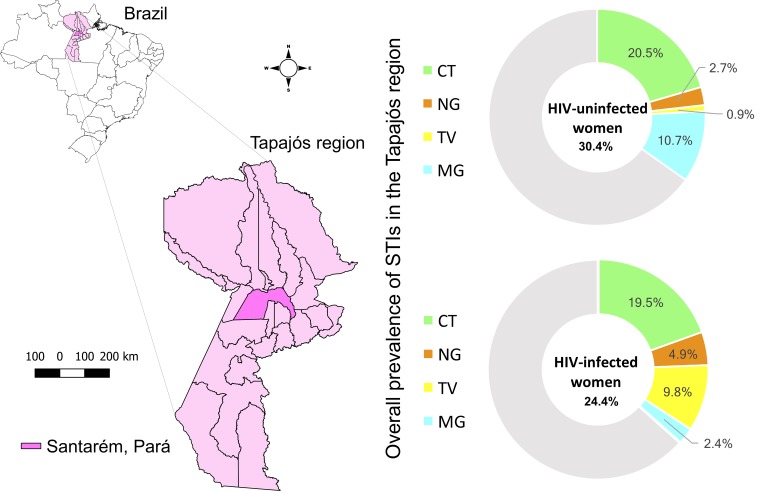
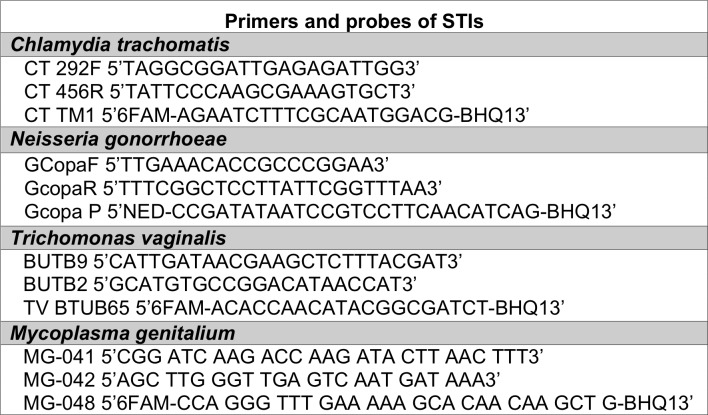
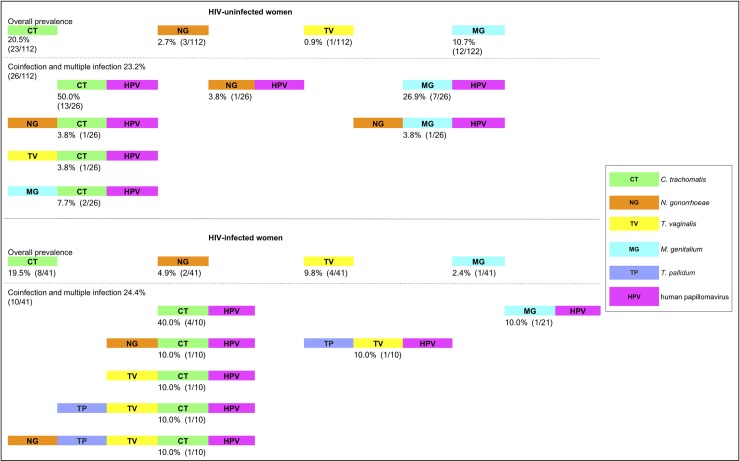
The anogenital prevalence of sexually transmitted infections (STIs) and the use of cervico-vaginal self-collected vs. clinician-collected samples were evaluated for the diagnosis of human immunodeficiency virus (HIV)-infected and HIV-uninfected women in the Tapajós region, Amazon, Brazil. We recruited 153 women for a cross-sectional study (112 HIV-uninfected and 41 HIV-infected) who sought health services. Anal and cervical scrapings and cervico-vaginal self-collection samples were collected. Real-time polymerase chain reaction methods were used for Chlamydia trachomatis, Neisseria gonorrhoeae, Trichomonas vaginalis and Mycoplasma genitalium. A syphilis test was also performed. Risk factors for STIs were identified by multivariate analysis. The overall prevalence of STIs was 30.4% (34/112) in HIV-uninfected women and 24.4% (10/41) in HIV-infected women. Anogenital Chlamydia trachomatis infection was the most prevalent in both groups of women (20.5% vs 19.5%). There was significant agreement for each STI between self-collected and clinician-collected samples: 91.7%, kappa 0.67, 95% confidence interval (CI) 0.49-0.85 for Chlamydia trachomatis; 99.2%, kappa 0.85, 95% CI 0.57-1.00 for Neisseria gonorrhoeae; 97.7%, kappa 0.39, 95% CI -0.16-0.94 for Trichomonas vaginalis; and 94.7%, kappa 0.51, 95% CI 0.20-0.82 for Mycoplasma genitalium. Women with human papillomavirus had coinfection or multiple infections with other STIs. Risk factors for STIs were being ≤ 25 years old, being employed or a student, reporting a history of STI and having a positive HPV test. A high prevalence of STIs in women in the Tapajós region was found. Cervico-vaginal self-collection is a useful tool for STI screening and can be used in prevention control programs in low-resource settings, such as in northern Brazil.
Conflict of interest statement
The authors have declared that no competing interests exist.
Figures
References
-
- World Health Organization—WHO. Report on global sexually transmitted infection surveillance 2015 [Internet]. Geneva, Switzerland; 2016. Available: http://www.who.int
-
- Torrone EA, Morrison CS, Chen P-L, Kwok C, Francis SC, Hayes RJ, et al. Prevalence of sexually transmitted infections and bacterial vaginosis among women in sub-Saharan Africa: An individual participant data meta-analysis of 18 HIV prevention studies [Internet]. PLOS Medicine. 2018. 10.1371/journal.pmed.1002511 - DOI - PMC - PubMed
-
- Ministério da Saúde do Brasil. Boletins Epidemiológicos–Linha do tempo. In: Ministério da Saúde do Brasil. Secretaria de Vigilância em Saúde. Departamento de Prevenção e Controle das Infecções Sexualmente Transmissíveis, do HIV/Aids e das Hepatites Virais. [Internet]. 2018 [cited 5 May 2018]. Available: http://www.aids.gov.br/pt-br/centrais-de-conteudos/boletins-epidemiologi...
-
- Miranda AE, Silveira MF, Travassos AGÁ, Tenório T, Val ICC, Lannoy L de, et al. Prevalence of Chlamydia trachomatis and Neisseria gonorrhea and associated factors among women living with Human Immunodeficiency Virus in Brazil: a multicenter study. Brazilian J Infect Dis. Sociedade Brasileira de Infectologia; 2017;21: 402–407. 10.1016/j.bjid.2017.03.014 - DOI - PMC - PubMed
Publication types
MeSH terms
Grants and funding
LinkOut - more resources
Full Text Sources
Medical
