Review
. 2019 Apr 12;6(2):32.
doi: 10.3390/bioengineering6020032.

Extracellular Vesicles in the Oviduct: Progress, Challenges and Implications for the Reproductive Success

Affiliations
Review

Extracellular Vesicles in the Oviduct: Progress, Challenges and Implications for the Reproductive Success

Carmen Almiñana et al. Bioengineering (Basel). .

Abstract

The oviduct is the anatomical part of the female reproductive tract where the early reproductive events take place, from gamete transport, fertilization and early embryo development to the delivery of a competent embryo to the uterus, which can implant and develop to term. The success of all these events rely upon a two-way dialogue between the oviduct (lining epithelium and secretions) and the gametes/embryo(s). Recently, extracellular vesicles (EVs) have been identified as major components of oviductal secretions and pointed to as mediators of the gamete/embryo-maternal interactions. EVs, comprising exosomes and microvesicles, have emerged as important agents of cell-to-cell communication by the transfer of biomolecules (i.e., mRNAs, miRNAs, proteins) that can modulate the activities of recipient cells. Here, we provide the current knowledge of EVs in the oviductal environment, from isolation to characterization, and a description of the EVs molecular content and associated functional aspects in different species. The potential role of oviductal EVs (oEVs) as modulators of gamete/embryo-oviduct interactions and their implications in the success of early reproductive events is addressed. Lastly, we discuss current challenges and future directions towards the potential application of oEVs as therapeutic vectors to improve pregnancy disorders, infertility problems and increase the success of assisted reproductive technologies.

Keywords: exosomes; extracellular vesicles; gamete/embryo-oviduct interactions; microvesicles; oviduct.


Conflict of interest statement

Funding: This research was partially funded by the SNSF grant 31003A_173171/1.

Figures
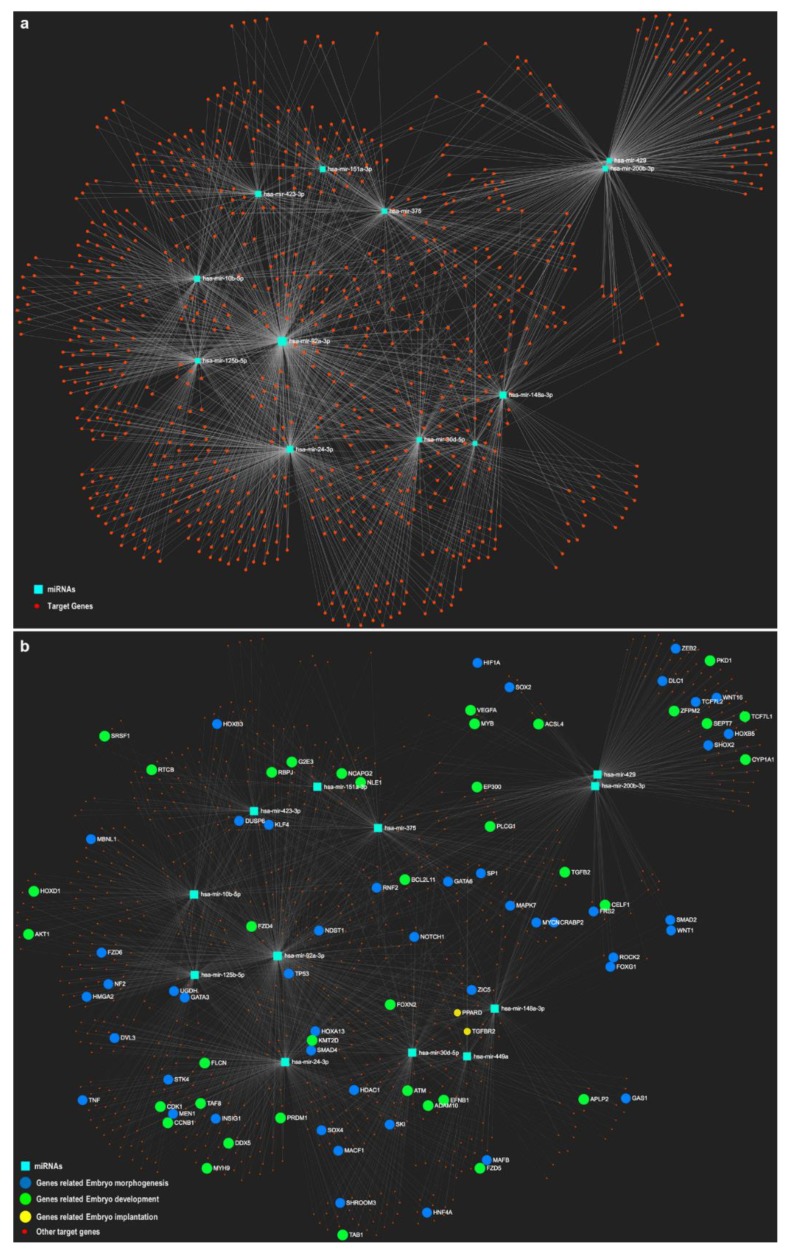
Figure 1
Figure 1
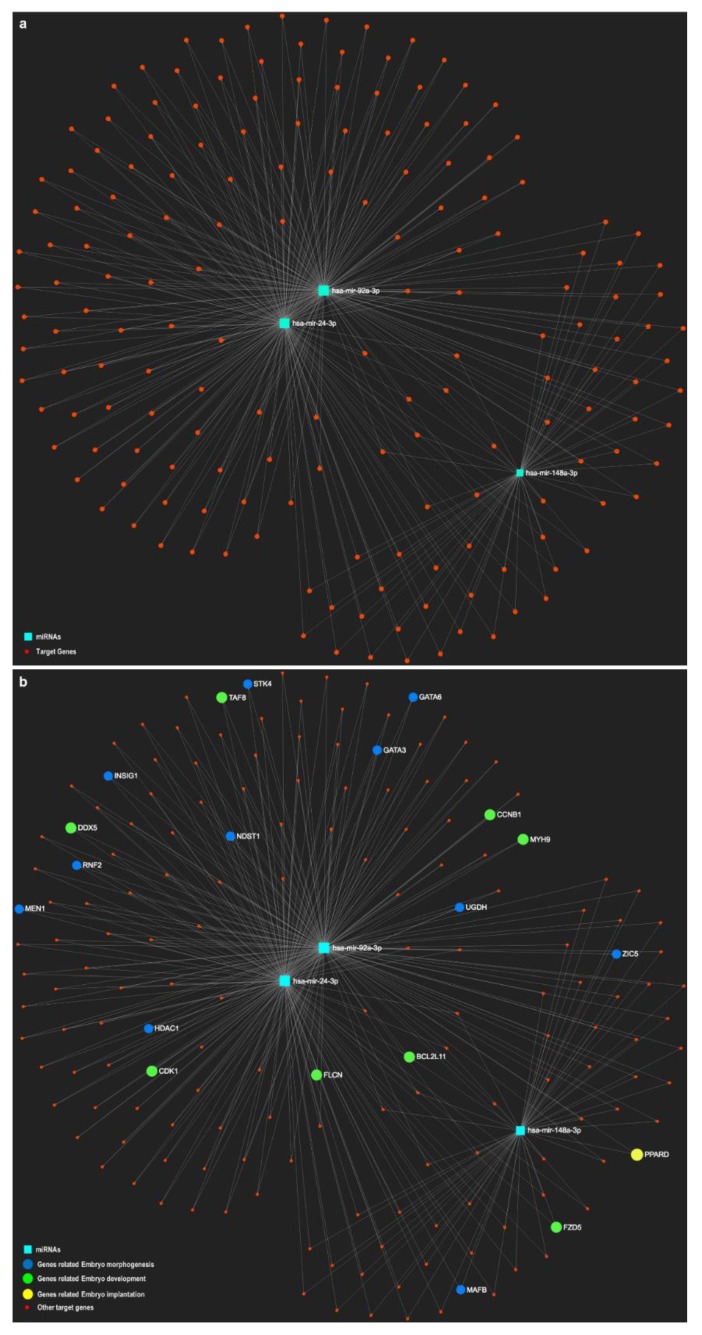
Networks of selected miRNAs identified in oviductal extracellular vesicles (oEVs) and potential target genes involved in embryo development. The miRNet online tool was used to represent selected miRNAs (13) (turquoise-blue nodes) based on differential expression and high abundance in oEVs at stage 1 of the bovine estrous cycle (recently ovulated follicle; days 1–4 post-ovulation) and potential target genes (red nodes) enriched in functional categories related to embryo development (green), embryo morphology (blue) and implantation (yellow) in a network. Since the miRNet online tool allows to choose the source/tissue for the list of miRNAs, network (a) represents 11 miRNAs contained in exosomes in the online tool database, with all target genes involved in embryo development. Network (b) represents 3 miRNAs contained in embryos in the online tool database, with all target genes involved in embryo development functions.
Figure 2
Figure 2
Networks of selected miRNAs identified in oviductal extracellular vesicles (oEVs) and contained in the embryo according to miRNet online tool with potential target genes involved in embryo development. The miRNet online tool was used to represent selected miRNAs (13) (turquoise-blue nodes) based on differential expression and high abundance in oEVs at stage 1 of the bovine estrous cycle (recently ovulated follicle; days 1-4 post-ovulation) and potential target genes (red nodes) enriched in functional categories related to embryo development (green), embryo morphology (blue) and implantation (yellow) in a network. Since the miRNet online tool allows to choose the source/tissue for the list of miRNAs, the network (a) represents three miRNAs contained in embryos according to the online tool database, with all target genes involved in embryo development functions (b).
Figure 3
Figure 3
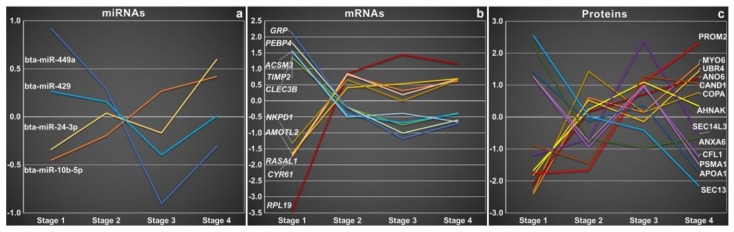
Profiles of miRNAs, mRNAs, and proteins during the estrous cycle in bovine oviductal extracellular vesicles (oEVs). MicroRNAs (a), mRNAs (b), and proteins (c) showing the most pronounced and representative changes with respect to typical expression profiles during the estrous cycle in oEVs were selected. Similar profiles are shown in related colors. Relative expression is shown as mean-centered expression values (log2-transformed expression value of the stage minus mean of all 4 stages). Stage 1: recently ovulated follicle (days 1–4 post-ovulation (po)); stage 2: early luteal development with medium or large follicles or both present (days 5–11 po); stage 3: fully functional corpus luteum (CL) yellow or orange in color (days 11–17 po); stage 4: regressing CL with little vasculature and a large preovulatory follicle present (days 18–20 po).

References

    1. Wolf E., Arnold G.J., Bauersachs S., Beier H.M., Blum H., Einspanier R., Frohlich T., Herrler A., Hiendleder S., Kolle S., et al. Embryo-maternal communication in bovine—Strategies for deciphering a complex cross-talk. Reprod. Domest. Anim. 2003;38:276–289. doi: 10.1046/j.1439-0531.2003.00435.x. - DOI - PubMed
    1. Fazeli A. Maternal communication with gametes and embryos. Theriogenology. 2008;70:1182–1187. doi: 10.1016/j.theriogenology.2008.06.010. - DOI - PubMed
    1. Fazeli A., Affara N.A., Hubank M., Holt W.V. Sperm-induced modification of the oviductal gene expression profile after natural insemination in mice. Biol. Reprod. 2004;71:60–65. doi: 10.1095/biolreprod.103.026815. - DOI - PubMed
    1. Georgiou A.S., Sostaric E., Wong C.H., Snijders A.P., Wright P.C., Moore H.D., Fazeli A. Gametes alter the oviductal secretory proteome. Mol. Cell. Proteom. 2005;4:1785–1796. doi: 10.1074/mcp.M500119-MCP200. - DOI - PubMed
    1. Lee K.F., Yao Y.Q., Kwok K.L., Xu J.S., Yeung W.S. Early developing embryos affect the gene expression patterns in the mouse oviduct. Biochem. Biophys. Res. Commun. 2002;292:564–570. doi: 10.1006/bbrc.2002.6676. - DOI - PubMed

LinkOut - more resources